


October 14, 2026 at 10:26 a.m.
What's in a name?
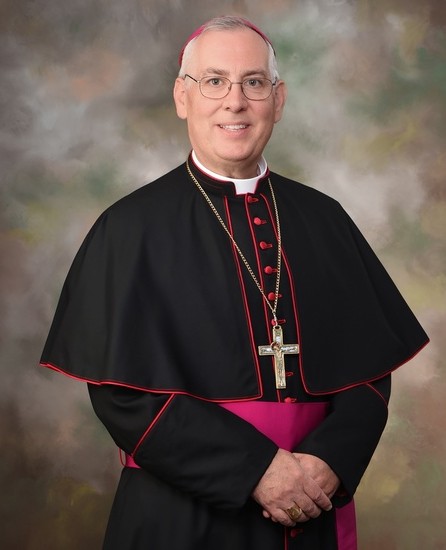
It’s funny the things you hear on a walk with friends. On Aug. 22, Bishop Mark O’Connell led the “Pilgrimage for Peace: A walk with Bishop Mark,” an approximately six-mile walk from the National Shrine of the North American Martyrs in Auriesville to the Saint Kateri Tekakwitha National Shrine and Historic Site in Fonda.
About 50 people — including two priests from the Albany Diocese — joined Bishop Mark in walking for peace. After the day ended, I asked Mike Matvey, who covered the walk for The Evangelist, how it went.
There was something funny he noticed in that setting — it wasn’t formal and everybody attending was relaxed, praying and making conversation — and, maybe because of that, all the priests, he noted, dropped the title “Father” and simply called each other by their first names.
I paused hearing that. It’s not something odd in nature — it’s not as if priests lose their birth-given name after ordination — but I had never considered how there might be settings when a priest isn’t organically addressed as “Father.”
It led me to wonder: when, if ever, is it appropriate or fitting to call a priest by a name other than “Father?”
I took my questions to Father Sam Bellafiore, diocesan Director of Vocations and Director of Campus Ministry, who said that customarily, at least in the United States, priests often address each other just by their first names.
“I think this varies by country, but in the U.S., especially, priests, one to another, just call each other by their first name, by and large,” Father Sam said. “Usually, (priests) don’t call another priest, ‘Father.’ ”
While at first this was news to me, it quickly became a bit of a “No, duh” moment. As someone who is neither a priest nor a woman religious, other lay Catholics and I probably are seldom in the circles or scenarios where that title would be dropped.
Father Sam explained that the title “Father” isn’t just a name for addressing, but an example of the relationship that exists between a priest and his people — which is different from the relationship between fellow priests, who are bonded more in brotherhood.
“It’s true that you’re always a ‘Father,’ and often priests are mentors to each other and spiritual ‘Fathers’ and confessors, but in a situation like that, the feeling is really like we’re brothers,” he said.
Father Sam added that men are prepared for this in seminary.
“The term ‘Father’ is something that we reflect a lot on in preparing for seminary,” he said. “I think generally people tend to think of their priests, or the priests being called ‘Father,’ like a title. And, although it’s a title, it’s really more of a relationship. It’s a title that denotes a relationship.”
For centuries, the Catholic Church has used the title “Father” to signify religious leaders. Up until the year 400, a bishop’s title was “Papa” in reference to “Father” but was later designed to be used solely for addressing the Bishop of Rome, or “Pope.” And in the Middle Ages, the term “Father” was used to address Franciscans or Dominican friars because their charitable works to the public felt like caring for God’s children.
Even today, men in seminary first consider, “What does it mean to be a father … and what does it mean to take on this spiritual responsibility?” said Father Sam. Then eventually, as ordination begins to come into sight, the question is raised of what name (first, last or something else) you want to be called by.
“For me, I was like, ‘Oh, so what am I gonna be called now?’ And I’m definitely a Father Sam,” he said.
Each priest walks his own journey with what name he would like to go by, and it’s typically only family or close friends — often someone known before ordination — who call a priest by just their first name.
“I don’t know what other parents do, but my parents call me by my first name,” Father Sam laughed.
“When I first got ordained, I didn’t really know what my preference was,” he added. “I had never been a priest before. So when friends (asked), ‘Should we call you ‘Father’ now?’ I didn’t always know.”
This made me think of a similar plight I encountered as an adult, trying to navigate the appropriate way to address the parents of my close, childhood friends. These were the parents who watched me grow up, whose houses I often frequented for sleepovers or to complain about my chemistry homework. Parents who forever and always were, to me, “Mr.” or “Mrs.” so-and-so.
I recently was at a friend’s house, sitting out on their porch, drinking wine with my friend and her mother, both of whom I had known for over a decade. Were we at a place where I could switch? Did my fully developed adult brain and preference for a dry Cabernet make us more first-name-basis people?
Maybe there were some scenarios where I felt the title could be dropped, but other parents will always be “Mr.” or “Mrs.” to me. And like with most things, it’s a debate that always takes some discernment.
And in a Catholic setting, knowing the background of the title “Father,” and why we address our priests that way, I think helps to make for a stronger, deeper connection.
“A title is … some kind of honor that you’re given because of something you’ve accomplished, but that’s not what this is,” Father Sam said. “Being a ‘Father’ is a free gift, and I never don’t like being called ‘Father.’ ”
- Catholic, evangelical leaders issue joint call for compassionate immigration reform
- Pope Leo XIV starts respiratory physical therapy a day after lung cancer surgery
- Catholics challenge moral, legal grounds of ‘barbaric’ US plan to livestream execution
- Prayers, well-wishes pour in after pope’s lung cancer diagnosis
- Pew: Trump’s support among Catholic voters drops heading into midterms
- Cardinal Tagle reads Pope Leo’s homily to bishops: ‘The world has no future without strong families’
- ‘To see the face of God in wartime’: a Jesuit’s mission in Siberia
- Trump revives baseless claims about Haitian migrants in Ohio while touting deportations
- Bishops, lawmakers in US and Canada offer prayers for Pope Leo after lung cancer diagnosis
- Pope Leo XIV’s surgery reveals lung cancer
Comments:
You must login to comment.