


May 27, 2026 at 10:34 a.m.
A HOLY SPACE
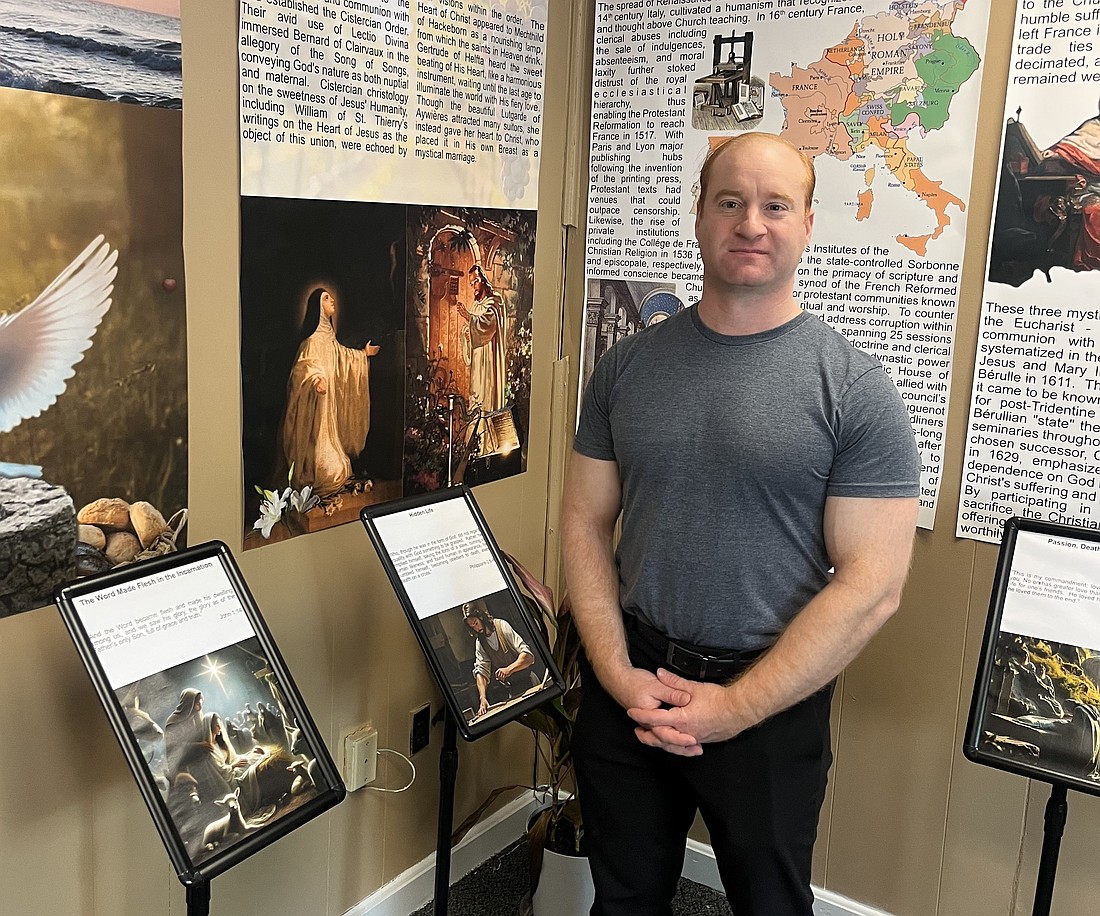
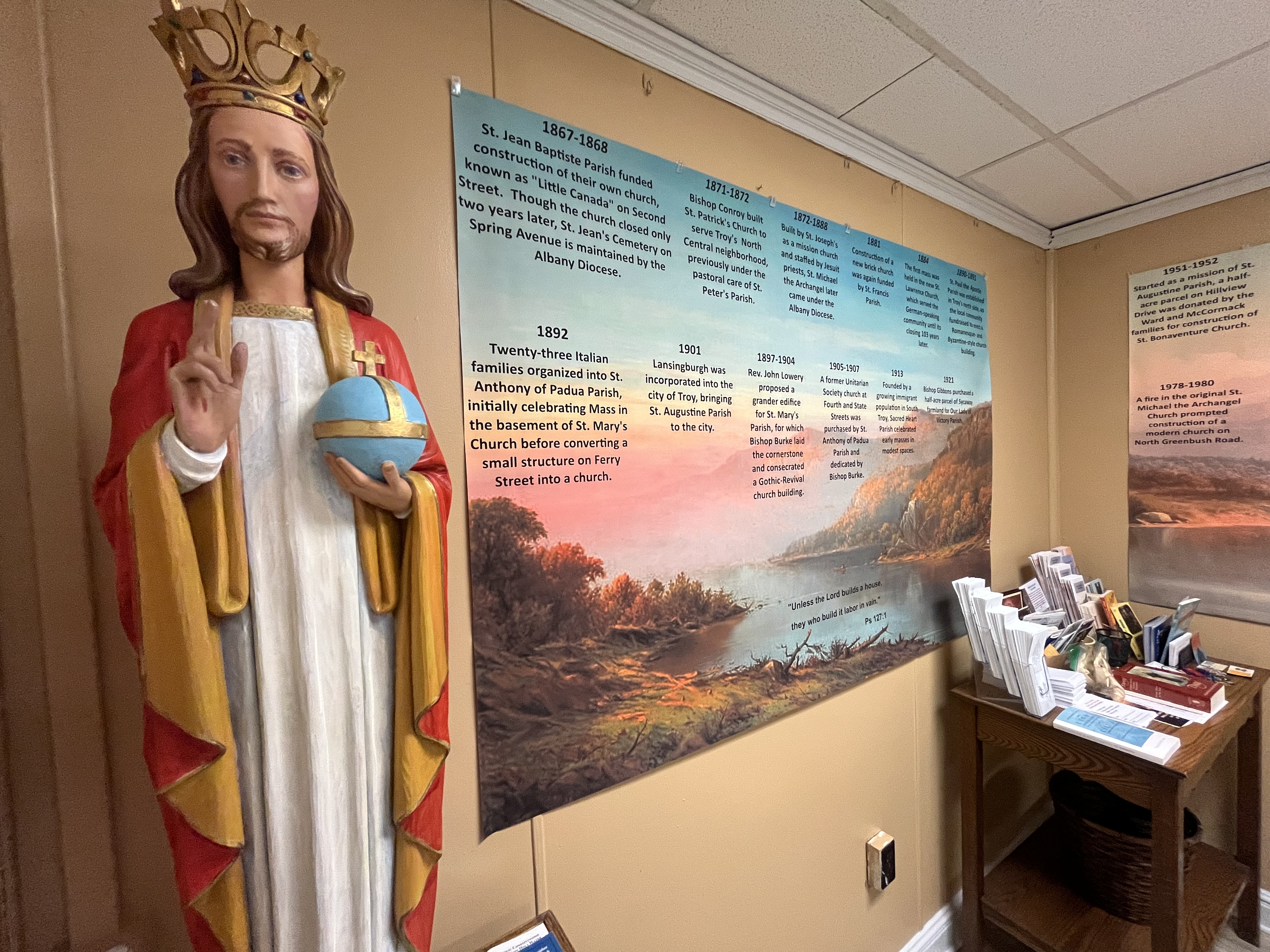
Back in November, Sacred Heart Parish in Troy held an opening ceremony for its latest parish installation, the “St. John Eudes Inner Sanctum.” The collection is made up of exhibits on the history of the Albany Diocese in Troy, the impact of Sacred Heart Parish, the patristic theology, monastic spirituality and the devotion to the Sacred Heart of Christ. Since its opening, the installation has brought a new space for parishioners to explore their faith and their church.
Emily Benson, staff writer for The Evangelist, caught up with Sacred Heart’s Faith Formation director, Stephen Dansereau, who designed and installed the entire exhibit, to discuss how it has been doing since opening and what parishioners — or visiting Catholics and locals alike — can gain from the church’s new offering.
TE: When did you start working on this exhibit? What was your inspiration?
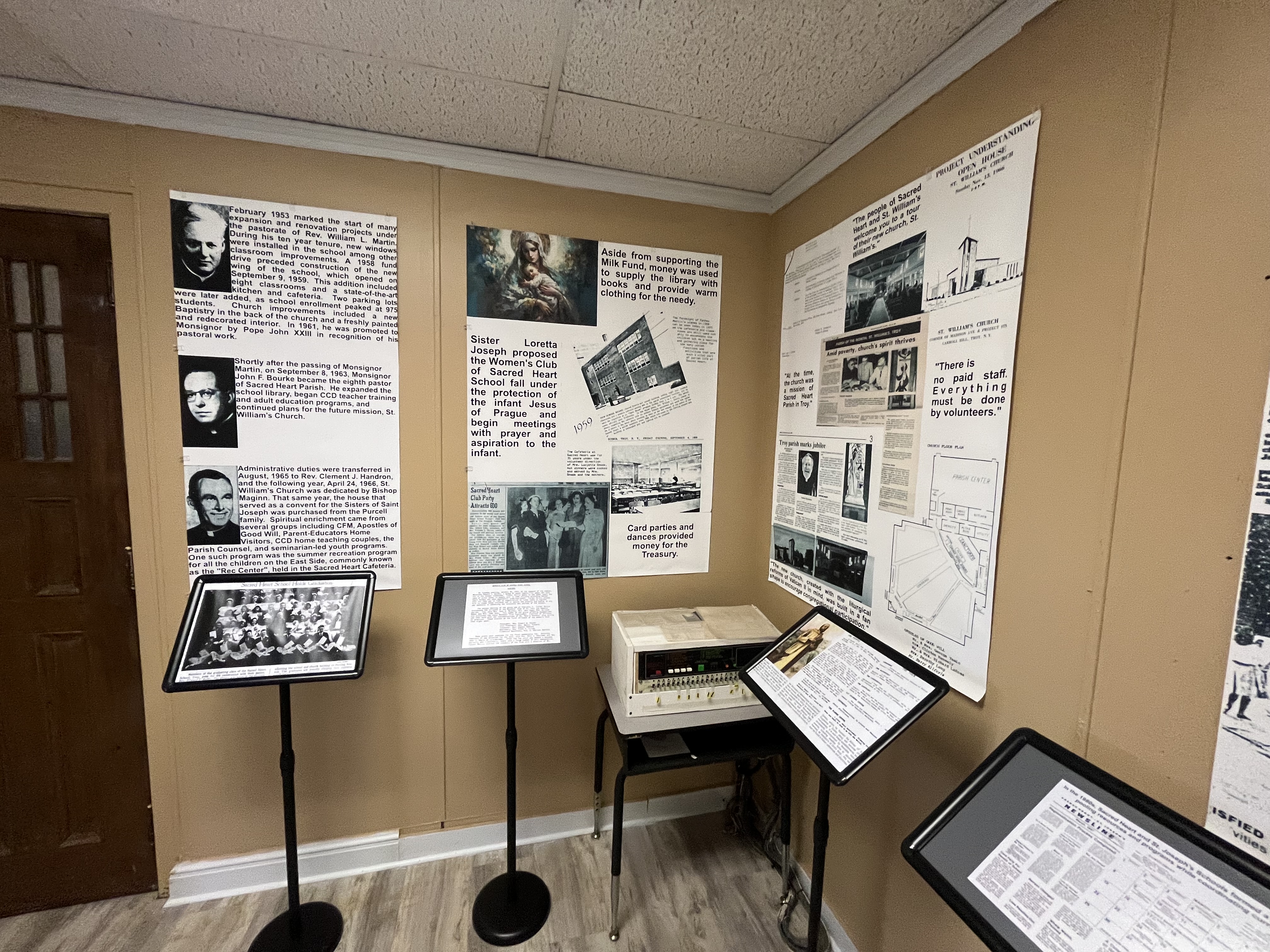
SD: I received a text from our parish administrator, Mark Trudeau, in May of 2025 about possibly taking over as director (of Faith Formation and Sacramental Preparation). Among my first priorities, beginning mid-June, was to repurpose a few rooms across the church vestibule, one of which was the former school office suite. Consulting the diocesan archives, I was impressed that each time Sacred Heart was a mega-parish, they built another self-sufficient parish — St. Jude in 1953 and St. Williams in 1966. This led me to trace the lineage of each parish in Troy, from the first settlers along the Hudson.
Catholic communities would rent spaces for visiting priests to celebrate Mass while fundraising to build their own church. Sacred Heart Parish itself began in the basement of what is now Carol’s Place, and the community took on a lot of debt to build their current church and school complex. In fact, the first pastor lived with his mom and sister because the parish did not yet have a rectory.
This was the second thing that resonated with me: the sacrifice that the pastors put into their parish out of respect for the community they were serving and dedication to the mission of the church. Three of the first four young pastors unexpectedly died within a single month to a year of their respective appointments, one of whom died at the altar. I believe the following three pastors, middle-aged and older, were motivated to honor their efforts, paying off the yawning debt, officially opening the school, upgrading the church interior, purchasing parking lots, and even building an expansion to the school.
Thirdly, the progression of the theology on the Sacred Heart of Christ from the patristics and Medieval Monks through the saints and cardinals of Renaissance France spoke to the unity of the church across time. Each figure offered a complementary perspective to meditate upon Christ’s pierced side, first viewing it as an exit for the church to enter into the world and later as a door through which to join our hearts to Christ’s.
So, in designing this St. John Eudes Inner Sanctum, I wanted to teach others to see themselves the way God sees them through a devotion to Christ’s Sacred Heart.
TE: You talked a lot about the importance of the parish family and the teachings on the Sacred Heart of Christ. Can you share again why these two items are so important for Catholics/parishioners?
SD: I think it comes down to each person having a unique identity in God, who sees us in our humility — when we are stripped of everything in our lives. Beyond that, anything we have is simply because God is good and for no other reason. It is noteworthy that He put Eve in the garden with Adam, entrusting them to one another. We share this calling, to love those who God puts in our lives, starting with family. To love is to freely give and be open to receiving. Everything we do should be out of love for God, who first called us by name and second commanded us to fill and subdue the Earth, thereby referencing family and work.
TE: This has been open for a few months now. What has the response been like? You mentioned that some parents will bring crying babies in during Mass to walk around. That seems like a very sweet outcome of the space.
SD: Yes, that was a surprising perk I had not considered, but it makes sense. One barrier, other than sports, in getting parents with children to attend Mass is boredom. We have coloring books and crayons near the entrance for parents to take to their pews with them, but it is also beneficial to have a meditation spot where parents can take their children without feeling as though they are missing prayer. I teased my second graders that I colored the posters myself because I got jealous of all the coloring they got to do.
The Inner Sanctum gets some traffic after Mass, and sometimes during the week, I will notice someone sitting at the reading table. The need to replenish the granola bars and Keurig cups also indicates use. We’ve had other people recently discover that it exists. Probably the most measurable level of appreciation is the sense of optimism around the parish that wasn’t there when I took over as director. I believe the exhibit has inspired faith while also demonstrating that faith can move mountains
TE: How has seeing this project come to life impacted your faith/connection with the parish?
SD: There is a chapter in J.R.R. Tolkien’s “The Silmarillion,” in which a Valar named Varda, shortly after the Two Trees of Valinor were created, cast the dew from those trees into the sky to create constellations that would guide and inspire the elves. Never again did she perform so great a deed because, in doing so, she actually gave a piece of herself to the world; it was the calling of the Valar to bind themselves to the world through their own creative acts. This is not to say that our identity changes, which is in God alone, but that we are to freely give and be open to receiving. What Varda lost, she gained through someone else’s gift. Community is leading one another to Christ and entrusting our brokenness to others.
Like St. John Eudes, I have admiration for those who taught me and, though I am content to be in solidarity with God, view serving others as a privilege when the opportunity arises. My two roles are to enrich the faith lives of the parishioners and invite others into our family in Christ. I am able to do this with confidence because I believe God wants us to remove all obstacles from being ourselves, the purpose of which is to know and love Him. I also believe that belonging to a parish and attending Sunday Mass helps us to live healthier and holier lives. So much of this hinges on the building.
- Full text: Pope Leo XIV’s World Day of Migrants and Refugees message
- Pope Leo prays for the sick and suffering in the Lourdes grotto in France
- In a secular France, Pope Leo makes the case for faith in public life
- Blessed Sheen’s baptismal church in Illinois to be part of world’s first parish named for him
- Pope Leo draws 800,000 to Mass in the heart of Paris
- ‘An immense opportunity and honor’: New Catholics meet Pope Leo in Paris
- Pope encourages French youth to seek holiness during visually rich stadium vigil
- Peoria bishop at thanksgiving Mass for Sheen beatification: ‘This is what God has done’
- Full text: Cardinal Tagle’s homily at the beatification Mass for Blessed Fulton J. Sheen
- Pope Leo prays in Notre Dame Cathedral in Paris 7 years after devastating fire
Comments:
You must login to comment.