


March 27, 2026 at 10:44 a.m.
|
Updated March 29, 2026 at 9:28 a.m.
'WITH ALL MY HEART I WANT TO SAY HOW SORRY WE ARE'
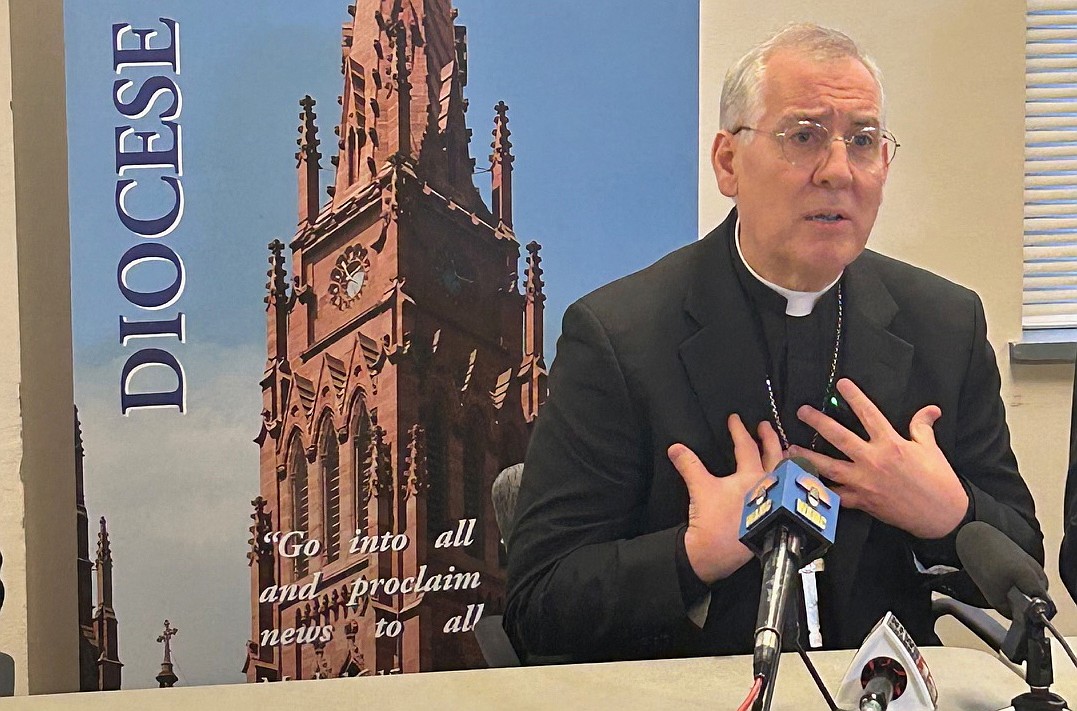
Just over three years to the date after filing for Chapter 11 protection under the crush of nearly 440 Child Victims Act claims, the Diocese of Albany reached a $148 million settlement agreement on March 27 with the survivors of sexual abuse by diocesan priests and others.
“This day is a day to honor survivors, to honor those who were very shamefully hurt by the Diocese of Albany and by priests and by the placement of them by bishops and that’s where the focus is today,” said Bishop Mark O’Connell at a press conference at the Pastoral Center. “I do not want to take away from their very painful day and I just want to send my apologies, along with my leaders in the Diocese of Albany. With all my heart I want to say how sorry we are, how sorry I am and to promise to diligently protect all as best as I can.”
What you need to know about the joint settlement
What was announced on March 27?
The Roman Catholic Diocese of Albany and the Official Committee of Tort Claimants in our Chapter 11 reorganization have reached agreement on the contribution to be made by the Catholic Family which includes the Diocese of Albany, its parishes and other Catholic entities. Both the Diocesan Finance Council and the College of Consultors have given their assent to this action. The amount of the contribution will be $148 million.
How much will parishes contribute?
Collectively, the parishes in the Roman Catholic Diocese of Albany will contribute $50 million, primarily from parish savings. Father Jim Walsh, Chair of the Parish Steering Committee, and Deacon Gregg Wilbur, diocesan CFO, are meeting with parishes to discuss the individual amount each parish will be expected to contribute. Those meetings are underway and will conclude after Easter.
Does the amount include the insurance carrier
contributions?
No. This settlement between the Tort Committee and the Diocese, parishes and other entities affiliated with the Diocese does not include a contribution from several of the insurance companies that provided coverage to the Diocese. The Diocese and the Tort Committee will continue to work in earnest with the mediators appointed to the bankruptcy case to negotiate with the insurance carriers who are involved in this case with the goal of achieving a global settlement. In diocesan bankruptcy cases, it is typical for Church insurers to contribute a significant portion of the global settlement amount paid to survivors of abuse.
What does this mean for St. Clare’s pensioners?
Work remains to be done to address the claims of the St. Clare’s pensioners. As many know, a jury verdict concluded that the Diocese of Albany had no historic fiduciary responsibility for St. Clare’s Hospital or its pension plan and, therefore, the Diocese of Albany was deemed not directly responsible for the losses incurred by the pension plan. The court’s decision finding the Diocese responsible for the acts of others in managing the pension fund is under appeal and we await the court’s decision.
What will be the average settlement for each
survivor?
That is impossible to tell because anticipated insurance settlements will fund a substantial portion of the eventual package. Once the total number is known there is a separate process involving independent parties who will help to determine what each survivor will receive.
What are the next steps?
This is the first step to our reorganization. We are continuing to develop a plan that will lead us out of Chapter 11. Work continues on important issues that will be included in the final plan, including agreements on child protection protocols that will be aimed at strengthening the protocols already in place in our Diocese.
When could survivors see the settlement money?
When the entire financial package comes together, there will be a confirmation process that has taken a considerable amount of time in other dioceses that emerge from bankruptcy. Only after confirmation will the plan distribute the awards to the victims. The final plan will establish an independent claims reviewer who will review the claims and determine payments to individual survivors. The Diocese will have no role in that.
How and when do parishes submit their portion?
Once Father Walsh and Deacon Wilbur meet with your parish to share the amount requested, the amount of the parish contribution should be moved into a bank account or very low risk investment (such as a money market account) so that the payment may be made when needed. Details regarding when and how payments toward the settlement will be made are still being worked out.
Is there an appeal process for the amount the
Parish Steering Committee is asking a parish
to contribute?
Yes. Appeals should be made directly to Bishop Mark.
Source: www.rcda.org/reorganization
The agreement will provide payment to survivors for acts perpetrated against them by clergy, religious, lay employees and volunteers of the Diocese. Although the settlement amount remains subject to a creditor vote and court approval, the amount has been accepted by the Tort Committee, which is a group of individuals who survived sexual abuse when they were children by clergy members and employees within the Diocese. The Diocese and the committee believe that this settlement is an important first step in forming a plan that will lead to the Diocese’s exit from Chapter 11.
Since the Diocese filed for Chapter 11 protection on March 15, 2023, there has been legal maneuvering, delays and accusations but little movement between the Diocese and the lawyers representing the survivors. Yet, it took Bishop O’Connell, who was installed on Dec. 5, 2025, along with other diocesan leaders just over three months to break through with this major agreement. As for what changed, it was a question that was asked of Bishop O’Connell.
“When I was able to speak to some of the survivors and their lawyers at our last mediation, I told them I know (the monetary agreement) has to hurt, I know it has to be a huge sacrifice (for the Diocese),” he said. “I think that attitude helped people here go with me and reach the number that we had to reach and so I’m very grateful to the parishes and very grateful to the other entities and to my staff for recognizing the truth in what I was selling. It has to hurt. It has to be a sacrifice and I think what we did today fulfills both of those.
“This is the number that we had every indication that we had to get to and so we did everything we could to get to that number. I don’t like to compare to other dioceses because in bankruptcy, you pay what you can, but you certainly don’t pay what (the survivors) deserve. There is no amount of money that can erase the pain. We paid from our hurt, from our sacrifice, but there’s no way that this is enough where everyone is happy. I have no regrets in leading the Diocese of Albany to reach this number.”
Of the $148 million, $50 million will come from the parishes and the rest from the Diocese and its entities, collectively known as the “Catholic Family,” which includes The Evangelist. The Parish Steering Committee, co-chaired by Father James Walsh, pastor of St. Pius X in Loudonville, and Deacon Gregg Wilbur, diocesan chief financial officer, has calculated how much each parish is being requested to commit based on factors such as parish savings, debt and offertory. The committee has met with parish leaders and trustees of 40 parishes to date and will meet with the remaining parishes after Holy Week and Easter. Parishes are encouraged to be as transparent as possible in discussing the requested figure with parish leaders as well as those in the pews. Whatever the requested amount is on a parish-by-parish basis, that amount can be appealed to Bishop O’Connell.
When asked if this monetary agreement would lead to the closing of parishes or schools, Bishop O’Connell said: “With this settlement, immediately no. Once the Diocese gives our $148 million, who knows what we’ll suffer, but I don’t like that word that I just used, because who suffered is the survivors. I don’t know how it will play out going forward but right now there’s no immediate closing connected with this.
“I know that we had to come to a place with our parishes and our entities and say we have to do this. We have to do it now. We can’t wait anymore. … We’re moving forward, I think, in a sacrificial way. I hope that sacrifice is accepted in some way by those who we hurt.”
This figure does not include significant contributions from the insurance companies that provided coverage to the Diocese. Negotiations are continuing with the insurance carriers with the goal of achieving what is known as the “global settlement,” which would pool money from the Diocese and the insurance carriers.
The agreement also includes ongoing discussions about enhanced child protection protocols that will add to robust measures already in place to protect young parishioners, students and other vulnerable individuals within the Diocese under the Office of Safe Environment. In a statement, the Diocese added that “the discussions on child protection have been productive, collaborative and extensive and Bishop O’Connell has been personally engaged throughout the process.”
The groups are expected to announce these enhanced measures soon.
“This settlement marks a significant step toward the conclusion of this bankruptcy case and closure for all survivors who have lived with this pain throughout their lives.” said John Ciota and Rick Salamone, co-chairs of the Tort Committee. “The Tort Committee wants to express its gratitude to each survivor involved in this case and assure all survivors that it is working to achieve the best result for them. The Tort Committee looks forward to working further with the Diocese to enhance its child protection protocols and with the Diocese’s insurers to reach a global settlement of survivor claims.”
A question on many people’s minds is where does this leave the St. Clare’s pensioners. On Dec. 12, 2025, the Diocese was found not directly liable for the collapse of the St. Clare’s pension fund, but individual defendants, Bishop Emeritus Edward B. Scharfenberger, the estate of the late Bishop Howard J. Hubbard, the estate of the late Father David LeFort, St. Clare’s Corporation, former St. Clare’s president Joseph Pofit and former St. Clare’s CEO Robert Perry, were found directly at fault. The jury awarded the 1,100 pensioners $54.2 million.
In his Letter to the Faithful, also released on March 27, Bishop O’Connell said: “Work remains to be done to address the claims of the St. Clare’s pensioners. As many know, a jury verdict concluded that the Diocese of Albany had no historic fiduciary responsibility for St. Clare’s Hospital or its pension plan and, therefore, the Diocese of Albany was deemed not directly responsible for the losses incurred by the pension plan.
“The court’s decision finding the Diocese responsible for the acts of others in managing the pension fund is under appeal and we await the court’s decision.”
The financial agreement is a giant step forward in a dark chapter in the Diocese of Albany. On Aug. 14, 2019, the Child Victims Act (CVA) — which expanded the statute of limitations for child sex abuse cases, allowing victims to file civil lawsuits until age 55, extended criminal prosecution limits until age 28, and included a “look-back window” which allowed lawsuits against abusers and institutions for past abuse — went into effect. During the two-year window to file claims, the Diocese was named in nearly 440 claims. After failed attempts at mediation, which started in 2022, between lawyers representing survivors and those representing the Diocese, the Diocese filed for bankruptcy on March 15, 2023, as Bishop Scharfenberger said at the time that it was the “best way, at this point, to ensure that all victims/survivors with pending CVA litigation will receive some compensation.”
During his introductory press conference on Oct. 20, 2025, Bishop O’Connell said of the diocesan bankruptcy, “In the midst of bankruptcy, there is shame and there is sadness, but there is also a chance to acknowledge sinfulness and continue to reach out and love those that have been so terribly hurt.
“There is an opportunity in bankruptcy that the church is better, stronger when we do this. In the midst of division in the world, we have the opportunity to build bridges of faith. In the midst of suspicion, we have an opportunity to gain trust.”
Every diocese in the state has either filed for bankruptcy or is in mediation due to the CVA cases. Most recently, on Feb. 25, the Diocese of Syracuse, which filed for bankruptcy in June 2020, announced it was funding a victims’ trust with more than $176 million to settle claims. Of the $176 million figure, $76.1 million will be provided by insurance and $100 million will come from parishes ($45 million), the diocese itself ($50 million) and other diocesan entities ($5 million). The diocese faced 411 claims from abuse survivors brought under the state’s CVA and the Adult Survivors Act, which was enacted in May 2022 and allowed a one-year period starting on Nov. 24, 2022, for victims of sexual abuse in which the statute of limitations had lapsed to file civil suits.
The Syracuse diocese also sheds some light on what the timeframe could be like going forward for the Diocese of Albany. Like the Diocese did last week, on July 27, 2023, the Diocese of Syracuse and the official Committee of Unsecured Creditors announced that they had reached a settlement agreement. Over two years later, on Aug. 27, 2025, the court accepted Syracuse’s plan. On Jan. 26, 2026, the diocese transferred $100 million to the fund and on Feb. 25, the judge approved the final decree.
During the press conference, Bishop O’Connell — who worked as a canon lawyer when the abuse crisis erupted in the Archdiocese of Boston in 2002 and was named last year as the chairperson-elect of the United States Conference of Catholic Bishops’ Committee on the Protection of Children and Young People — also was asked if the $148 million figure would allow the Diocese “to move past this.” He emphatically said no.
“Excuse me for being strong in this answer, absolutely not. We are not moving past this. This will be part of my time in Albany as long as I’m here,” he said. “And speaking from my heart, we’re not moving past, we are meeting what was asked for in a humble way with an apology and doing what we can, but what we’re doing can’t be enough. … I feel strongly that this is not in the past.”
And he added near the end of the press conference: “I think there is a vigilance. Again, I’ve spent 25 years on this in my life. I was in the eye of the storm in Boston when it first hit. I was living literally in the chancery building. I was meeting with all the tsunami of cases and I’ve been moved to the tribunal where I was the chief judge and prosecutor. I have been in every part of this. It has changed my life, it has changed my perspective and every part of me is sorry that our church collectively did this to these poor people who were hurt deeply. Every part of me is sorry.”


- Washington Letter: Catholic voters likely reflect broader voter trends, with unique factors
- North American martyrs: Saints for those who suffer for the faith
- French bishops condemn ‘unacceptable violence’ as riots sweep nation
- Priest in Ecuador, 53, struck and killed by falling crucifix during Mass
- Sense and Sensibility
- Full text: Pope Leo XIV’s Angelus address given October 18, 2026
- Pope Leo returns to Vatican window for Angelus saying prayers sustained him after cancer surgery
- Pope Leo XIV discharged from hospital early following lung cancer surgery
- Pope Leo XIV’s brother shares his own cancer battle, the role of faith and his 1 request
- Global progress must ‘truly serve the human person,’ nuncio tells major interfaith forum in Utah
Comments:
You must login to comment.