


March 18, 2026 at 12:26 p.m.
|
Updated March 25, 2026 at 9:50 a.m.
CELEBRATING 100 YEARS!
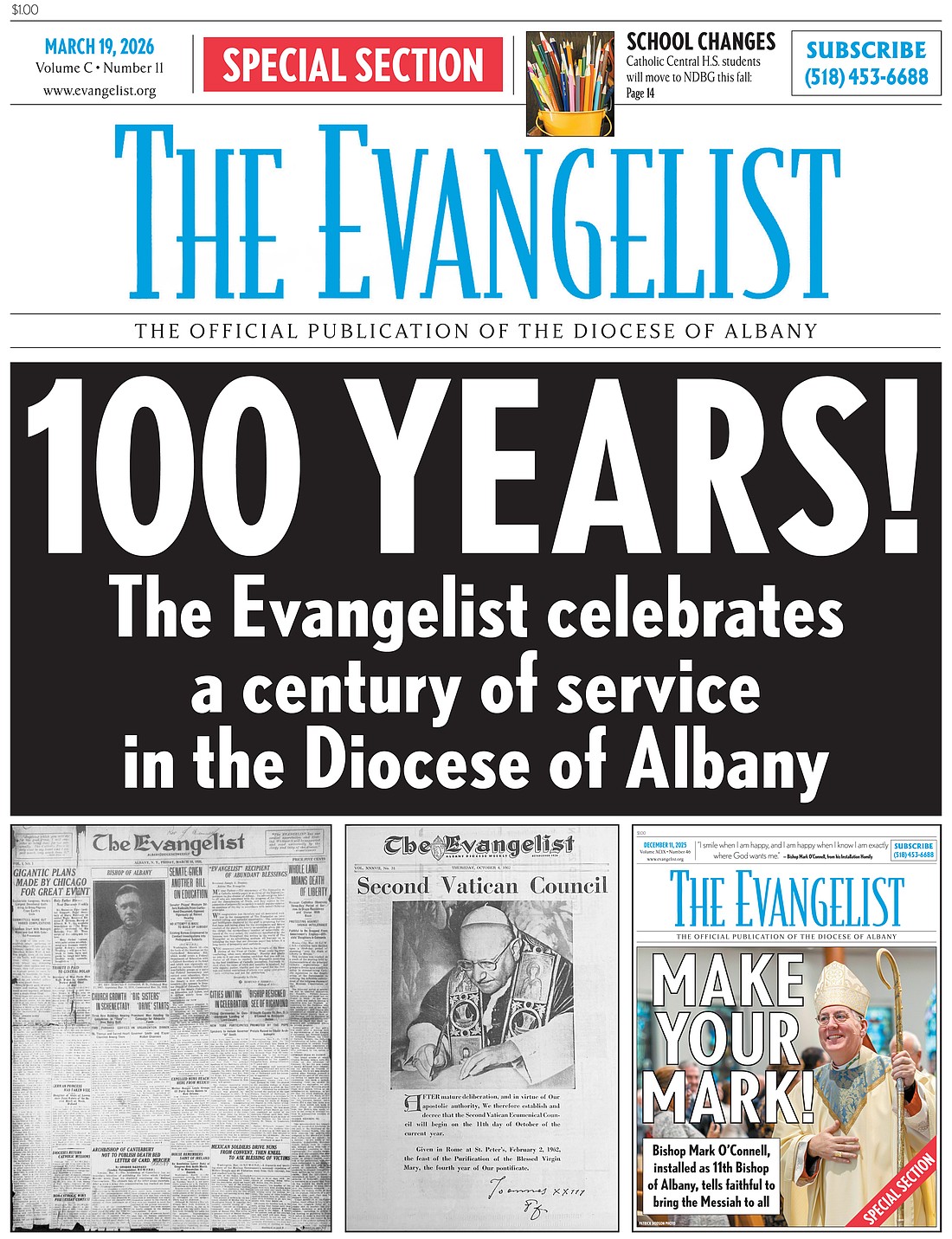
With these following words addressed to Rev. Joseph A. Dunney, Editor, on page 1 under the headline — “Evangelist” Recipient of Abundant Blessings — Bishop Edmund F. Gibbons brought to life The Evangelist exactly 100 years ago today on March 19, 1926.
“My dear Father: — The appearance of The Evangelist as a Catholic weekly paper is an event of the highest importance to the diocese of Albany. Its advent gives heart to all who are concerned with the progress of the Church, and the dissemination of Truth, and they rejoice in the possession of so powerful an agency to (mold) popular opinions on questions of the day in accordance with sound Christian principles.
EDITOR'S NOTE: The dates listed under the following Evangelist covers correspond to the dates that the paper was published, not when the events actually happened.
“We congratulate you therefore on all associated with you in the management of The Evangelist on your exalted calling and splendid opportunity. The enthusiasm and intelligence displayed by the staff in preparing for the first issue and laying plans for the development and future conduct of the paper, the hearty co-operation given you by the clergy, the extraordinary number of subscribers obtained at the very outset, the confidence manifested by the business men throughout this section in the worth of The Evangelist as an advertising medium, all warrant us in indulging the hope that our diocesan paper has before it a long career of prosperity and usefulness.
“You commence your labors in the strength of the Benediction in the Vicar of Christ. What could be more comforting, what more stimulating! Humbly and gladly we join to it our own blessing, confident that you will endeavor at all times to conduct The Evangelist according to the best tradition of Catholic journalism, fearlessly indeed when the cause of truth and morality is involved, but with dignity, justice, charity and due regard for the feelings and honest convictions of others, ever using your power ‘unto edification and not for destruction.’ ”
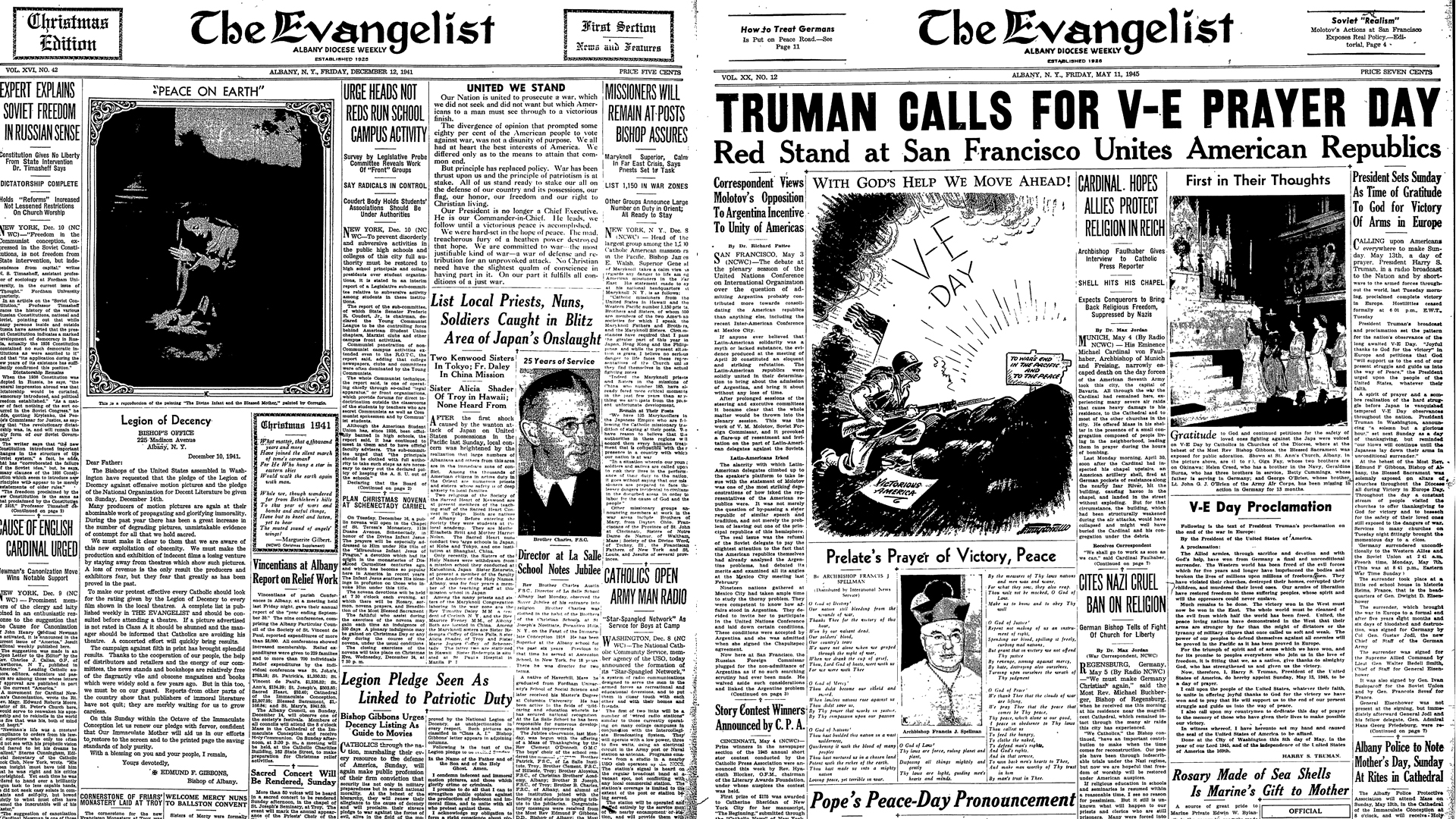
December 12, 1941 * Japanese bomb Pearl Harbor May 11, 1945 * V-E DAY
The first edition of the paper, which cost 5 cents, was published on a Friday and consisted of 17 stories and shorts on the cover. Headlines included “CHURCH GROWTH IN SCHENECTADY” and “SENATE GIVEN ANOTHER BILL ON EDUCATION.” Across the 10-page section contained stories on the schools, the parishes, Catholic fraternal organizations, and one page dedicated to the Propagation of the Faith. There were a host of ads from, just to name a few, The College of Saint Rose, Christian Brothers Academy, Schenectady Savings Bank, Saul’s, Hayes Clothing Co., and you could buy a $6 Westinghouse turnover toaster — “The Secret of Good Toast” — at C.J. Bernhardt, Inc.
Many of the names of the people in the stories and the businesses may have been lost to memory and time, but one century later The Evangelist remains standing with the same mission that Bishop Gibbons enshrined 10 decades earlier.
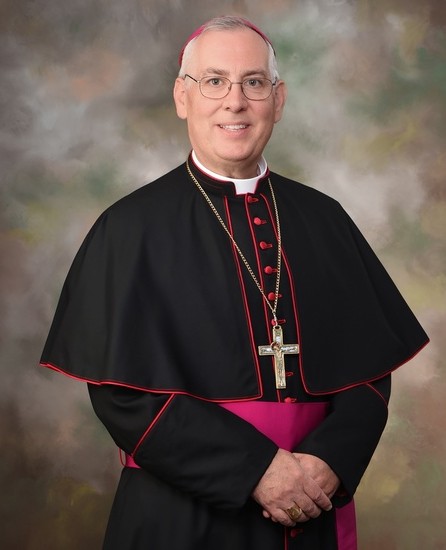
“As the eleventh Bishop of Albany, I stand in a long and cherished line of bishops who have partnered with The Evangelist to deliver trustworthy, faith-filled Catholic news and perspectives to the people of our Diocese,” Bishop Mark O’Connell said. “This newspaper has faithfully served as a vital voice of the Church in our region for a full century, illuminating the Gospel amid the joys and challenges of daily life. I look forward with gratitude and hope to collaborate with the dedicated staff of The Evangelist as we embark together on the next 100 years of proclaiming the Good News and fostering a vibrant Catholic community.”
The Evangelist — which has always been published as a weekly — has reported on 17 presidents, nine popes, six diocesan bishops and one auxiliary bishop, two World Wars, the assassination of the first Catholic president, the Moon landing, Roe v. Wade and the overturning of it, and the amazing growth of the 14-county Diocese of Albany, much of which happened under Bishop Gibbons’ tenure (1919-1954). Besides establishing The Evangelist, he oversaw the building of the Mater Christi Seminary in Albany, 22 high schools and 82 primary schools. The story of the Diocese of Albany and the Capital Region has been written in The Evangelist for years and it is something that everyone who has worked at the paper takes very seriously.
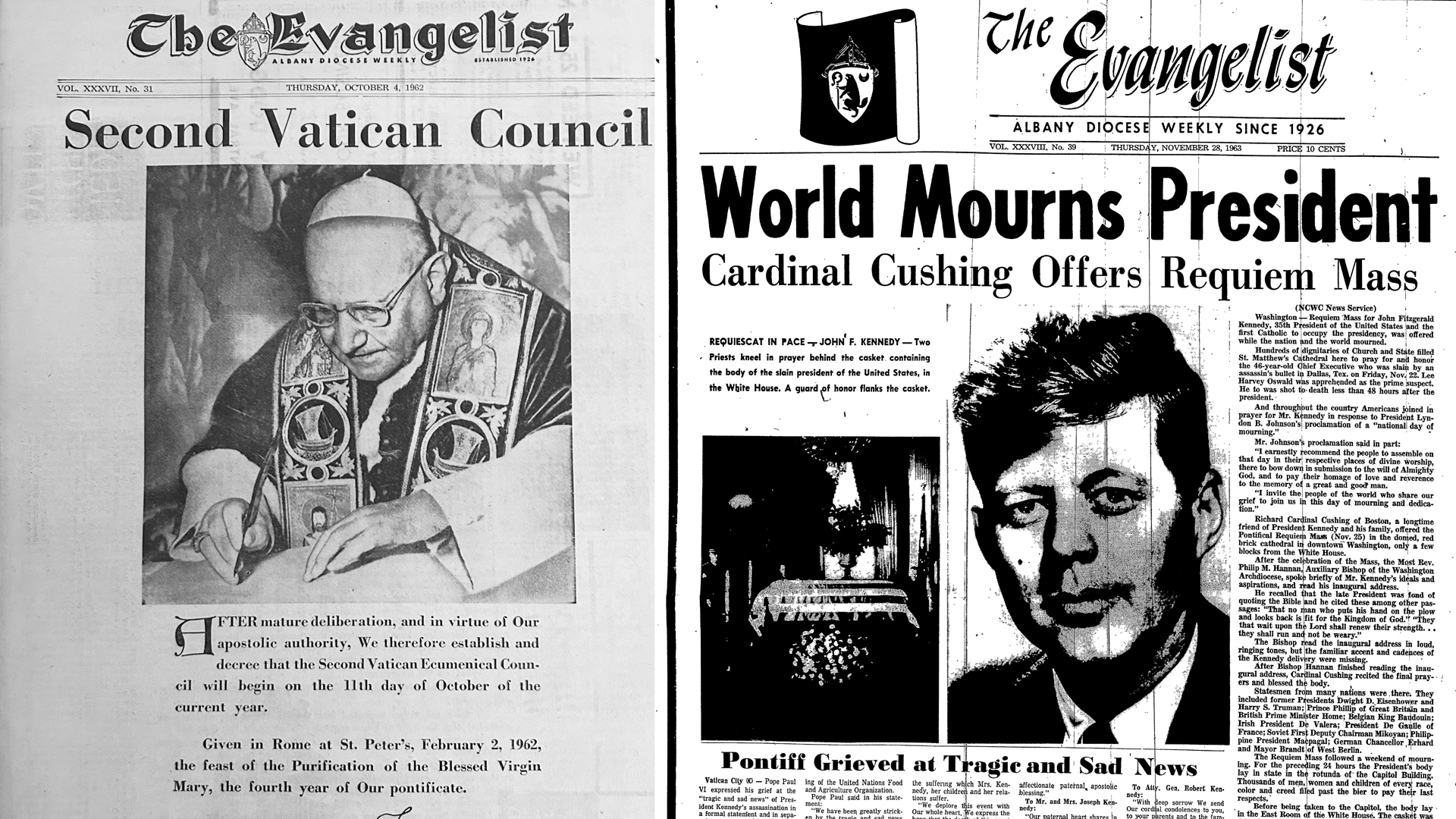
October 4, 1962 * Second Vatican Council November 28, 1963 * President Kennedy assassinated
“It is an awesome honor to be the editor of The Evangelist and continue the work of those that came before me,” said Mike Matvey, editor of The Evangelist. “While looking through the past issues of the paper from the late-1920s all the way up to the present day, the longevity of the paper is a testament to not only the many people who shaped the paper but to the faithful of the Diocese of Albany. Even all these years later, The Evangelist is the biggest weekly newspaper in the Capital Region. I will remain a faithful custodian of the paper — as well as our social media channels and website — and thank our dedicated readers for their patronage.”
To put that staying power into sharper focus, the year 1926 saw Calvin Coolidge as the 30th president of the United States. It was just a short three years later that the “Roaring Twenties” collapsed with the Wall Street Crash of 1929. On June 1, 1926, Norma Jeane Mortenson, better known as Marilyn Monroe was born, and in October of that year, Babe Ruth of the New York Yankees set a record by hitting three home runs in a World Series game against the St. Louis Cardinals. And on Dec. 11, Adolf Hitler, Fuhrer of the Nazi Party, published the second volume of his manifesto “Mein Kampf.” In Vatican City, Pope Pius XI declared John of the Cross a Doctor of the Church and on Nov. 18, 1926 he protested against the slaughter and persecution of Catholics in Mexico.
As for what a dollar could buy in 1926, a new Model-T cost between $250-500, a new home around $7,000, gas was 22 cents a gallon and bread was 10 cents a loaf.
“Wherever did the last 100 years go? People my age are prone to reckon time in decades, not years. ‘A couple years ago’ is seldom less than two, though the event recalled might seem to have happened yesterday,” Bishop Emeritus Edward B. Scharfenberger said. “As we celebrate the centennial of The Evangelist under the sponsorship of the Catholic Press Association, humility and candor demand that, ancient of days though some of us may be, none are old enough to remember all the history that has formed us. The recorded annals of The Evangelist will serve to remind us.
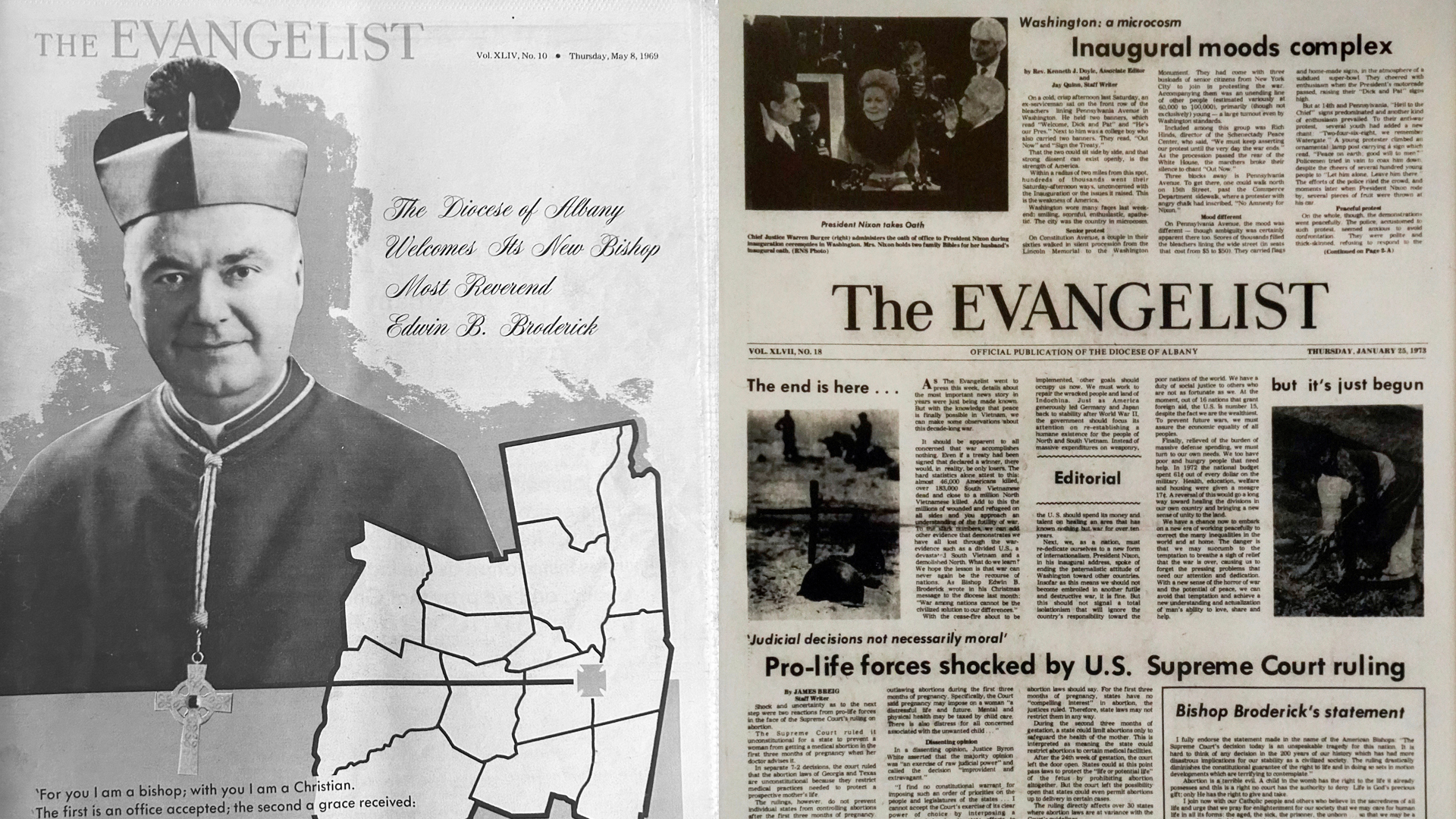
May 8, 1969 * Diocese welcomes Bishop Broderick January 25 * Roe v. Wade
“We are grateful for all those, yesterday and today, whose writing, reporting, photography and layout artistry, and editing have gone into each publication. I add my own cheer of congratulations and sincerest best wishes to Mike Matvey and the trustees and staff of our esteemed diocesan newspaper. Ad multos annos!”
Besides covering the day-to-day operations of the schools and parishes, the paper has always been a staunch advocate of the power of Catholic Social teaching, particularly the “Life and Dignity of the Human Person,” and being a stone’s throw away from the state capital, it has worked arm-in-arm with the New York State Catholic Conference for decades.
“In my quarter century with the New York State Catholic Conference, the Catholic press has been essential in getting the word out about the bishops’ public policy priorities and calling Catholics to action,” said Dennis Poust, executive director of the Conference. “In that time, no outlet has been a stronger partner than The Evangelist. As the Catholic newspaper of the Capital Region, The Evangelist has always leaned hard into the state government beat, with other state and national outlets frequently picking up their stories. The Evangelist has been central to our communication strategy for decades and continues to be so.”
When exploring the history of The Evangelist, the first name that we have to start with is Rev. Dunney, the first editor of the paper. In the 1920s, he was joined by William J. Cormack, business manager, and the office was located in the Dolan Building at 469 Broadway in Albany.
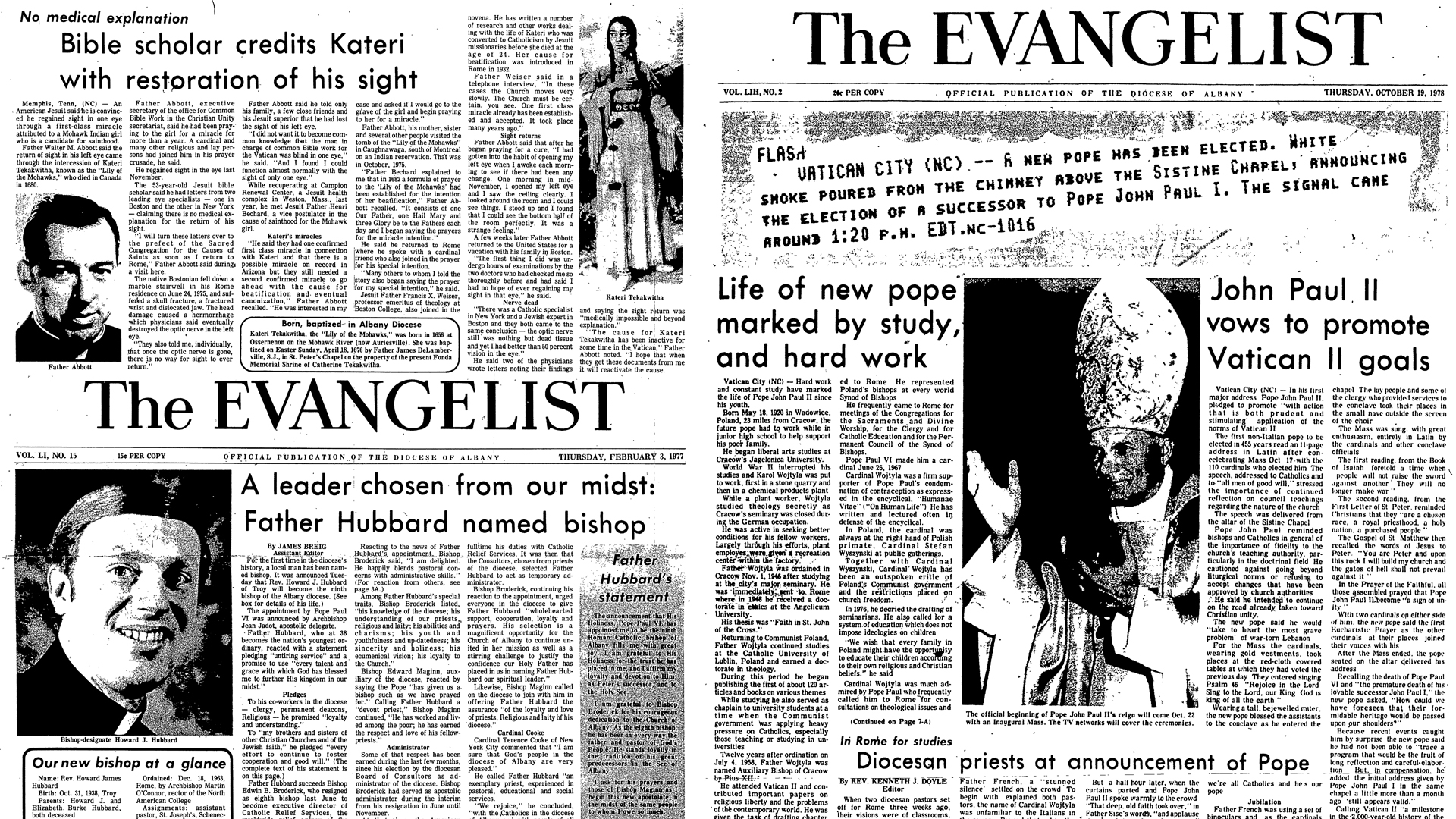
February 7, 1977 * Bishop Hubbard appointed October 19, 1978 *Pope John Paul II elected
A yearly subscription to the paper cost $2 and you could sign up for a half-year for $1.15. As the ’20s came to an end, Rev. John J.A. O’Connor had taken over as editor. By the mid-1930s, Rev. Gerald H. Kirwin was on staff as associate editor and Rev. John J. Collins was the question box editor. (The trio would continue into the 1940s) Some sample questions from the March 8, 1935, edition included: “A non Catholic asked me how sins could be forgiven by merely telling them. What should I tell him?” and “If Christ is the head of the Church, why is there any need of a pope?” Also in 1935, Vincentian Institute became the largest Catholic high school in the Diocese with four Brothers of the Congregation of the Holy Cross joined the faculty in the fall, and in 1937, Siena College opened its doors in Loudonville.
In the 1940s, just days after Pearl Harbor, the paper published an editorial titled “UNITED WE STAND,” and stated “Our Nation is united to prosecute a war, which we did not seek and did not want but which Americans to a man must see through to a victorious finish. … Our President is no longer a Chief Executive. He is our Commander-in-Chief. As he leads, we follow until a victorious peace is accomplished.
“We were hard-set in the hope of peace. The mad, treacherous fury of a heathen power destroyed that hope. We are committed to war — the most justifiable kind of war — a war of defense and retribution for an unprovoked attack. No Christian need have the slightest qualm of conscience in having part in it. On our part it fulfills all conditions of a just war.”
In 1944, Rev. Edward J. Maginn was named pastor and principal of Vincentian Institute, and Monsignor William Scully appointed as coadjutor in 1945 of the Diocese as the Second World War came to an end in both Europe and in the Pacific.
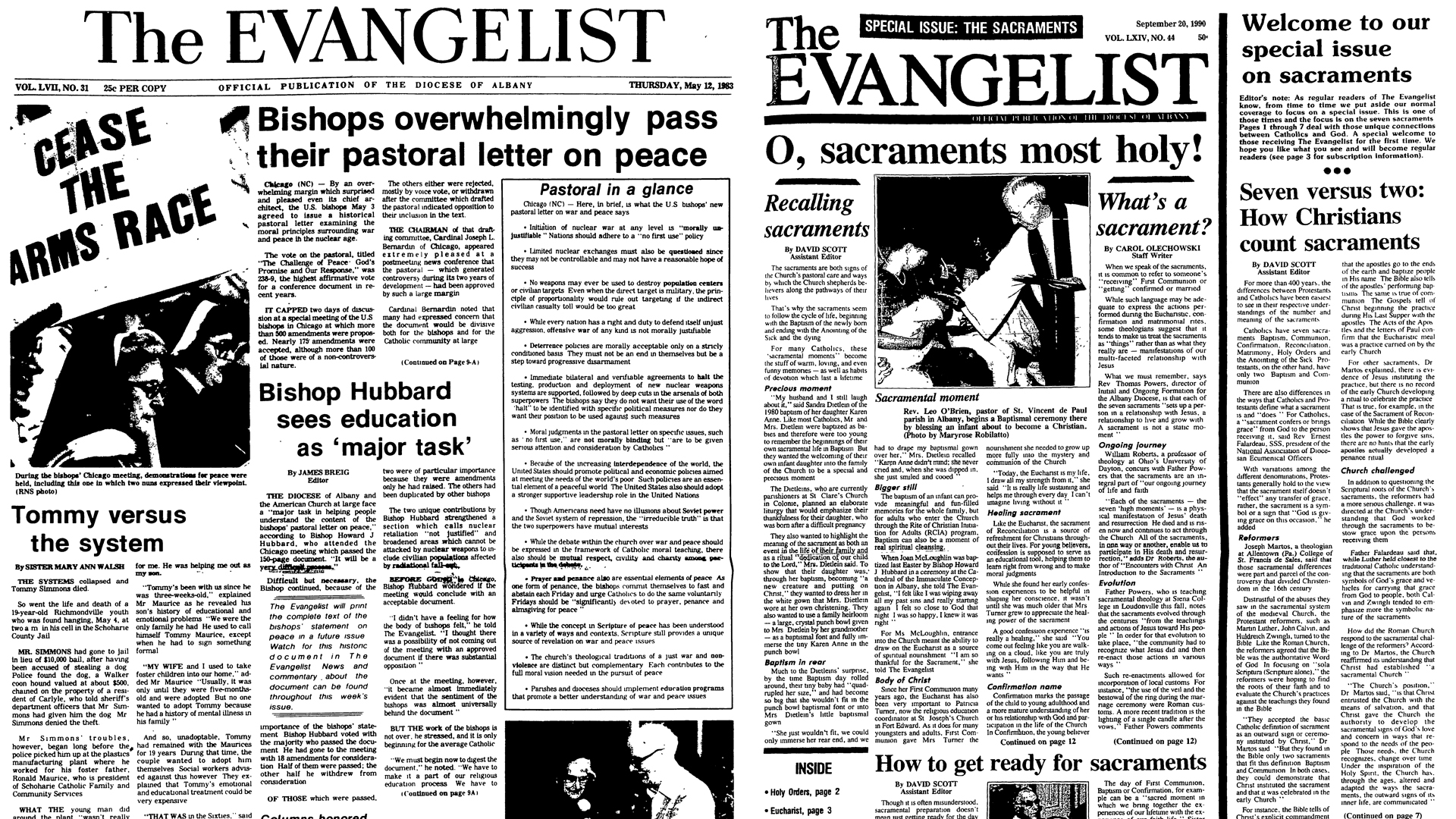
May 12, 1983 * Pastoral letter on peace September 20, 1990 * Sacraments special edition
After V-E Day, The Evangelist said in an editorial titled “V-E Day Significance:” “The paroxysm of delight which swept America into a wild hysteria on Armistice Day of 1918 was lacking on last Tuesday. Reaction to the news of Germany’s unconditional surrender was sobered by the realization that V-E Day meant only partial victory. The Pacific struggle still stares us in the face.”
After Japan surrendered in the Pacific, The Evangelist wrote on May 11, 1945, that “The heart of the world was lifted to God in thankfulness, and joy at the news of the conclusion of the most devastating conflict in history. … In thanking God for this rebirth of peace, let us pray that it will be lasting.”
In the 1950s, everything — more new parishes and schools and more Catholics! — was booming after the war. The Bishop’s Fund was established in 1955 and Bishop Gibbons High School (1958), Notre Dame High School (1959) and Maria College (1959) were all founded. At the Evangelist, Rev. Gerald H. Kirwin was now editor-in-chief, Rev. Joseph P. Varden was assistant editor and the Very Rev. John J. Collins was question box editor.
On Nov. 10, 1954, Bishop Gibbons retired and Bishop Scully became the seventh Bishop of Albany, and the Evangelist said in a front-page article that the “Albany Diocese is blessed in the Providential succession that follows the resignation of the beloved-and- venerable Bishop Gibbons. An episcopate weighted with glorious accomplishments for the Divine Master and His Church evidenced over a period of almost 36 years blends into the vigorous and inspiring leadership of the new Seventh Bishop of Albany, the Most Rev. William A. Scully.”
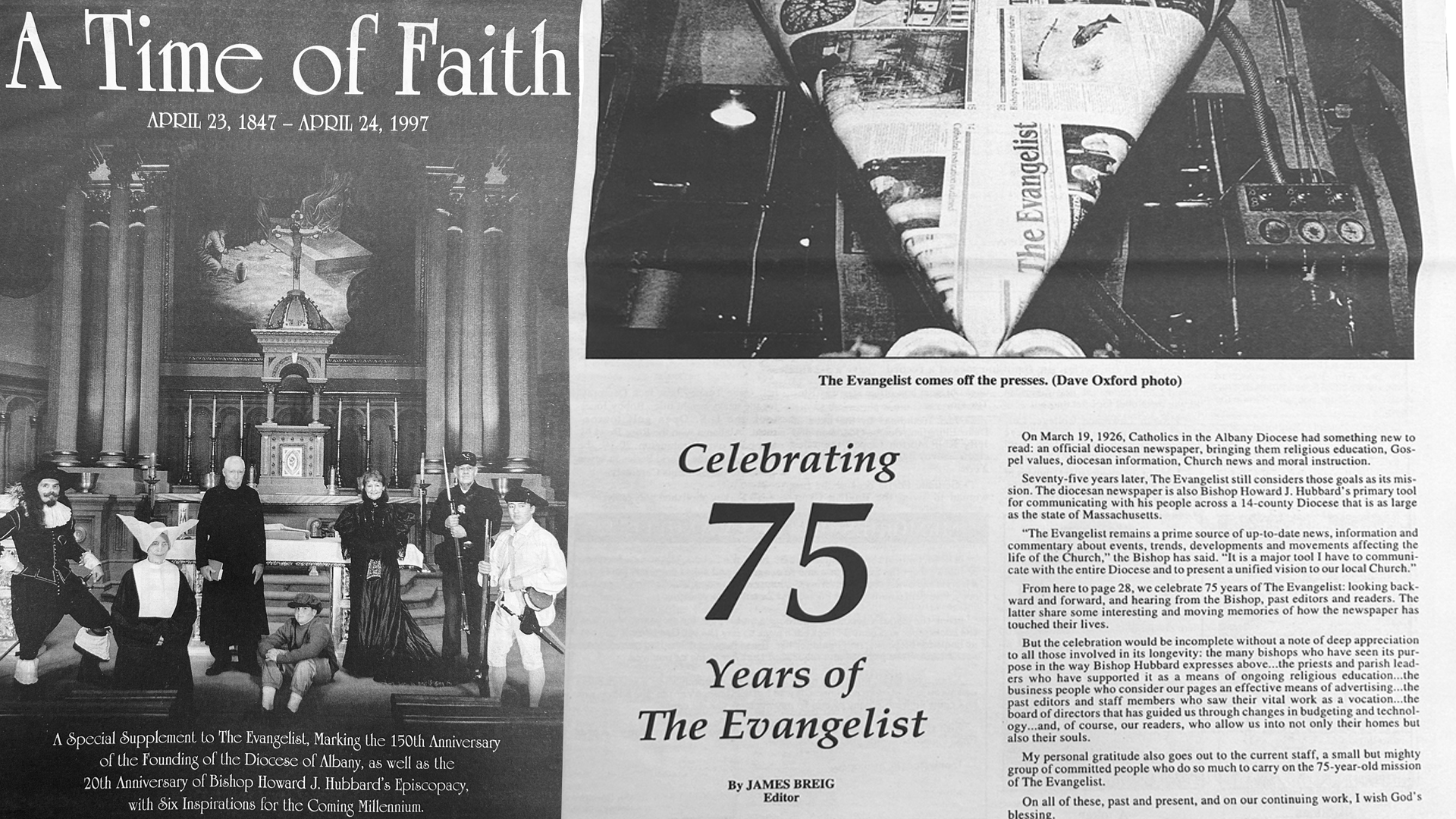
April 24, 1997 * Diocese's 150th anniversary March 15, 2001 * Evangelist's 75th anniversary
In the 1960s at The Evangelist, the editor-in-chief was the same but his title was now Rt. Rev. Msgr. Gerald H. Kirwin. Rev. Varden was now managing editor, Rev. William F. Jillisky was assistant editor, and the paper was now published on Thursday.
This was a decade of change and turmoil: now-auxiliary Bishop Maginn attended the Second Vatican Council (1962-65), and on Nov. 22, 1963, President John F. Kennedy, the first Catholic president, was assassinated in Dallas. The headline in the paper read “World Mourns President.” Rev. Martin Luther King Jr. was slain by an assassin’s bullet on April 4, 1968, and later that year on Nov. 5, Robert F. Kennedy was also murdered. And all the while the war in Vietnam raged on. In 1969, Bishop Edwin B. Broderick became the eighth Bishop of Albany. It was also during this time that The Evangelist circulation tripled due to a mandate from Bishop Broderick.
Rev. Kenneth J. Doyle, then-assistant editor at the paper, said in an Evangelist interview in 2022 that “the pivotal point, I thought, in the history of The Evangelist came when we went full coverage. It had been purely a voluntary subscription for many years and then in the late ’60s, Bishop (Edwin) Broderick decided that it should go to every family in the Diocese. So we immediately jumped from 30,000 to over 100,000 in circulation. It had much more impact.”
As we moved into the 1970s, the paper ramped up its defense of life from conception to natural death as well as its staunch opposition to the death penalty. With Rev. Jillisky and Rev. Doyle, who was named editor in 1973, running the paper, which now cost $5 for a yearly subscription, the staff had grown and included: reporters James Breig, Kathleen Powers, Barbara Oliver, Jay Quinn and Robert Whalen; editorial assistant Helen M. Fagan; W. John Harrington, business manager; Thomas C. Cable advertising manager; and Elizabeth A. Joeks, principal clerk.
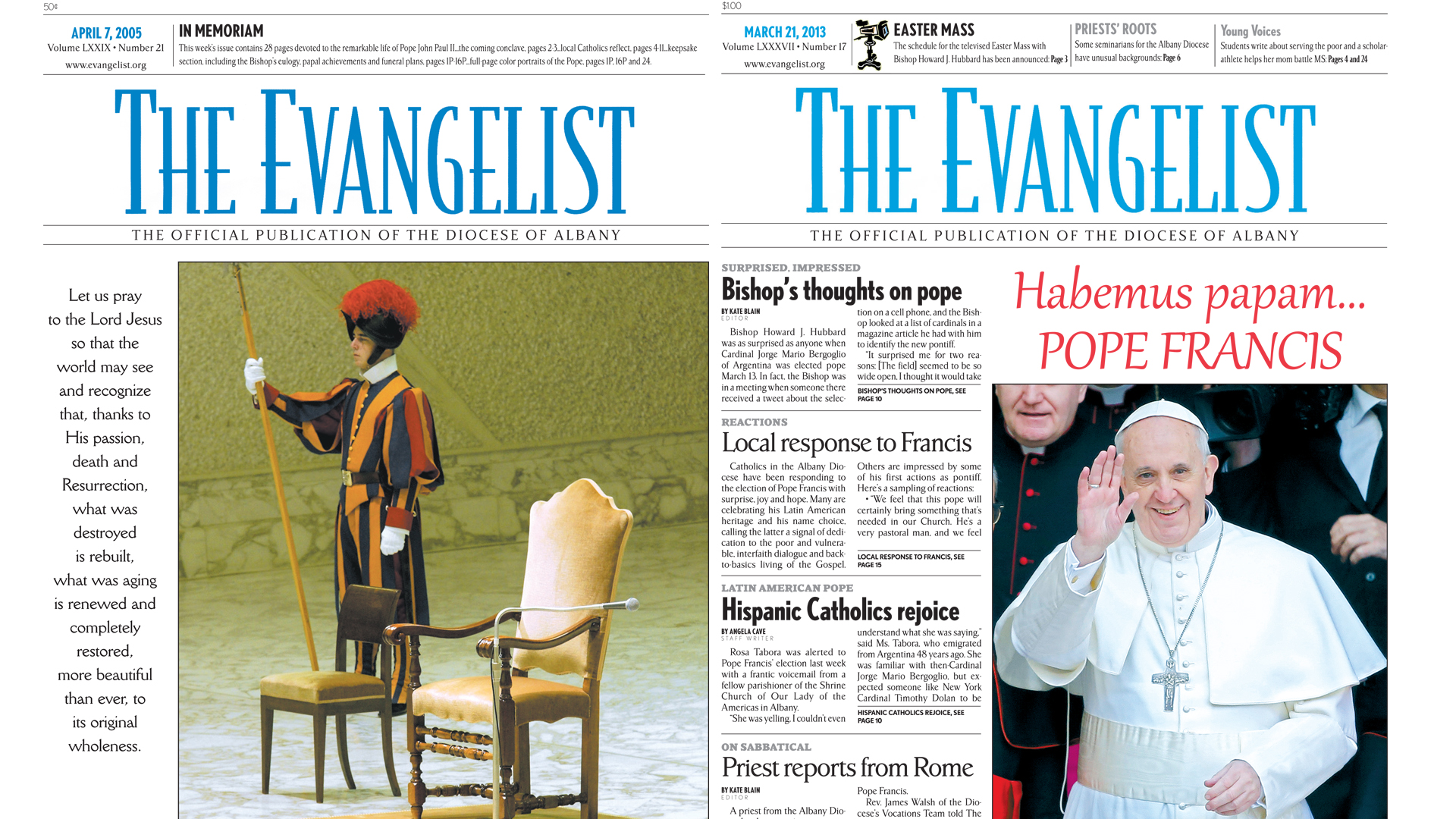
April 7, 2005 * Pope John Paul II dies March 21, 2013 * Pope Francis elected
Two events dominated the decade nationally and locally: the Roe v. Wade decision on Jan. 22, 1973, basically legalizing abortion nationwide, and the installation of Bishop Howard J. Hubbard, from Troy, as the ninth Bishop of Albany. He was appointed on Feb. 2, 1977, and installed on March 27, 1977 at Siena.
By 1977, Breig and Fagan were the assistant editors under Rev. Doyle. Breig wrote the main story about then-Father Hubbard being named bishop under the headline: “A leader chosen from our midst: Father Hubbard named bishop.” In an editorial on page 4, it opened by saying, “Only the man’s genuine discomfort with praise keeps us from expressing fully how we feel about Rev. Howard J. Hubbard’s selection as bishop. But we will say a few things. A chorus of alleluias burst spontaneously from around the diocese on Tuesday at the announcement of his choice.” The Evangelist published a 71-page special section on March 23, 1977, looking at the life of Bishop Hubbard as well as previewing his ordination.
And one event dominated the world stage: Pope John Paul II was named the first non-Italian pope in over 400 years on Oct. 16, 1978. That same year Brian Baker joined the paper as a staff writer.
In 1981, Rev. Doyle left The Evangelist to become the Catholic News Service’s bureau chief in Rome and Breig was named the first lay editor of the paper, a position he would hold for the next 27 years.
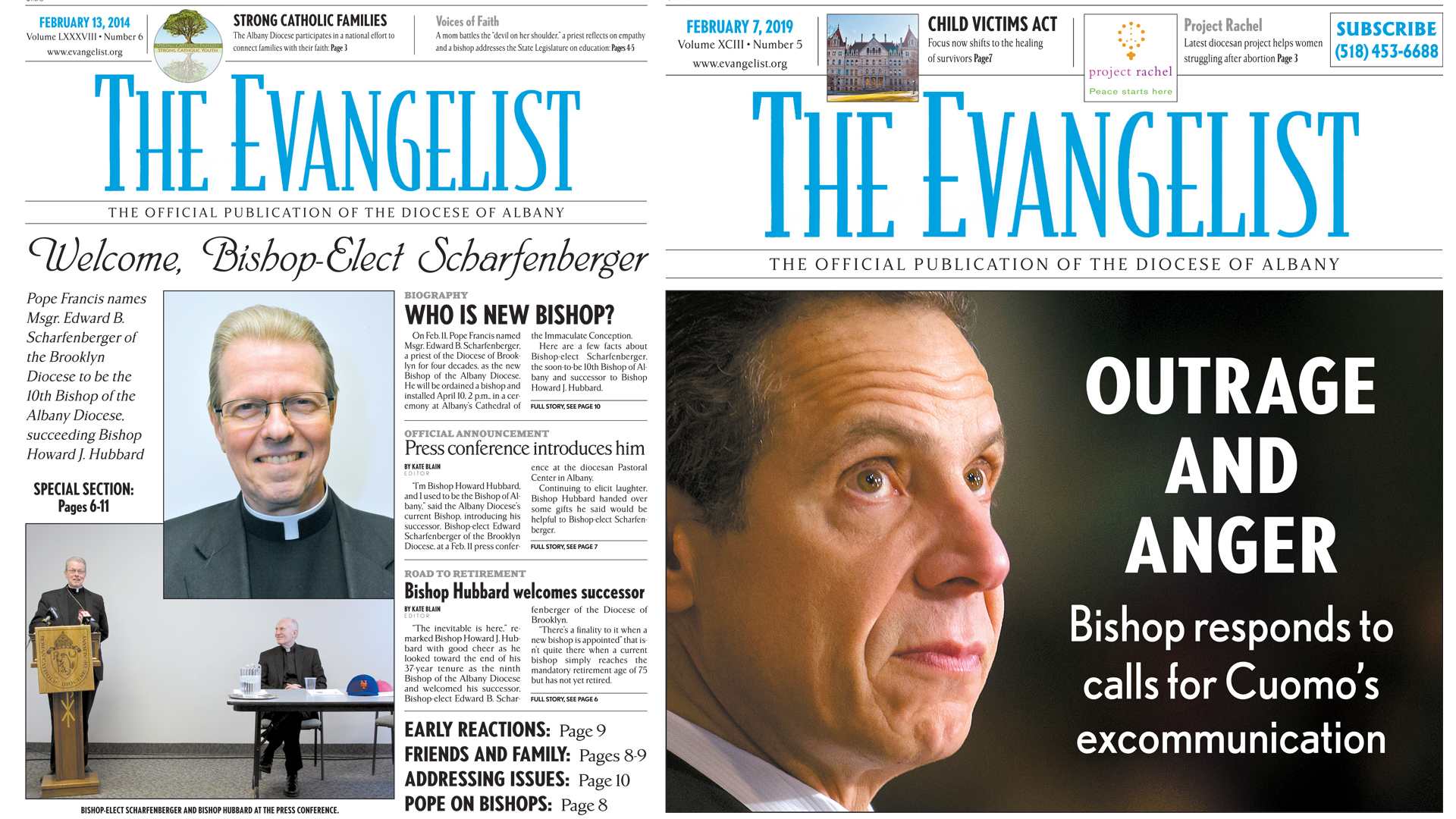
February 13, 2014 * Bishop Scharfenberger appointed February 7, 2019 *Cuomo excommunication talk
It is quite impossible to talk about the history of The Evangelist without Breig, who worked at the paper for 37 years. He led the paper through significant changes, including its transition to a tabloid format and its adoption of modern production methods. As an editor and writer, he received dozens of awards from the Catholic Press Association. He was nominated three times as the best Catholic journalist in North America and he won awards for feature writing, reporting, editorial writing and his column, “Tuned In,” a weekly critique of the media. That column was syndicated for close to 30 years to dozens of other Catholic newspapers in the U.S. with a cumulative circulation of nearly a million people. During the 1980s, Peter Feuerherd, assistant editor, and Carol Olechowski, staff writer, were added to the team.
As the Diocese continued its outreach locally, it made history on March 23, 1986, when the first reconciliation service in the world between Jews and Catholics was held at the Cathedral of the Immaculate Conception in Albany on Palm Sunday. On that date, Bishop Hubbard formally apologized on behalf of the church for centuries of anti-Semitism in a service titled “From Fear to Friendship.”
The service was commemorated by the sculpture titled “Portal,” which was erected in 1989 outside the Cathedral by Schenectady sculptor Robert Blood. At the dedication, on March 19, 1989, in what was another unprecedented event, Bishop Hubbard and Rabbi Martin Silverman joined hands to walk through the 16-foot, one-ton arch of 12-gauge steel, as a gesture of friendship. The sculpture is of a Jew and Christian in embrace.
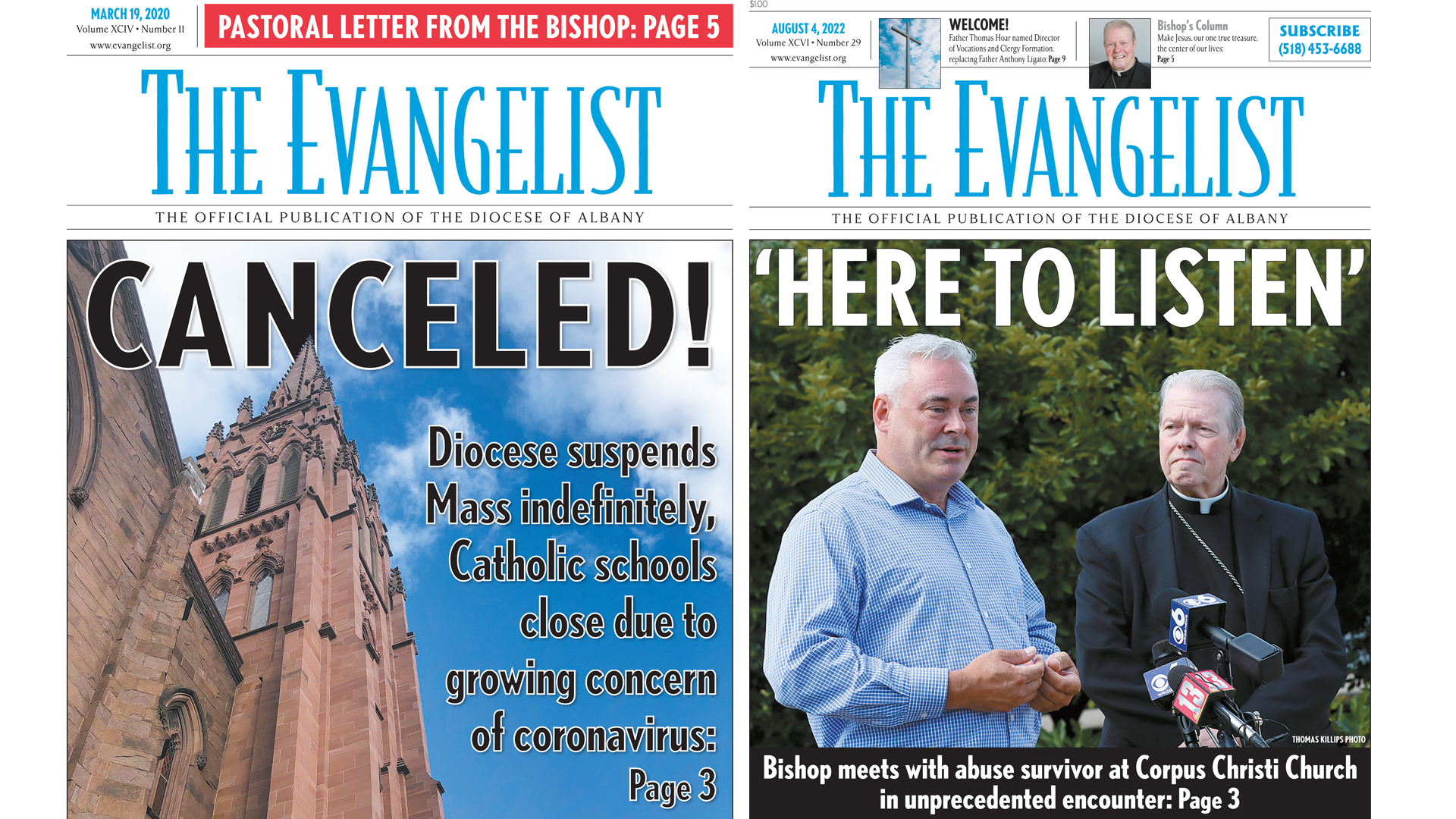
March 19, 2002 * Masses canceled due to Covid August 4, 2022 * Bishop Ed meets abuse survivor
As the 1990s dawned more names were added to The Evangelist masthead under the leadership of Breig: David Scott, assistant editor; staff writers Liz Urbanski, Cathy Cartier Hayes and Kate Blain — who became assistant editor later in the decade — Maureen McGuinness and Paul Quirini; Mary Breig, circulation, Jo Ellen Hahn, bookkeeper and Rosemary Maloy, secretary. Key events in the Diocese during the decade included: the Pastoral Planning Process, which was initiated in March 1994, and the First Diocesan Youth Day — named “Called to be One: Celebrating Unity and Diversity” — was celebrated in July 1998.
As the new millennium dawned, Bishop Hubbard proclaimed in the Jan. 6 paper that all the faithful need to proclaim the “Good News.” The Diocese celebrated the millennium with RENEW 2000, which was created in response to Pope John Paul II’s directive for the global Catholic Community to celebrate the 2,000th anniversary of the birth of Jesus and prepare for the third millennium. It involved spiritual renewal through prayer and worship, faith-sharing, reflection on Scripture, and action. Also on the diocesan level, in May 2002, in the wake of the sexual abuse scandal in the Boston Archdiocese, the Albany Diocese’s Clergy Sexual Misconduct Policy was reviewed by an independent panel and changes were made based on recommendations of the panel. And in 2006, “Called to be Church” began. The five-year grassroots planning process involved Catholics from across the Diocese in a planning effort designed to reimagine the future of the Diocese. In 2009, the Diocese merged 11 parishes and closed 33 worship sites to address population shifts and fewer priests.
There was big news at the paper as well, as Breig retired as editor in June of 2008, and he was succeeded by award-winning local journalist, teacher and author Christopher D. Ringwald. In addition, artist Mary Lou Samaha, who drew the “Little Love” cartoon that appeared on The Evangelist’s youth pages, retired after 23 years, and staff writers Pat Pasternak and Karen Dietlein were added to the masthead.
On the world stage, beloved Pope John Paul II died on April 2, 2005, and April 19, Pope Benedict XVI was named pontiff.
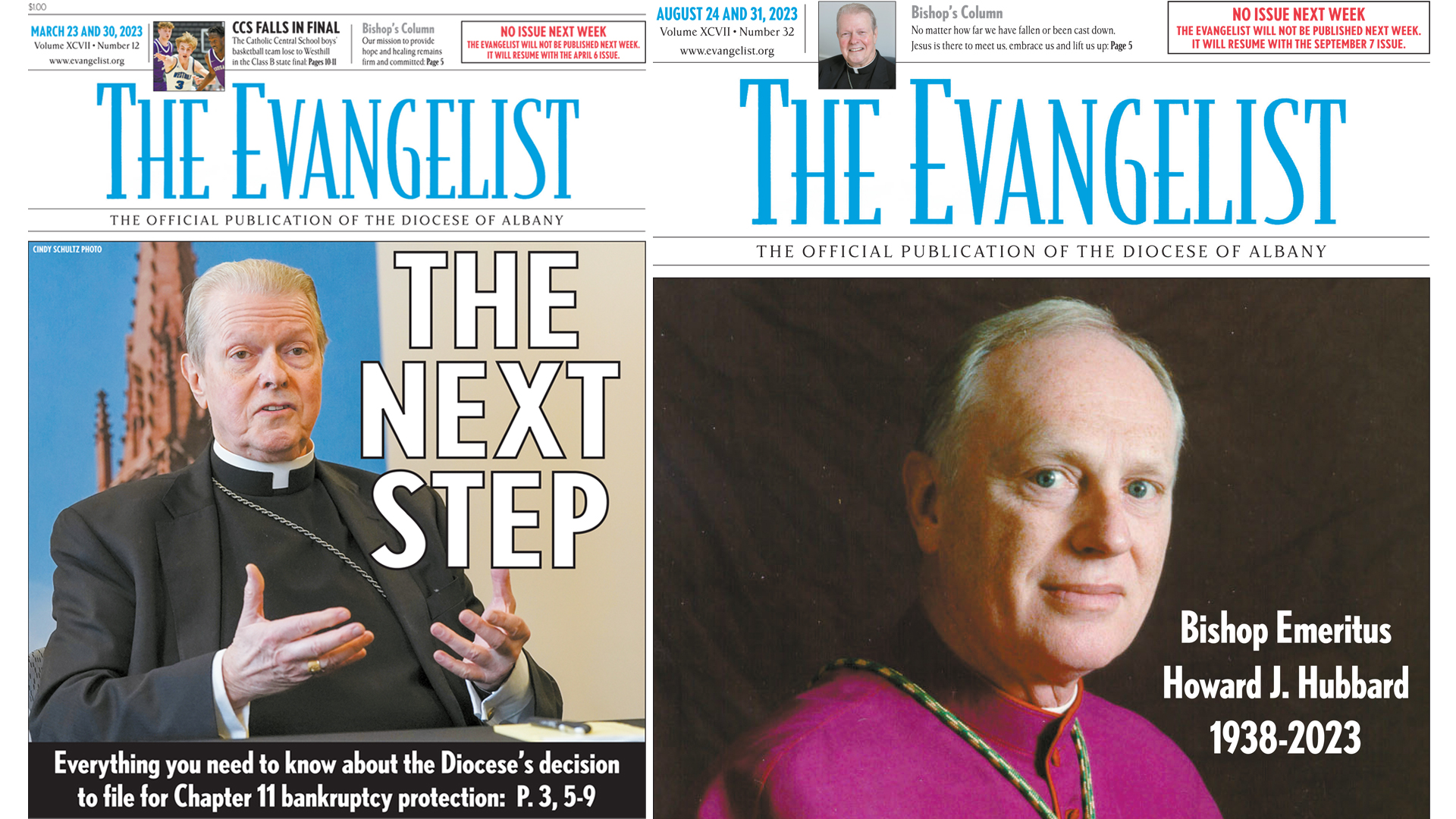
March 23, 2023 * Diocese files for bankruptcy August 24, 2023* Bishop Hubbard dies
In the 2010s, Blain succeeded Ringwald as the first woman to be named editor of The Evangelist. During her seven years as editor, the paper won 55 national journalism awards. One-quarter of those were for Blain’s individual work, most notably consecutive “editor of the year” awards. The Evangelist also increased its web and social media presence and completed a digital preservation process of its archives. Prior to her time as editor, Blain had won many national awards for news and feature writing and for her weekly children’s Scripture column, “Good News for kids.”
The rest of The Evangelist’s staff in the early 2010s was made up of staff writers Angela Cave and Kathleen Lamanna, business manager Stephanie Zebrowski, composer Carol Raabe, Anne Cataldo in circulation, administrative assistant Susan Burns and advertising rep John Salvione.
On the diocesan level, Bishop Hubbard retired after 37 years in 2014 and Bishop Edward B. Scharfenberger was named the 10th Bishop of Albany. Bishop Scharfenberger took on the abuse crisis head on in the Diocese in 2018, and following a subpoena from the New York attorney general, he invited the Albany district attorney to review the Diocese’s handling of sexual abuse cases. In September 2018, the Hearts Aflame Eucharistic Congress at the Shrine of the North American Martyrs in Auriesville was the first of its kind in the Diocese in roughly 80 years. Mass was celebrated in the 1930s-era coliseum. More than 4,000 pilgrims prayed in one of the numerous chapels on-site and walked prayer-paths that visitors have enjoyed for decades.
In 2018, Blain stepped down as editor and was replaced in January 2019 by Matvey, who refreshed the look of the paper relying on bold designs and photography by Cindy Schultz. (Speaking of photographers throughout the years, we would be remiss not to mention D.A. Gleason, Dave Oxford, Nate Whitchurch and Thomas Killips) Matvey also cleaned up the look of the website (evangelist.org), adding a video component, and pushed stories to Facebook and photos to Instagram in real time. Under his stewardship, The Evangelist was won nearly three dozen Catholic Media Awards.
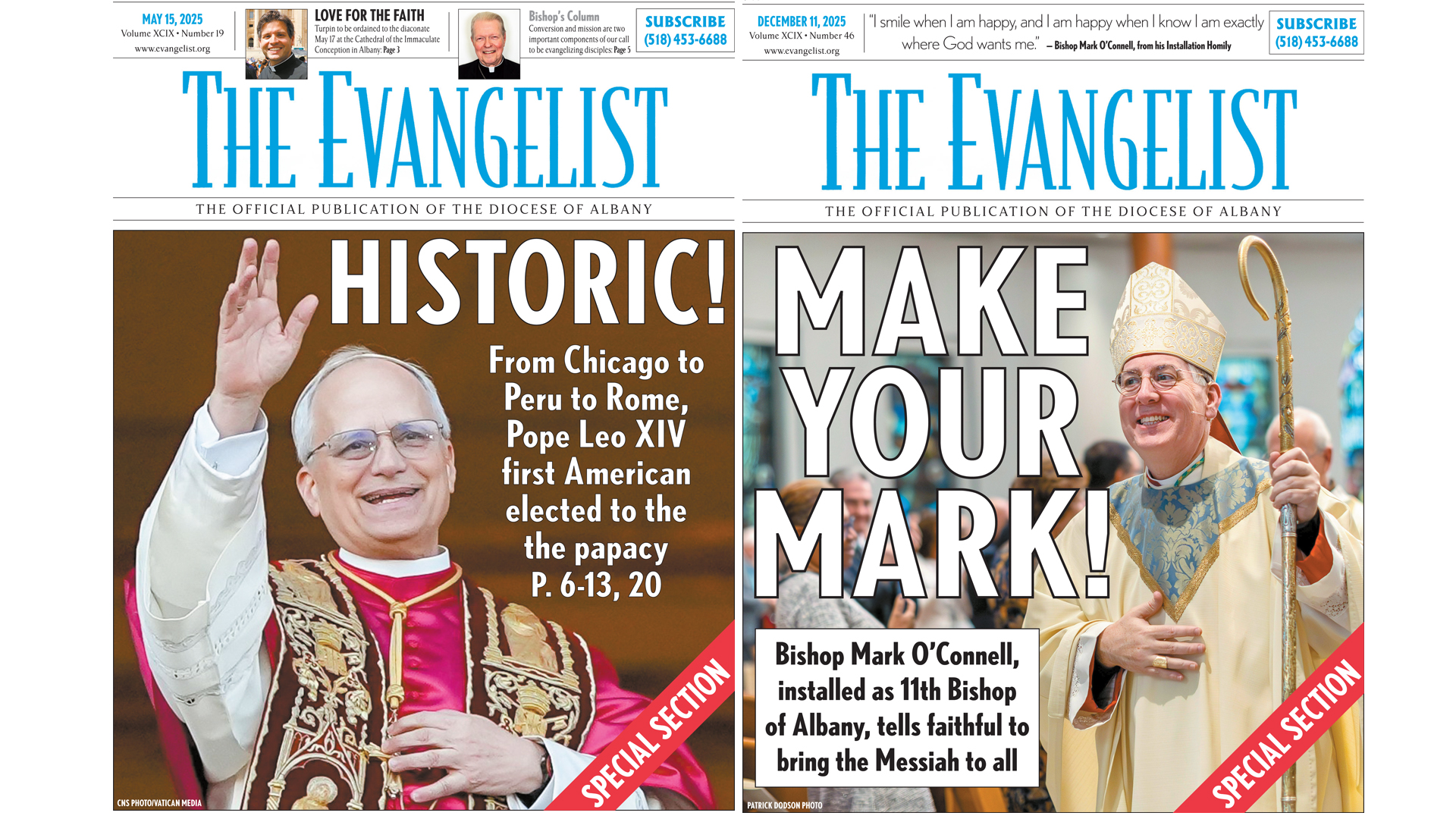 May 15, 2025 * Pope Leo XIV is elected December 11, 2025:Bishop Mark's installation
At the time the staff writers were Emily Benson and Franchesca Caputo, Brenda Powell was the designer, Ann Egan took care of circulation and Kathy Hughes was legal coordinator/administrative assistant.
In The Evangelist’s 10th decade, Bishop Scharfenberger continued to walk with victims/survivors, most notably meeting with Stephen Mittler on July 31, 2022, at Corpus Christi in Round Lake. The Evangelist article began with the words “Just after 10:40 a.m., on this historic Sunday morning, sex abuse survivor Stephen Mittler and Bishop Edward B. Scharfenberger of the Diocese of Albany walked out of the doors of Corpus Christi Church in Round Lake together.
“They stopped and paused at the steps where Mittler met his alleged abuser, Mark Haight, a former priest, in 1988. Then they continued their walk to tell Mittler’s family and friends, media members, and everyone in the Diocese what they had just discussed in private.”
Bishop Ed also shepherded the Diocese through the start of bankruptcy on March 15, 2023, turned in his resignation to the Vatican on May 29, and on Aug. 19, Bishop Hubbard died. Then on Oct. 20, 2025, Bishop Mark O’Connell was appointed the 10th Bishop of Albany and installed on a frigid day on Dec. 4 at St. Edward the Confessor in Clifton Park.
As you can see there has been no shortage of news for The Evangelist to report on in the last 100 years. Even though this story is just a snippet of the events of the last century, we hope and pray The Evangelist will be here for as long as there is news to report in the Diocese of Albany.
- A life that points beyond the tomb: Mother reflects on son’s faith as sainthood cause opens
- You had to be there: Thomas’ lesson for an Easter people
- USCCB chairman calls on Trump to back peace, humanitarian aid for Lebanon after massive strikes
- Dioceses, parishes take up Pope Leo’s call to pray for peace, plan vigils for April 11
- Pentagon disputes report senior officials lectured Vatican diplomat about Pope Leo
- Scholar: World order under attack from great powers’ ‘raw exercise of military power’
- Hungarian election stirs unease among Catholics amid Church preelectoral silence
- Nuncio to Lebanon says war ‘is not the right path,’ calls for ceasefire
- Analysis: Deepfake popes and bishops abound: Here’s how Church can push back ‘AI attack’ on truth
- Why are there so many different kinds of convents out there?
Comments:
You must login to comment.