


March 12, 2026 at 6:14 p.m.
‘DANCING WITH CHANGE’
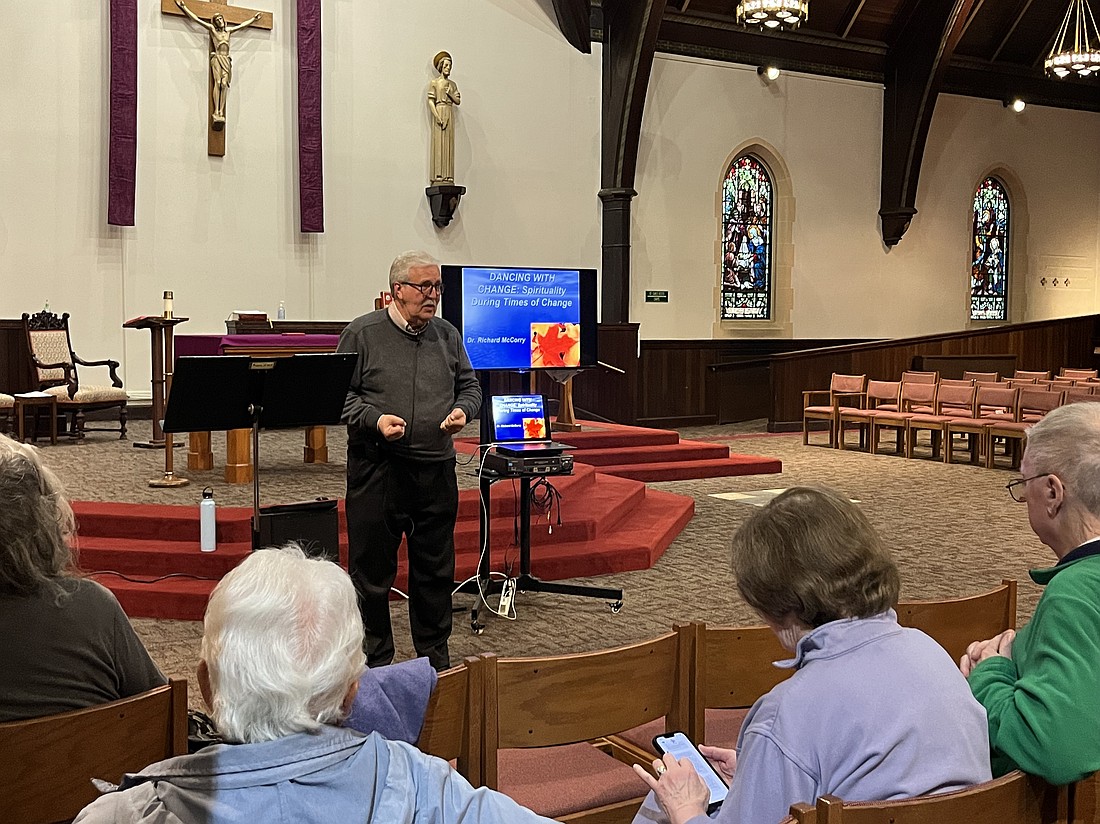
“Why do we resist change?”
It’s a difficult, albeit true, statement. One that Dr. Richard McCorry asked the crowd of attendees at St. Joseph’s Church in Scotia last week. Hands shot up around the room with answers: It takes effort to change, we like to keep the status quo, and — simply put — it can feel scary.
Change is difficult enough as it is, but what is it about changes within our churches and church communities that go even deeper? Why are churches so resistant to change, and how can Catholics better prepare themselves to work with church changes instead of against them?
McCorry navigated these questions, particularly on changes in the Catholic Church, during his presentation “Dancing with Change: A Spiritual Response to Changes in the Church,” held on March 9 in St. Joseph’s.
“We resist change because sometimes it requires us to let go of something, something that we love dearly,” McCorry said.
McCorry is no stranger to change himself. He received his doctorate in transformative leadership from Colgate Rochester Divinity School and consults dioceses and parishes in the Rochester area on change management. His book “Dancing with Change” is a culmination of his research and the basis of his presentation.
Father Tom Konopka, pastor of St. Joseph’s and director of the diocesan Consultation Center, first read McCorry’s book when it was published in 2004.
“Right after it came out, I found the book … and I’ve used it for the basis of a lot of my talks,” Father Konopka said. He also took McCorry’s approaches to changes in the church and applied them to his social work experience.
When changes were beginning to be discussed in parishes across the Diocese last year, St. Joseph’s looked into bringing McCorry in to help with the discussions on change.
“I was doing these presentations between 2004 and 2008,” McCorry told The Evangelist. “I traveled all around the country and did 50 or more of these and in 2008 we had the economic collapse and churches didn’t have the extra money to bring in speakers like myself, so it died a quiet death.”
Then last year, he got a call to come to Scotia. While it might seem out of the blue, the thing about change, he noted, is that it’s always going on somewhere: “Change is timeless and always timely,” he said.
Before the presentation, the crowd of around 40 attendees was given questionnaires to answer throughout the presentation, such as: What is a change happening in my life or parish right now? How do I feel about that change? What are the reasons I resist change?
McCorry opened the talk by explaining why any change can be difficult. Change can make us feel like our personal identity is challenged, like we’re losing a sense of control when changes are imposed on us, and other non-related stressors in someone’s life might make other life changes seem bigger.
And the Catholic Church in particular can be resistant to change.
“Emotions play a large role in the church and emotions make change messy,” McCorry said. “People who are weary of change often turn to the church, but where do they turn when it’s the church that’s changing?”
During a previous presentation, McCorry spoke with a man who complained that the church he attended took his Mass away. His previous Mass, which was at 10 a.m., was changed to 10:30 a.m., but seeing the church change on him was upsetting.
“It removes predictability,” McCorry said. “(Change) takes us out of our comfort zones.”
There is also the chance that any changes will drive people away from the church. “When a parish closes and people are asked to go to another parish, two-thirds will go to the other parish and a third won’t,” he said. “They either won’t go to church anymore or go to another church.”
However, there are tools at hand to make navigating change (in the church and otherwise) less daunting. McCorry describes his spiritual approach to change that he calls “The LEAP of Faith.” Each letter of “LEAP” — which stands for learning, experience, action and prayer — is a step to help navigate change.
In learning, we are invited to be open-minded and to educate ourselves as much as possible on the change we’re struggling with. In experience, we’re called to feel our feelings about what we’re going through.
“With change, we’re talking about death, a little death,” McCorry said, and we often feel similar emotions of grief that come with death. “The quickest way to go through them is to go through them. Allow yourself to feel those feelings.”
In action, McCorry proposes cooperating just a little with the change you’re resisting. If a Mass time you love changes, try the new Mass time for a month. “The wisdom of this is that it puts you back in control,” he added. “Nobody is telling you what to do; you’re choosing to give it a shot.”
And finally, prayer is something that McCorry said cannot be overstated.
“All we have to do is reach out and this whole leap of faith, when we’re struggling, when we can’t see any good coming out of the change we’re struggling with, we have to take a leap and trust once again God can never leave us to our struggles alone.”
Terry Smith, a parishioner at St. Joseph’s, enjoyed getting to hear people’s responses to the questions and asking their own questions at the end.
“Give anything a chance, and give it time and prayer, always,” Smith said.

- Matisse’s 14 stations, depicting the ‘most profound of human dramas,’ on exhibit in Baltimore
- Cardinal Ouellet defamation suit against accuser awaits judge’s verdict after early March trial
- Bishops’ Civil Rights pilgrimage shows need to face past to build new future
- Philadelphia archbishop ‘OK’ after mild medical episode during chrism Mass
- Pope Leo XIV on Holy Thursday: Jesus teaches us how to love at the Last Supper
- Full text: Pope Leo XIV’s Holy Thursday homily given April 2, 2026
- 8 takeaways from Pope St. John Paul II’s final Holy Thursday letter to priests
- ‘In this dark hour of history,’ do not shy away from your mission, says pope at chrism Mass
- Here’s a glimpse of Holy Week around the world
- Bishops’ pro-life chair backs longshot bill to revoke mifepristone’s FDA approval
Comments:
You must login to comment.