


July 1, 2026 at 10:43 a.m.
‘MAGNIFICA HUMANITAS’
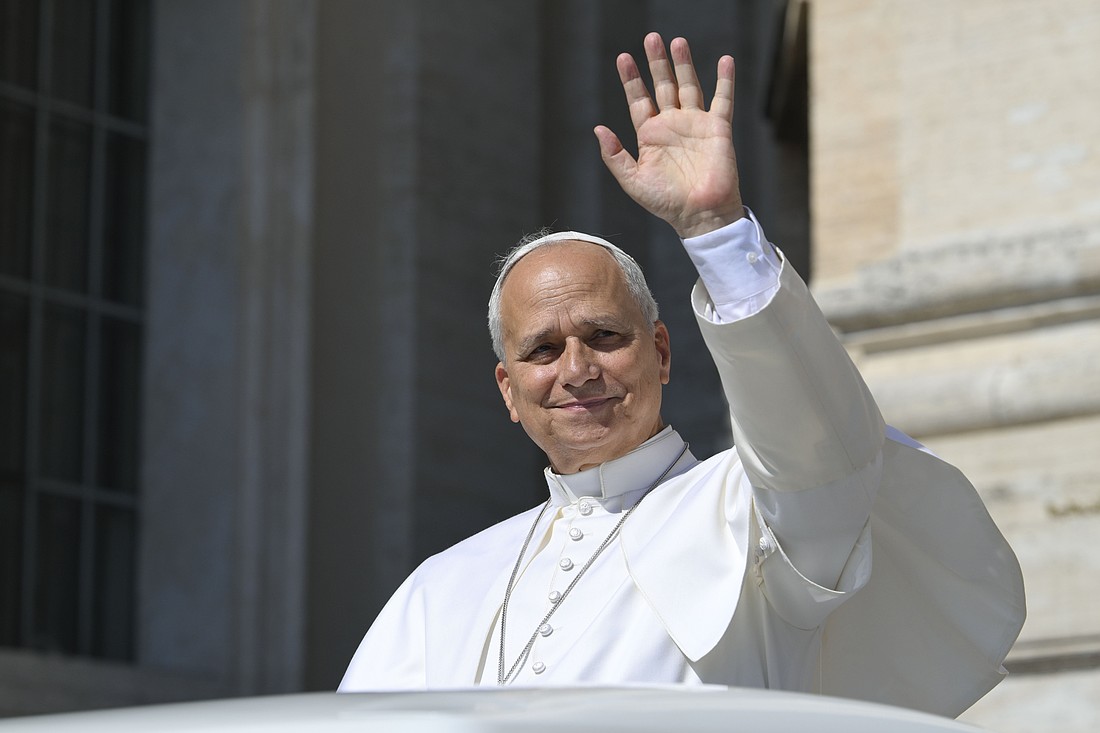
Part 5: Pope Leo asks us to consider what kind of world we want to live in
In the film version of “The Fellowship of the Ring,” a hobbit considers some of the bleak news coming in from outside the borders of their country. A second hobbit brushes the news off, saying “Well, it’s none of our concern what goes on beyond our borders. Keep your nose out of trouble, and no trouble’ll come to you.”
I think that many of us in suburban parishes might be tempted to think something similar. What care is the rest of the world to those of us in our communities? Don’t we have our own problems to consider?
In Chapter 5 of “Magnifica Humanitas,” Pope Leo talks about things that we might be tempted to see as other people’s problems. But by asking us to take responsibility in whatever ways we are able, he is urging us to have a share in the rest of humanity. He wants us to consider what kind of world we are allowing to be built. Is it one that creates more suffering? Or are we “working to build the holy city of coexistence and peace?” (185) Next week we’ll close with his most practical solutions but the tone this week might be a little somber.
We live in a most polarized age. Some people are hesitant to discuss big issues because of how others might respond. Not a few people actually look forward to argument and conflict … and it’s not just around our dinner table. Throughout the world, whole groups of people are poised toward killing each other. And while it is assumed that armed conflict plays by some kind of rules, Leo sees things otherwise.
With an increased callousness with regard to our shared humanity and with the perpetual threat of conflict, Pope Leo reminds us of the teaching of his predecessor, Paul VI. He writes “the Church proposed an alternative path to that of ideological opposition between systems, and envisioned a social order in which justice and charity are intertwined and love becomes the guiding principle of economic, political, and cultural life” (186). When applied to technology, the pope writes that “it is not enough for artificial intelligence to make us more efficient or connected; it must also serve to build a universal human family, with shared rights and duties, where digital proximity becomes a real opportunity for encounter and mutual care” (187).
A world at war
Leo reflects on the normalization of war as public opinion is shaped by ideologies and a mass media with its own agendas. Even something like the so-called “just-war theory,” which had long attempted to serve as a safeguard to exploitative conflict, has itself been exploited by those who appeal to it inappropriately. This leads Leo to declare the theory “outdated” (192).
Remembering the past
Recent studies have shown that a shocking number of young people have little or no awareness of what happened in World War II, including the Holocaust, where six million Jews and others were systematically exterminated by the Nazis. A motto taken up by Jewish survivors was “never forget,” a way of honoring the memory of those who were taken and to ensure nothing like it happens ever again. George Santayana famously said that “those who cannot remember the past are condemned to repeat it.” Yet this is precisely where Leo finds us: “We are also witnessing a disconcerting loss of historical memory, as first-hand accounts of the Holocaust and the two World Wars are disappearing.” He says that this “leads to a selective or distorted rewriting of the past, in a context where fake news and the manipulation of narratives obscure the lessons that have been learned.” What does this lead to? “Without a living memory of the horrors of war, political decisions risk being made on the base of power alone, without consideration of the long-term consequences” (191). He also sees facts themselves as being manipulated and weaponized by those who stand to benefit.
Force without limits
We live at a time where the “military-industrial complex” has become so pervasive that it is the driving force behind the economies of various nations (193). He laments the move away from disarmament and that the world still operates under the myth of nuclear deterrent. We now have the large-scale war machine as well as “new armed operatives, such as jihadist groups, private militias and criminal networks” competing with states, a state of affairs where the young and the vulnerable are among the most harmed (196).
AI and weaponry, ‘Terminator’ stuff
Technology, particularly artificial intelligence, has made the ability to harm more efficient as it de-personalizes its victims, transforming people into mere data. Conscience is taken out of the equation (198). Pope Leo stresses that automated war must not be an option and that conscience and decision making must always be a part of life and death decisions (200).
The big picture
At the risk of oversimplifying the pope’s argument, he does consider the deep cracks of our entire system of doing things. He sees a failure in “power politics,” a weakening of the common good, a system that demonizes other sides and nations and the exaltation of our own (201-203). The fronts of war are not just spatial, they are “economic, financial, and cyber” (204). “Might is right” and the “inevitability of war” become the cynical basis of what is considered to be practical political policies, as well as the centrality of the economy over and against individuals (205). Instead of solving problems, our technology, removed from moral considerations, is harming people.
Leo wants us to remember the lessons of history, that in the past, industrialization did not bring in an era of peace but more efficient harm. Though we’ve entered into a new technological age, we’ve forgotten the hard-won lessons that previous generations bore as wounds in their collective psyche. He wants us to consider both the world as it was and the world as it is before pointing a way forward in hope.
Tom Acemoglu is Pastoral Associate for Evangelization and Catechesis at St. Ambrose Church in Latham. He has 25 years of experience in parish ministry and has worked in the church for 18 years.


- Pope Leo declares death penalty ‘inadmissible’ attack on dignity of human person
- Novena, resources respond to ‘urgent pastoral challenge’ of mental health
- Pope Leo names Archbishop Viola new archpriest of St. Peter’s Basilica
- Everything ‘begins with God’ for first Black woman to be president of Denver’s Regis University
- Keeping the faith when dealing with mental illness
- Mike Ditka dies at 86: A life of football, fire, and Catholic faith
- Catholicism comes to the Pacific Northwest and Northern Rockies
- Traveling ‘Immigrant Crosses’ memorial of ICE-involved deaths launches in Illinois
- Bishops discuss cohabitation of young couples at Vatican meeting on marriage and family
- FOCUS names Jonathan Reyes as CEO
Comments:
You must login to comment.