


January 7, 2026 at 10:34 a.m.
An open mind and dialogue
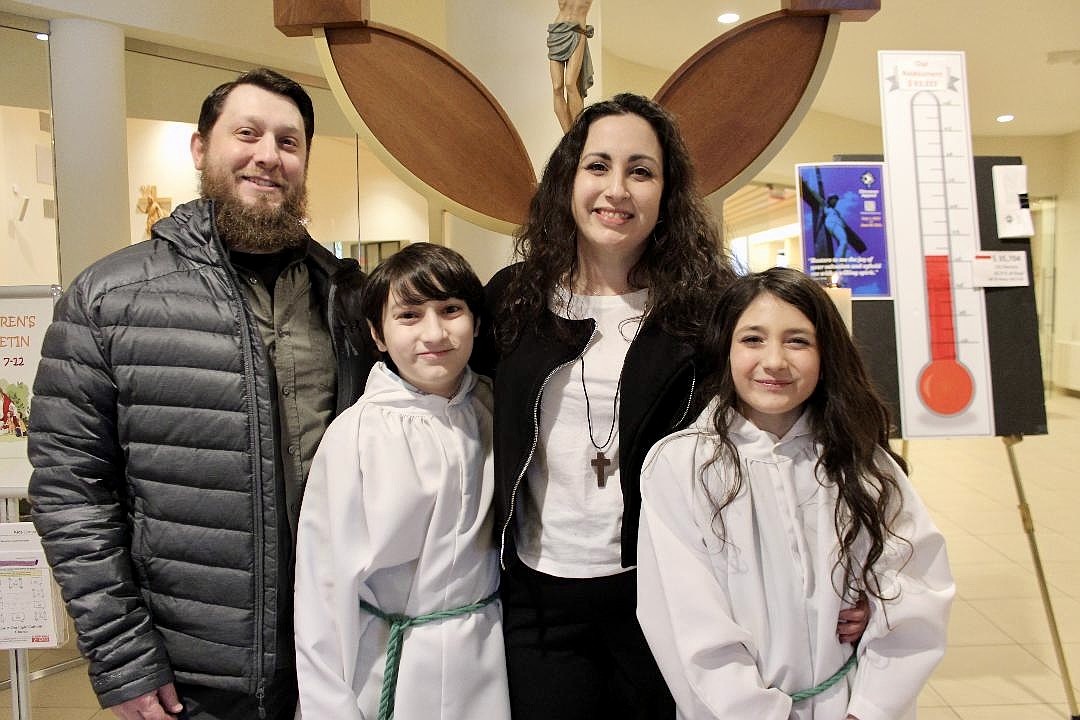
The Kurtz household contains a dad — Brian, who is culturally Jewish, and a software developer, a mom — Kari, who is a cradle Catholic, and a Pastoral Associate for Faith Formation at Christ Our Light and the Church of St. Clare’s and two middle schoolers — Jackson, 13, in eighth grade, and Victoria, 11, in sixth grade, both being raised Catholic. We are transplants to Albany, residing with our three cats. Brian and Kari have been married for over 21 years.
So how do we try to have a family that respects both the cultural importance of dad’s family and still be Catholic? As a couple we discussed everything openly right from the start. Even before Brian proposed he knew marrying Kari came with — a Catholic wedding, Catholic children and a Sunday obligation. We had frank discussions about how we wanted our life to look. Kari knew that being Catholic for her and for future children was non-negotiable.
We find keeping an open mind and an open dialogue is the key to making sure everyone’s heritage and beliefs are respected. Kari and Brian’s grandmother, Sylvia, spent many hours together in her kosher kitchen — learning recipes, sharing ideas and learning what we had in common. When Kari was discerning working for a Catholic Church, Brian was the one to say, let’s go for it. We do everything as a family. Brian isn’t Catholic, but he attends more Masses than most people because that is where his family is.
Yet what do we do with all these holidays? We try our best to honor them and contextualize them. As a family we read a psalm, discuss the meaning behind the Jewish holiday and tie it into our Catholic faith. Maybe it is with a video, a song, but always with a discussion of Jesus’ heritage and what he would have done when he was alive. How do we make those leaps and find those resources? Google. The videos, songs, etc. are everywhere! Google “Psalms for Passover” and in minutes you can open your Catholic Bible and pray a passage perfectly suited to the occasion. No theology degrees required.
Probably one of our best decisions is that often we also throw away the calendar. Some years, we declare our Rosh Hashanah or Passover on a different day (trying to keep it as close as we can to the intended date). If it allows us to be together to discuss the true meaning of it, moving it a few days is the better option. We’ve tried having a Passover Seder immediately following it with an Easter Dinner and it was CHAOS! Neither holiday had the room to breathe and be experienced. Not to mention all of the leftovers! After that, we knew when our holidays were that close, we needed to choose when we celebrated them. Making the food, enjoying the company and being truly aware of what we are celebrating is the bigger piece of the puzzle than trying to get too many good things into one weekend.
- In primetime address, Trump cites nuclear threat as polls show most Americans disapprove of Iran war
- USCCB president asks Catholics to ‘pray ardently’ for an end to war with Iran
- Catholic leaders warn against antisemitism in Holy Week liturgies
- Pope Leo XIV to wash the feet of 12 priests on Holy Thursday, highlighting support for clergy
- Supreme Court hears case on birthright citizenship executive order with Trump in attendance
- Thomas More Society is awarded $4.5 million in attorney fees in California gender secrecy case
- Some thoughts on washing feet
- From the Chesapeake to the Carolina frontier: Catholic origins in the Upper South
- All Catholics share in Church’s mission, not just clergy, pope says
- Full text: Pope Leo XIV’s general audience given April 01, 2026
Comments:
You must login to comment.