


August 5, 2026 at 10:58 a.m.
‘CARE — NOT SUICIDE’
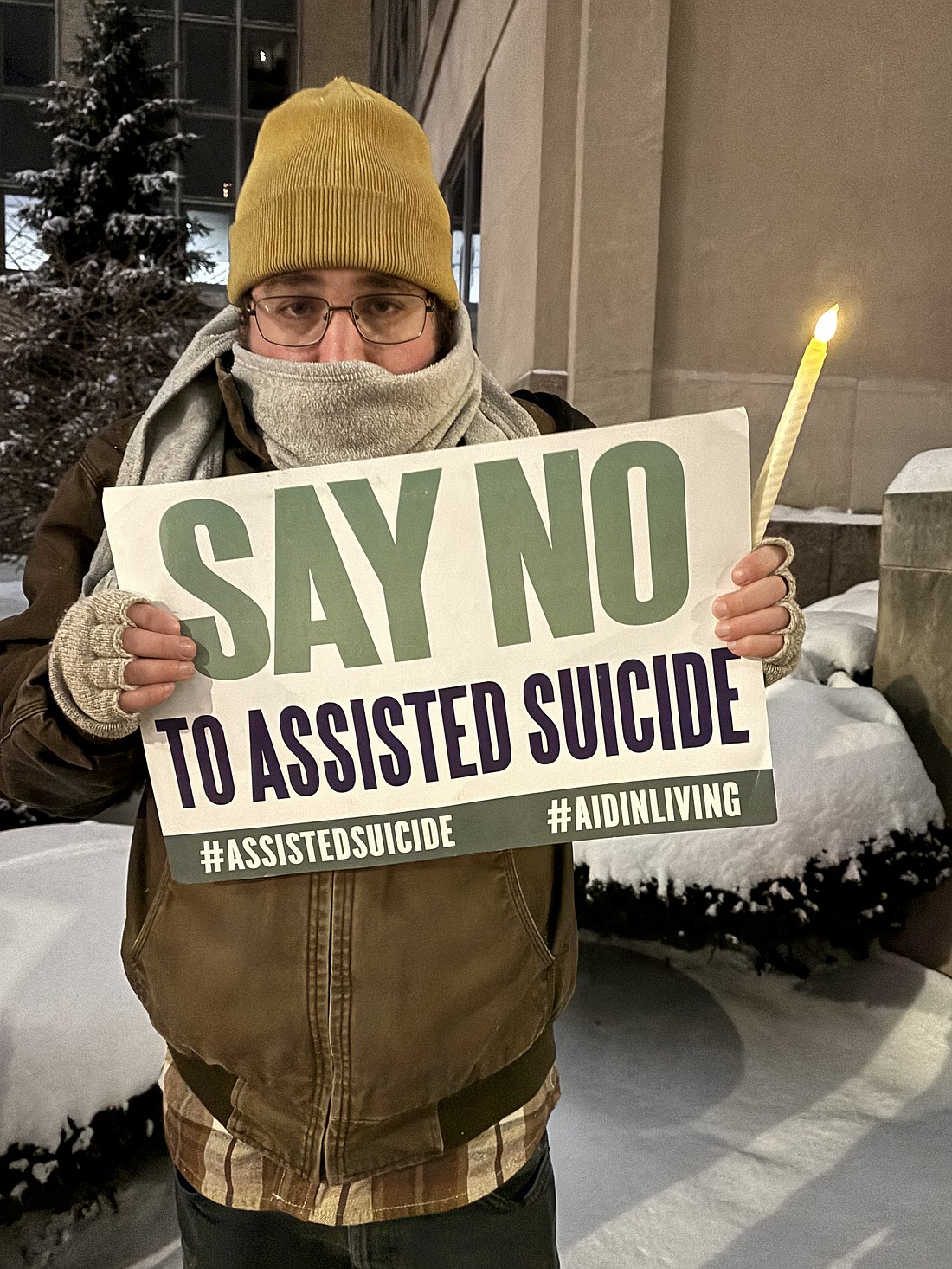
The bright orange and white signs told the story of the protesters holding them outside the United Nations: “We deserve care — not suicide.”
“Suicide is not medical treatment.”
“Fund services — not suicide.”
“Assisted suicide is dangerous and discriminatory.:
Some stood, while others sat in wheelchairs during that June 11 protest. They represented End Assisted Suicide, a coalition of patient advocacy groups that maintain assisted suicide is inherently discriminatory against the rights of people with disabilities.
Diocese releases guidance for PAS
Staff Reports
With the Medical Aid in Dying Act scheduled to go into effect in New York State on Aug. 5 legalizing physician-assisted suicide, the Diocese of Albany has released the document “Physician-Assisted Suicide: Pastoral and Liturgical Guidelines and Directives” with the goal of answering the “many difficult and complex pastoral situations” that pastors and ministers may face due to this legislation.
While rejecting the “culture of death,” the 24-page document states that “as Christians, a most compelling factor is our belief in life and, in God, the author and source of life. We believe that life is a gift.” Some of the questions that pastors and ministers might encounter include: “How can we continue to be defenders and promoters of a culture of life? How can we best help the many wonderful people and groups who work with the elderly, the dying, or those who find life hard and burdensome? The legalizing of physician-assisted suicide raises, of course, specific moral, pastoral and liturgical questions: How do we minister to those who have chosen, or are contemplating assisted suicide? How do we minister to their family or friends? How do we counsel and assist many Catholic (and other) members of the medical profession, who now find themselves in an invidious position due to this Act? What should we do once someone has taken their own life by physician-assisted suicide?”
The four main situations pastors and ministers are likely to encounter are:
“1. A person who is considering physician-assisted suicide (PAS), but who has not yet determined whether or not to request this course of action.
“2. A person who has firmly determined to request PAS, but has not yet done so.
“3. A person who has formally requested PAS and now awaits, or has already obtained, the prescription to end his or her own life.
“4. A person who has come to a firm and final decision to administer the prescription.”
The document then offers guidelines on three key sacraments — Reconciliation, Anointing of the Sick and Viaticum (also called “last rites”) — and how pastors or ministers should confer them to someone who is considering, requested or made the final decision to use PAS. There is also a section on guidelines for the Order of Christian Funerals, as well as appendices on “Samaritanus bonus,” the 2020 letter issued by the Vatican’s Congregation for the Doctrine of the Faith regarding the care of persons in critical and terminal phases of life, and prayers, which include general intercessions, prayers for people contemplating ending their life through physician-assisted suicide, prayers for the intercession of the Blessed Virgin Mary and other saints, prayers for people who have died through physician-assisted suicide, and prayers for the funeral Mass.
To read the complete document, go to rcda.org/endoflife.
* * *
The Catholic Bishops of New York State have also released a revised and updated edition of their teaching booklet “Now and at the Hour of Our Death: A Catholic Guide to End-of-Life Decision-Making.”
The first half of the eight-page booklet, published by the New York State Catholic Conference, summarizes Church teaching on various end-of-life issues, including assisted suicide and euthanasia, ordinary vs. extraordinary treatment, and what is required regarding artificial nutrition and hydration. The second half outlines legal options for advance planning available in New York State. It is intended as a guide to help Catholics navigate difficult issues and decisions that face every family eventually.
In the revised booklet, the bishops continue to recommend the health care proxy as “the most morally appropriate advance care planning tool in New York State.” A New York State Department of Health health care proxy template can be downloaded at www.nyscatholic.org/healthcare-proxy-form. The NYS Catholic Conference booklet suggests sample language Catholics may wish to use in their proxy forms.
“Now and at the Hour of Our Death” is available for free as a digital download at www.nyscatholic.org/now-and-at-the-hour-of-our-death. Individual hardcopy booklets are available free of charge. Bulk purchases are 50 cents per copy for up to 50 copies, and 34 cents per copy for amounts above 50 copies. Email [email protected] or call (518) 434-6195.
All had the same concern: that New York state’s Medical Aid in Dying Act — scheduled to go into effect Aug. 5 — will, as their June 11 lawsuit in the U.S. District Court for the Eastern District of New York reads, “allow providers to prescribe drugs — not to alleviate pain or suffering — but to cause the death of the patient and intentionally facilitate suicide.”
The MAID legislation itself, which makes New York the 13th U.S. state along with the District of Columbia to authorize physician-assisted suicide, was signed into law by Gov. Kathy Hochul on Feb. 6.
Hochul, a Catholic and graduate of The Catholic University of America’s law school, said in an official statement her personal family experience impacted her decision.
“Witnessing my mother’s suffering from ALS was an excruciating experience, knowing there was nothing I could do to alleviate the pain of someone I loved,” she said.
“Our state will always stand firm in safeguarding New Yorkers’ freedoms and right to bodily autonomy, which includes the right for the terminally ill to peacefully and comfortably end their lives with dignity and compassion,” Hochul said.
The governor did not, however, sign the legislation without some amendments.
“Gov. Hochul addressed several of our concerns by requiring them to amend it in exchange for her signature,” Dennis Poust, executive director of the New York State Catholic Conference, told OSV News.
The amendments mandate a 5-day waiting period, a mental health evaluation and an initial physician evaluation done in person. The MAID request must be recorded as video or audio, and anyone who may benefit financially from the patient’s death is barred from acting as a witness or interpreter for the request. MAID requests are also limited to New York residents.
“One of those things is also increased religious liberty protection for our facilities,” Poust said. “There was always protection for inpatient healthcare facilities — but it was broadened to include affiliated agencies, such as home care institutions affiliated with Catholic hospitals, hospice programs, and things of that nature. So we have pretty good religious liberty protection now — but it will certainly be tested, and we’ll have to be very on guard to ensure that holds up.”
Poust, whose conference offers “Now and at the Hour of Our Death,” a downloadable Catholic guide to end-of-life decision-making, noted Hochul’s concerns were shared by other politicians.
One Democratic member of the state assembly who voted against the bill, he said, “told me her mother, who lives in Canada, was offered assisted suicide in the hospital for a non-terminal illness. ... They said, ‘Well, we could offer you MAID.’ That opened her eyes, as an assembly member, to say, ‘Whoa, wait a minute here.’ So she was a no vote.”
As to what passage of the legislation portends, “I think rather than look at the experience of other states for what we could expect, we all need to start looking at Canada — our immediate neighbor to the north,” suggested Poust.
“Canada did this nationally — as opposed to the U.S. which is going state by state, because that’s how our system works,” he said. “But now that we’re starting to get to a critical mass of states that have passed this — including the biggest ones, California; New York; Illinois — we’re going to start seeing advocates push for expansions, like they did in Canada.”
Poust said he expected legislation to expand MAID to those with chronic illnesses or even mental illness. He pointed to Canada’s expanding MAID law, which will permit people with mental illness to request MAID unless parliament acts before March 17, 2027.
“That’s my biggest concern,” he said.
The Catechism of the Catholic Church is explicit in its opposition to euthanasia or assisted suicide as MAID. Regarding suicide, the Church teaches that human beings are “stewards, not owners, of the life God has entrusted to us. It is not ours to dispose of,” and for that reason suicide, or voluntary cooperation in it, is contrary to the love of God and the moral law. The Church also states, “Whatever its motives and means, direct euthanasia consists in putting an end to the lives of handicapped, sick, or dying persons. It is morally unacceptable.”
Matt Vallière, executive director of Patients Rights Action Fund and the Institute for Patients’ Rights, said the impact of New York’s law has yet to be felt.
“We're going to have to watch and wait. Who knows who will be hurt by this,” he told OSV News. “But as with other states, as they implement the law, you will see vulnerable people being harmed by this: whether it’s through the discrimination of being offered assistance (in) suicide ... or not receiving equal suicide prevention care and services, based on people’s disability status.”
End Assisted Suicide has filed lawsuits in California, Colorado, Delaware, Illinois, and New York, with the aim of those cases eventually being heard by the U.S. Supreme Court.
“These laws never get more careful,” Vallière said. “They never get tighter; they always expand. The ways they expand are by making it faster and easier to get, and they include additional subsets of people with disabilities.”
Advocate Ebony Payne — in a statement provided to OSV News about why she joined the lawsuit against Illinois as an individual plaintiff — said, “The risks faced by people living with disabilities are tough enough. We don’t need to add one more in the form of assisted suicide — all in the claimed name of compassion.”
Vallière noted a paradox at work.
“In a medical setting — if somebody were to express a desire to kill themselves — in every other instance, they are going to get the full benefit of the state’s suicide prevention programs,” he explained. “Unless and except if that person happens to have a life-threatening disability. Those people may or may not get suicide prevention — but they can and they will get suicide help.”
In California, where MAID became legal in 2015, Molly Sheahan, associate director for healthy families at the California Catholic Conference, told OSV News, “On the whole, what you’re seeing in California is that there’s been a lack of oversight.”
“There has been an expansion of assisted suicide, and we’re seeing an increase in the number of deaths by assisted suicide each year,” she added. “We’re over 1,000 in 2024, which is the most recent year we have data for.”
In 2025, Gov. Gavin Newsom, also a Catholic, signed an amendment to California's End of Life Option Act, making the MAID law permanent by removing its sunset clause.
“From the Church’s perspective, it’s never acceptable to help someone end their life,” Sheahan said, “and we should be offering the best pain management possible — palliative care; supportive hospice care; spiritual care; whatever the person needs — and a recognition that whatever suffering a person is going through, they deserve to be accompanied through that in hope of the resurrection.”
The Whole Person Care Initiative (wholeperson.care), a collaborative project of California’s Catholic bishops and Catholic health systems, seeks to ensure parishioners and patients are supported during their serious illnesses and end-of-life journey.
Sheahan, too, stressed the danger to threatened populations.
“Just from a public policy perspective,” she said, “regardless of one’s position on assisted suicide, it should be deeply concerning that assisted suicide continues to expand, and puts at risk those who are most vulnerable.”
NOTE: More information on the Whole Person Care Initiative can be found here: https://wholeperson.care.


- Spanish Church seeks new directions from a 16th-century mystic
- Pope Leo appoints Knights of Columbus Supreme Knight Patrick Kelly to Vatican dicastery
- Cardinal Cupich reinstates Chicago priest and social activist cleared of abuse allegations
- More than 270 faith leaders urge Trump administration to extend TPS for El Salvador
- Historic Illinois church thrives despite devastating floods and a town that’s disappeared
- Baptisms in Ireland see dramatic drop of 30% in a decade
- ‘Blue Miles,’ Cistercian monk’s debut novel, offers glimpse into abbey life
- Vatican’s top diplomat begins visit to Russia as European leaders flock to Kyiv
- Catholic schools’ new year sees safety, security and budget impacts after school shooting
- Catholic priest’s new study Bible brings faith and science together for a doubting generation
Comments:
You must login to comment.