


April 22, 2026 at 10:07 a.m.
OUR NEIGHBORS' FAITH
For most Shinto shrines, the most intense period of activities is the first three days of January. Throughout Japan, millions of people flock to Shinto shrines to ask the gods for blessings, prosperity and happiness during the new year. There is a small Shinto shrine 10 minutes’ walk from my friary here in Fukuoka, Japan. I visited it earlier today. The sign says it is perhaps 800 years old.
The word “Shinto” is composed of two Chinese characters, usually interpreted as the “way of the gods.” Shinto is the indigenous religion of Japan. It is a polytheistic religion. If you ask how many gods, the typical answer is, “Yao yorozu.” Literally “eight million,” but implying a countless number.
It is an animistic religion. In as much as any object in nature contains a divine spark, it can be referred to as a “kami” (god). A kami can be associated with a certain tree, a rock, a mountain, a river, a lake, a rice field. Shinto believes that it is possible for a person to become a kami after death. My favorite Japanese poet of the 9th century is named Sugawara no Michizane. He was a scholar and government official. Years after he died, he was recognized as a god and given the name “Tenjin.” He is worshipped as the deity in a major Shinto shrine a few miles away from where I live.
Looking at the religion as a Christian from a western country, one is tempted to describe Shinto in terms of things that it does not have but that we are used to in our religions. It does not have a strong centralized system of organization. It does not have a set of sacred texts. It does not have a strong emphasis on a set of moral teachings. It emphasizes blessing, purification and harmony with nature, but also features fortune-telling and the use of lucky amulets.
Besides the nature “kami,” there is a pantheon of mythical Shinto gods. The central deity is Amaterasu no Ōmikami — the Goddess of the Sun. Legend says that she was mother to Emperor Jimmu, the first emperor of Japan. Therefore, all emperors are descended from her and hence divine, including Emperor Hirohito. This teaching was weaponized by Japanese authorities during the lead-up to World War II. “State Shinto” said that Japan was a divine nation protected by Amaterasu, justifying military expansion in her name.
Three years ago, I revisited Izumo Taisha (Izumo Grand Shrine) in Shimane Prefecture. Although the exact date of its founding is shrouded in the mists of antiquity, reliable authorities say that it is at least 1,300 years old — the oldest in Japan. When I first visited there 40 years ago, I was intrigued by its magnificent simplicity. Elegantly “off-center” and charming. An amusing legend says that every year during October, all the gods of Japan leave their assigned posts and assemble in the courtyard of the Taisha for a month of meetings and celebrations.
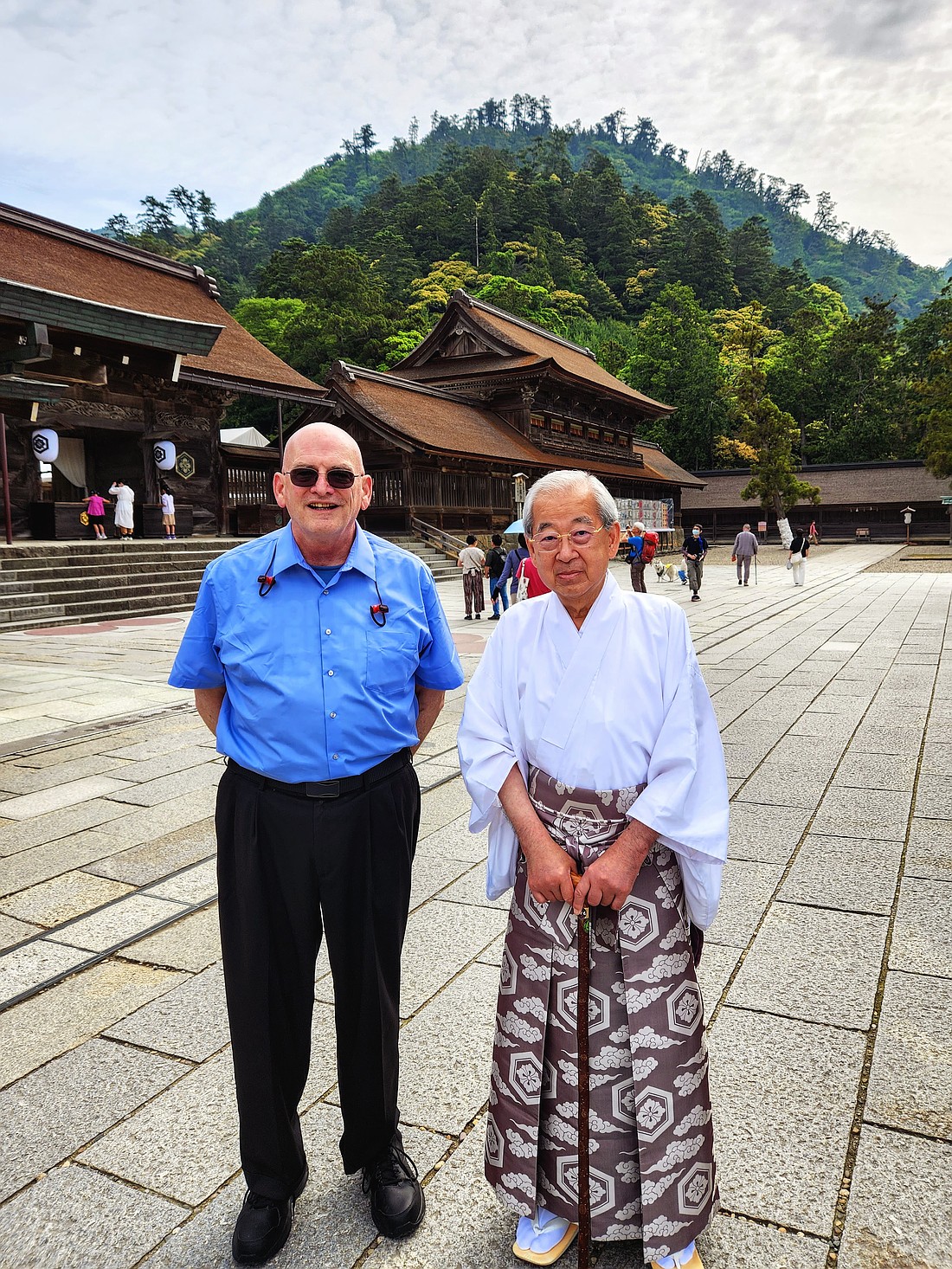
Walking leisurely in the outer courtyard of the shrine, I encountered the chief priest of the shrine (Rev. Senge Takamasa) and his entourage. He greeted me and called one of his assistants to translate for him. I assured him that we could converse in Japanese. I introduced myself as a Catholic priest, dedicated to Jesus, and at the same time having great respect for the good and beauty in other religions. He suggested that we have our photo taken together, and that we pray fervently for peace in the world.
So, here’s the photo (at top of page). Let us all continue to pray for peace.
Father Liam O’Doherty is an Augustinian friar, formerly assigned to St. Augustine Church in Troy and St. Mary of the Assumption in Waterford. He is currently the pastor of St. Augustine Church in Fukuoka, Japan.



- Court allows multifaith challenge of Trump administration policy to permit ICE arrests at churches
- Pope Leo urges Catholic schools to be aware of ‘digital loneliness’ and ‘misguided meritocracy’
- Catholic sister challenges JD Vance over ICE tactics, treatment of immigrants
- Blaming Autumn: Unjust cranks in this excellent season of wonder
- Trump holds Oval Office meeting with some US bishops shortly before midterms
- Savannah bishop shares timeless witness of Georgia Martyrs ahead of beatification
- Pope Leo cancels Assisi visit on doctor’s advice following lung surgery
- Vatican diplomat warns UN of arms race in space, calls for ban on all space weapons
- Alberta rejects separation in referendum, but ‘road to healing will be a long one’
- Archbishop Coakley: Botched execution, proposed livestream reveal ‘inhumanity’ of death penalty
Comments:
You must login to comment.