


April 2, 2026 at 12:33 p.m.
'In this dark hour of history,' do not shy away from your mission, pope says
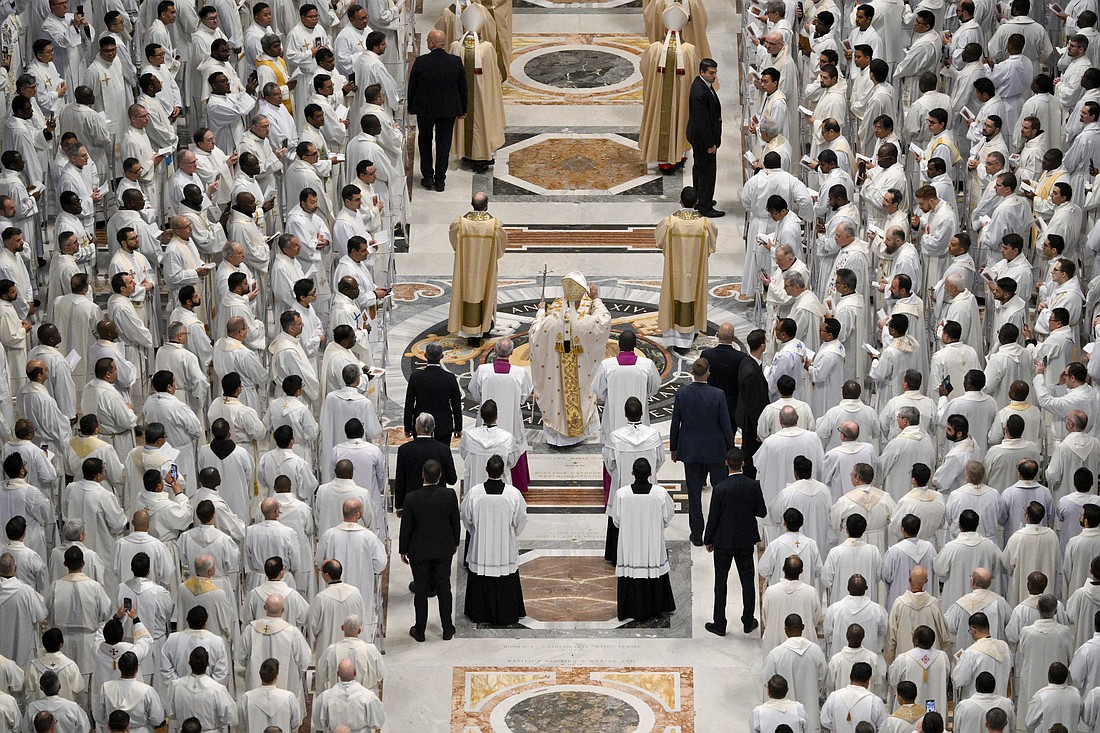
VATICAN CITY (CNS) -- Pope Leo XIV urged Catholics to reject comfort, power and domination and instead embrace a mission rooted in self-giving love, even when it requires risk, vulnerability and suffering.
As Catholics prepare for Easter on Holy Thursday, Pope Leo also called on the faithful in his homily to overcome fear and a sense of powerlessness in responding to the world’s crises.
"In this dark hour of history, it has pleased God to send us to spread the fragrance of Christ where the stench of death reigns," he said April 2 at St. Peter's Basilica during Mass. "Let us renew our 'yes' to this mission that calls for unity and brings peace."
While grounding his remarks in the teaching of his predecessors, saints and clergy, the pope in this homily placed particular emphasis on the Church’s mission through his own eyes as a missionary.
The first step of accepting the Christian mission, he said, is to risk leaving behind what is familiar and certain, in order to venture into something new.
"Every mission begins with that kind of self-emptying in which everything is reborn," he said.
It is through this self-emptying that Christians encounter the love of Christ, the pope said.
At the heart of his first Holy Thursday homily as pope, he reflected on the nature of Christian love, saying it is rooted not in power, but in self-giving.
"Jesus' journey reveals to us that the willingness to lose oneself, to empty oneself, is not an end in itself, but a condition for encounter and intimacy," Pope Leo said. "Love is true only when it is unguarded."
He said true peace is not found in remaining comfortable, but in embracing the risk and detachment that mission requires. Calling it a "fundamental secret of mission," the pope said "everything is restored and multiplied if it is first let go, without fear,” a process repeated “in every new beginning, in every new sending forth."
God calls upon the faithful to take risks, so "no place becomes a prison, no identity a hiding place," he said. Every mission requires reconciliation with the past, with the "gifts and limitations of the upbringing we have received," the pope said.
Once the faithful are able to detach from what is familiar and comfortable, Pope Leo said they must then "encounter" the other through selfless service and the sharing of life. This detachment, he said, creates the conditions for authentic encounter rather than control.
He emphasized that it is a priority that "neither in the pastoral sphere nor in the social and political spheres can good come from abuse of power."
He pointed to the example of missionaries, a role he held as an Augustinian in Peru, whose work must be rooted in service, dialogue and respect.
"The great missionaries bear witnesses to quiet, unobtrusive approaches, whose method is the sharing of life, selfless service, the renunciation of any calculated strategy, dialogue and respect," Pope Leo said.
Rather than seeking to "reconquer" increasingly secular societies, the pope said Catholics must approach as guests, not to impose, but to listen and accompany.
The Church's mission, the pope said, is guided by the Holy Spirit, and the faithful must not try to control it but instead follow its lead, entering each culture with humility and "respecting the mystery that every person and every community carries within them."
In his third point, the pope explained that this mission is not a "heroic adventure" reserved only for a few, but rather the "living witness of a Body with many members," and every mission includes rejection and suffering.
He recalled that the people of Nazareth were filled with rage when they heard Jesus' words and drove him out of the town. Every Christian must "pass through" a trial just as Jesus did, the pope said.
"The cross is part of the mission: the sending becomes more bitter and frightening, but also more freeing and transformative," he said.
Throughout life, Pope Leo said the faithful may be called to experience many "resurrections," as they immerse themselves in service.
Throughout life, Pope Leo said the faithful may be called to experience many "resurrections," as they immerse themselves in service. He pointed to the hope of many witnesses, one of whom "is particularly dear to me."
That witness is St. Óscar Romero of San Salvador, El Salvador, who wrote a month before his assassination that Jesus helped martyrs and if the need arose, "I entrust my last breath to him."
"But, more than the final moment of life, what matters is to give him one’s whole life and to live for him," he wrote.
He continued, saying that "despite my sins, I have placed my trust in him and I shall not be disheartened." St. Romero, remembered as a martyr for defending the poor and speaking out against injustice, was canonized by Pope Francis in 2018.
A successful mission is not about the results, but rather about the disciple's faithfulness and hope in God. Jesus embarked on a journey "in a world torn apart by the powers that ravage it," Pope Leo said.
"Within it arises a new people, not of victims, but of witnesses," he said.
Pope Leo is expected to wash the feet of 12 priests and celebrate Mass Thursday evening, commemorating Jesus' institution of the Eucharist and the priesthood.

- Bishops’ Civil Rights pilgrimage shows need to face past to build new future
- Philadelphia archbishop ‘OK’ after mild medical episode during chrism Mass
- Pope Leo XIV on Holy Thursday: Jesus teaches us how to love at the Last Supper
- Full text: Pope Leo XIV’s Holy Thursday homily given April 2, 2026
- 8 takeaways from Pope St. John Paul II’s final Holy Thursday letter to priests
- ‘In this dark hour of history,’ do not shy away from your mission, says pope at chrism Mass
- Here’s a glimpse of Holy Week around the world
- Bishops’ pro-life chair backs longshot bill to revoke mifepristone’s FDA approval
- Martin Scorsese presents the story of Mary in Easter special of ‘The Saints’
- ‘I commend my spirit’: The gift of self flows from love
Comments:
You must login to comment.