


November 25, 2025 at 10:40 a.m.
IN HIS OWN WORDS
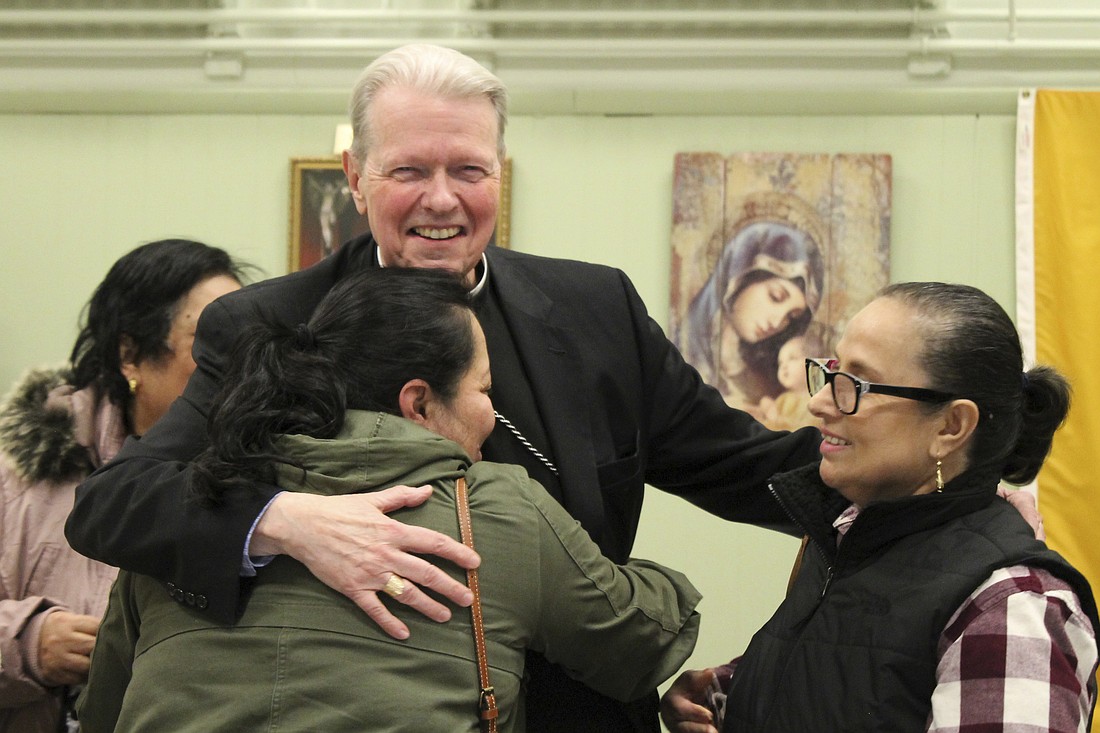
Just about a week after the news broke that Bishop Mark W. O’Connell, auxiliary bishop of the Archdiocese of Boston, would be the 11th Bishop of Albany, Bishop Edward B. Scharfenberger sat back on his couch in his office at the chancery, with a calm and relaxed demeanor.
And after all, who could blame him. Bishop Scharfenberger, 77, has led the Diocese of Albany for the past 11 years through some very tumultuous times and submitted his mandatory retirement more than two years ago, as is required by the Vatican. He knew this day was coming.
“I feel more relaxed the more it has begun to dawn on me, and that is usually a good sign because St. Ignatius always said … ‘There are experiences that we have that we feel good going through them, but then when they are over we feel a little bit of a letdown.’ Like Thanksgiving dinner, where we eat too much,” Bishop Scharfenberger said. “... I feel increasingly a sense of completion of a certain phase, but retirement is not a canonical term. People have been so incredibly kind, but to me it is going to the next step, but I don’t know what that is yet.”
In an interview with The Evangelist, Bishop Scharfenberger, who will serve as apostolic administrator of the Diocese until Bishop O’Connell is installed on Dec. 5, at which point he becomes bishop emeritus, talked about his 11 years of service to the Diocese — as well as what his future holds — and had a message for the faithful.
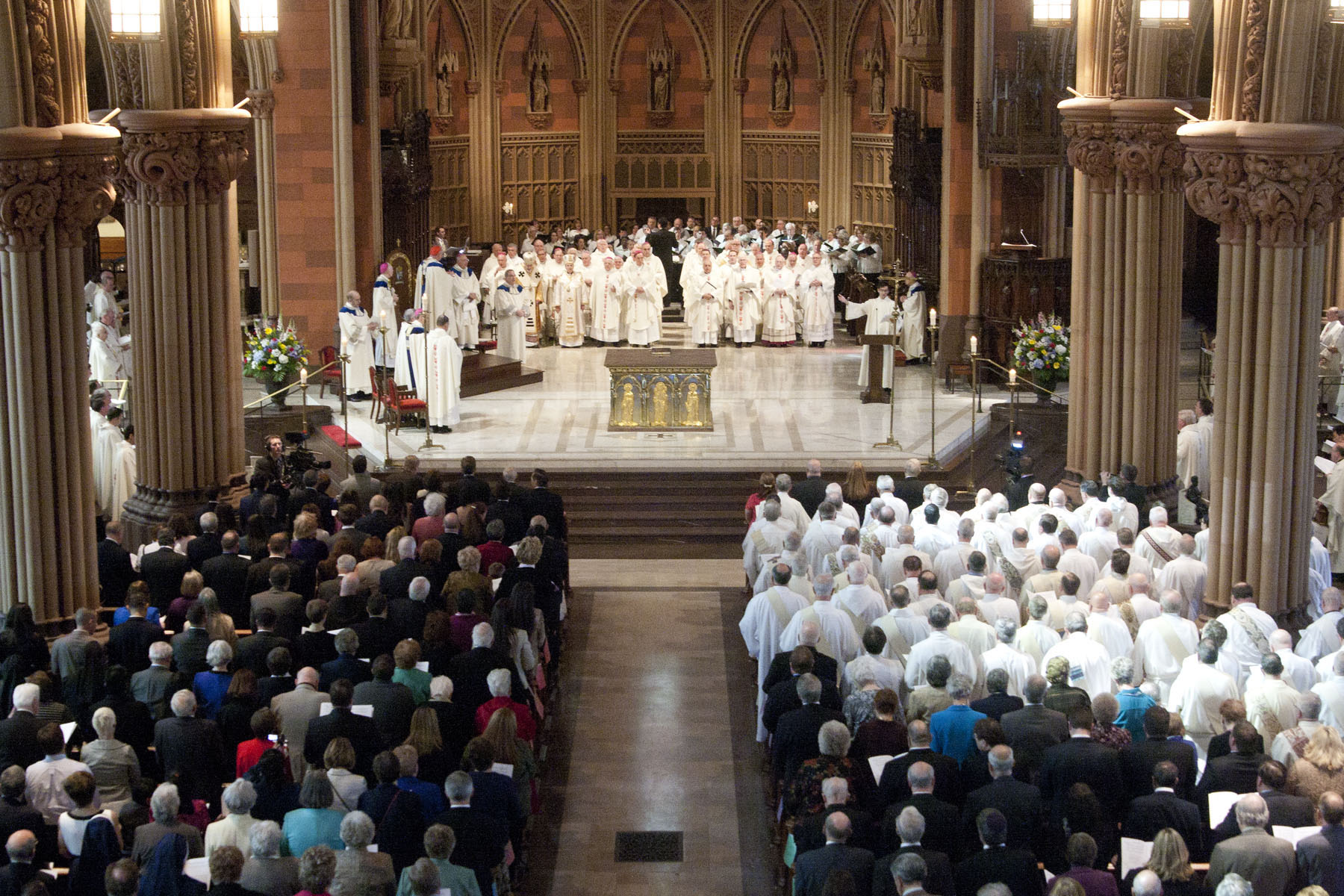
On April 10, 2014, Bishop Edward B. Scharfenberger is installed as the 10th Bishop of Albany at the Cathedral of the Immaculate Conception in as hundreds of bishops, priests and deacons join Catholics from across New York State for the ordination. (Nate Whitechurch photo)
ON BECOMING BISHOP
On Feb. 11, 2014, Pope Francis appointed Bishop Scharfenberger as the 10th Bishop of Albany, succeeding Bishop Howard J. Hubbard, who had been bishop for 37 years. On April 10 of that same year, he was consecrated by Cardinal Timothy Dolan at the Cathedral of the Immaculate Conception in Albany, with Bishop Hubbard and Bishop Nicholas DiMarzio of Brooklyn acting as co-consecrators.
“I have had a mission here for (more than) 10 years … I saw whatever I do, whatever is needed in the Diocese’s on-going pilgrimage (I will do) and now I am very happy to pass the torch to the next guy. … I always see the Church’s mission as just that, of pilgrimage. Like the guy with the Olympic torch, you run with it for a while and you keep running, and then you pass it along to the next person. You keep passing the torch on. That was the way that I looked at.”
The Evangelist: Did you ever feel like you were in a situation where you weren’t going to please everyone?
“Oh sure,” Bishop Ed said. “I’ll tell you something, pleasing people — I like people to do well — but it does not influence (me) at all, it never has because I always felt you have to do the right thing. Maybe that’s Catholic grammar school that was always pumped in me: Do the right thing. The right thing ultimately is not my thing or his thing, but what does God want of me now. My concern was more: Am I really listening to what the Lord wants out of me to help serve others. That is just the way I am hardwired, and that is why I have always believed in teamwork. One of the first questions that people asked me was, ‘What’s your vision for the Diocese?’
“My vision has not really changed all that much. It is basically, tell people the Good News, that they are not alone, that God loves them and we are also given to one another to walk together and discover what God wants from us. We also have a common mission to our natural environment to take care of God’s creation in every way, and we do that by being good stewards.
“In Remade for Mission, it’s the same message again: where are we, who’s here and how are we best going to be instruments to best promote this Gospel, which is healing, which is reconciling and how do we do it together?”
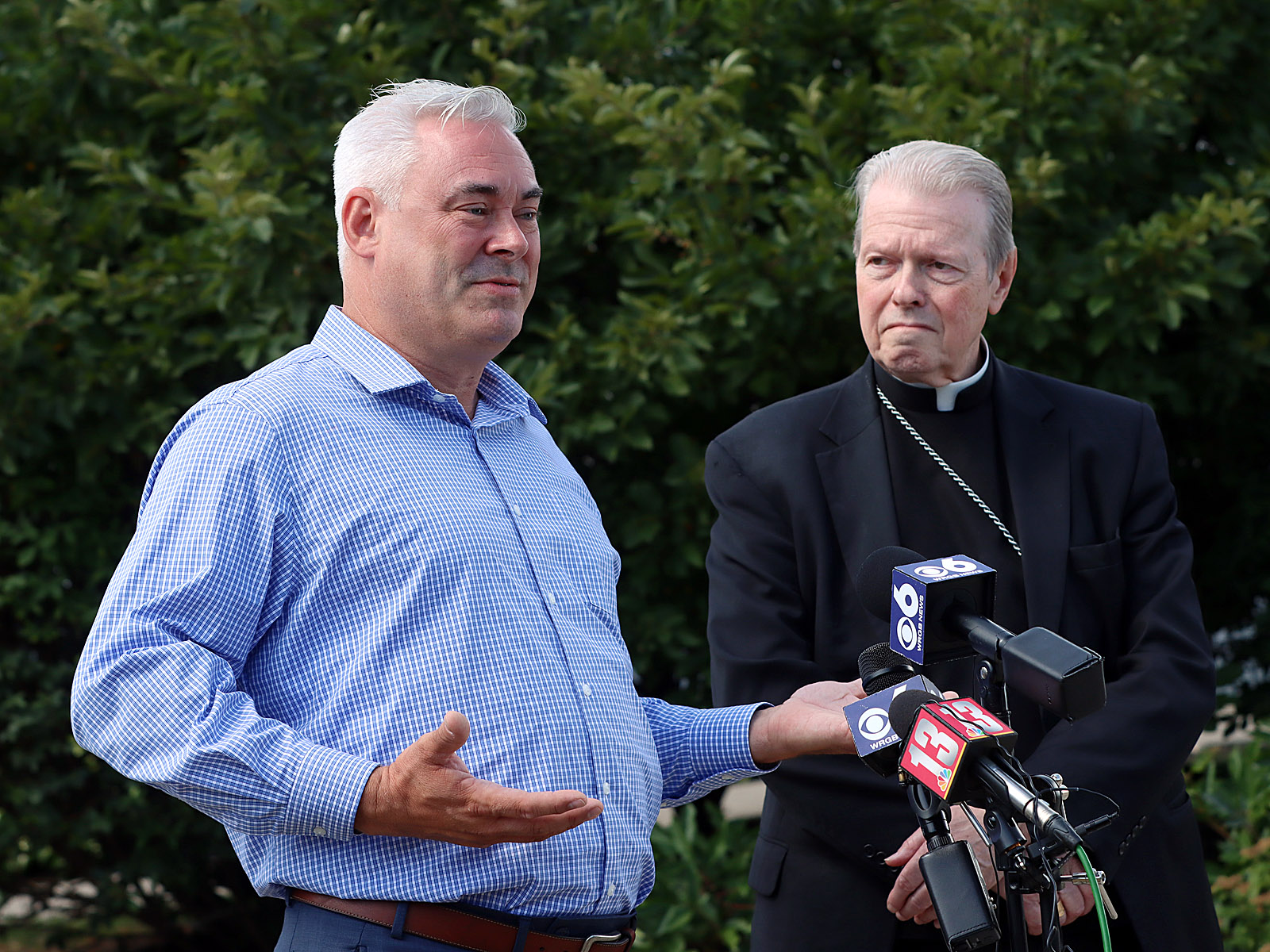
Clergy sex abuse survivor Stephen Mittler and Bishop Scharfenberger have a historic meeting at Corpus Christi Church in Round Lake on July 31, 2022, the same church where Mittler was abused as a child. (Tom Killips photo)
TRANSPARENCY AND THE ABUSE CRISIS
Bishop Ed has been a national leader in responding to the clergy abuse crisis. He was one of the first bishops to publish a list of offenders in the Diocese in 2015, was among the first bishops in the country to call for an independent lay-led investigation of the scandal involving former Cardinal Theodore McCarrick, revamped the diocesan review board, and established a predominantly lay task force on sexual abuse to make recommendations to the Diocese on its response to survivors and its internal policies. In 2022, he met with abuse survivor Stephen Mittler at the church — Corpus Christi in Round Lake — where he was abused as a kid. And he was particularly struck when Bishop O’Connell said at his opening press conference that the Church will never get over the abuse crisis, that it will always be a part of its history.
“I was so happy to hear him say that,” said Bishop Ed. “You never put it behind you. The effects of abuse are ongoing in the life of a person. I agree with that because we live in a world where there is temptation. I was so happy to hear his sensitivity to that.”
The Evangelist: How important has it been for the Diocese — which established a Hope and Healing Committee during your tenure — to walk with survivors and hear their stories?
“I had no idea how that was going to turn out,” he said. “When Stephen Mittler came in and said, ‘He said he was going to walk with us,’ and he took it literally. He wanted me to meet him and walk into the place where he had experienced his abuse. I said sure, let’s do that. For him, that was a big step, that was his day. The reporters started to talk to me. I am here with him, but talk to him, this is his day.
“Every (survivor) has their own story and that’s the way that I always looked at. No matter how many names are on that list, no matter how many survivors come forward, even when the CVA process is over, it is still not over.
“You know what bothers me more than anything else, I worry about those that suffer in silence. I hope in some way, somebody will hear, don’t be afraid, don’t be afraid to come forward. It is safe to come forward, and we begin by acknowledging it. That is where the transparency comes in. We’re not suppressing, we’re not hiding, we’re not canceling. I know the foundation of my confidence is because of the gift of faith, that I believe in Jesus. That he is truly present in all of our relationships and therefore we can be confident that we are not alone. … ‘Do not fear’ should be the theme going forward. Don’t be afraid; you are not alone.”
CHURCH IN THE TIME OF COVID
The first confirmed case of the coronavirus in New York State was March 1, 2020, and on March 16, the Diocese of Albany took the unprecedented step to cancel public Masses until further notice, which turned out to be not until June. With the ever-changing nature of the virus, we became a people of masks and livestreams.
“It is a funny thing, and this is just my thought. People talk about what Biden did, what Trump did, and what they didn’t do. I think everybody did the best that they could given what we knew,” Bishop Ed said. “Now we are beginning to find out that we didn’t know all that we thought we did and we could go back and point fingers — who handled it the best, who handled it the worst. … Hopefully, we learned something from it.”
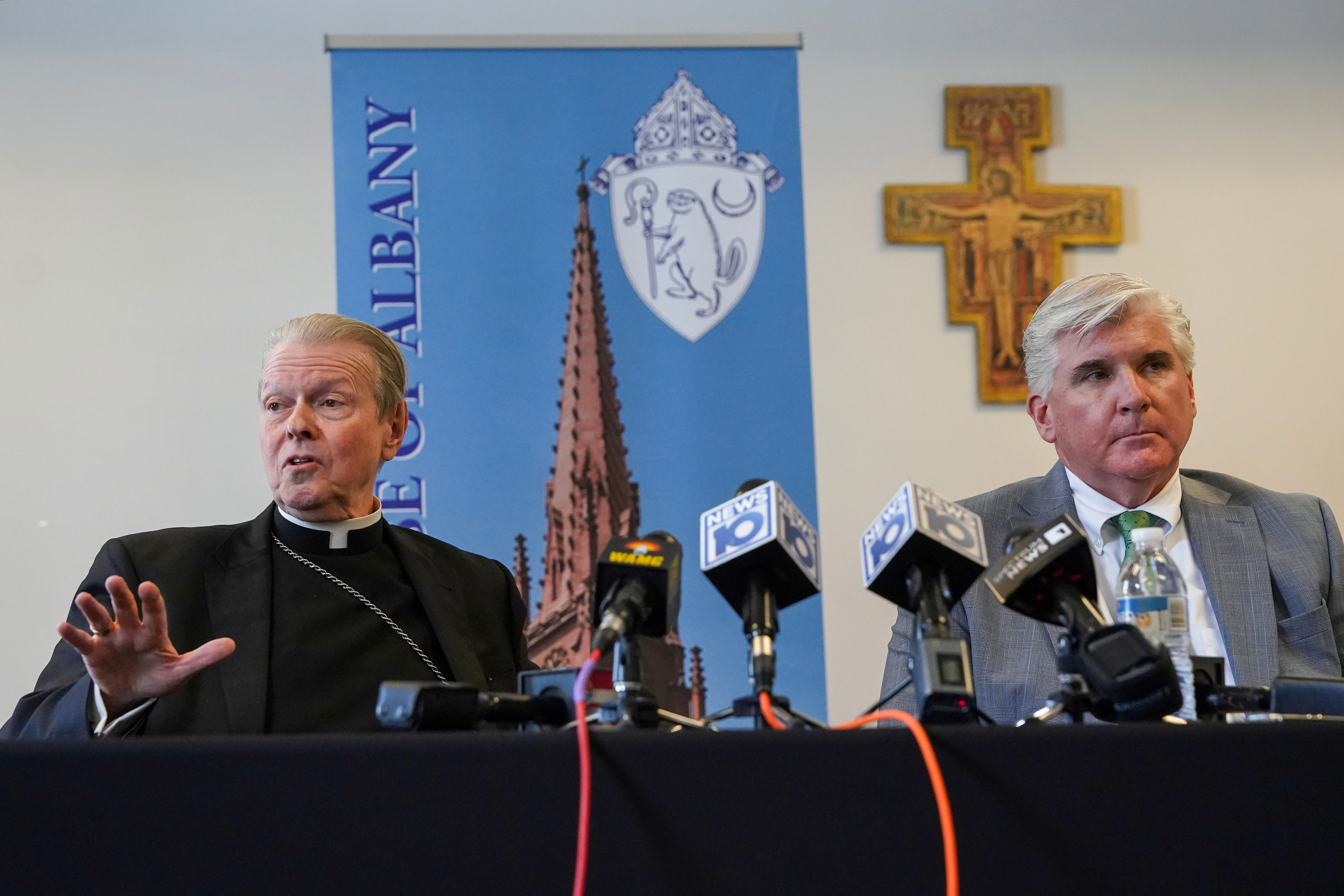
Bishop Scharfenberger and Diocese bankruptcy attorney Frank Brennan are shown talking with the media after the Diocese of Albany files for Chapter 11 protection on March 15, 2023. (Cindy Schultz photo for The Evangelist)
BANKRUPTCY
After the Child Victims Act (CVA) went into effect in August 2019, Bishop Ed did everything he could to keep the Diocese out of Chapter 11 reorganization. But with the crush of more than 400 lawsuits filed, the Diocese declared bankruptcy on March 15, 2023.
“I tried to avoid it. We settled 50 cases … but we got to the point where it was no longer responsible to do that. We did the best we could to settle, and it was unfortunate with some of the plaintiff attorneys who refused to settle and we just had no choice,” he said.
The Evangelist: One of the biggest frustrations is how bankruptcy is structured in that it seems that most of the money — the Archdiocese of New Orleans paid $50 million in lawyer fees during their proceedings — goes to the lawyers first. That was one of the reasons that Bishop Ed tried to prevent the Diocese from going into Chapter 11 protection.
“I have been saying that the longer this drags out, there is a burn rate of $400,000 a month,” he said. “That’s money that could go to survivors. The general narrative of the Bishops of New York State is that they opposed the CVA and that is true. (Editor’s note: The Bishops of New York and the New York State Catholic Conference did eventually remove opposition to CVA legislation when it was amended to include public school abuse victims as well as private school abuse victims.).
I can only speak for myself. I never opposed a legal means of dealing with the issue, but I had another plan and, in fact, I worked on it with survivors, that there would have been a better legislative tool than the use of litigation alone. … I think there should have been a provision in some way of marshalling resources for some form of universal settlement. People could tell their story, maybe not everybody wanted to tell it publicly, but come up with a better tool in order to do that.
“I think going forward we need to continue to have something more like that so even when the CVA claims are settled, I would like to see ongoing ways of developing resources, and it is not only financial. We actually have that right now in the Diocese with the Hope and Healing Committee; we call it the mission that goes on. That we realize the desire to be heard, to be affirmed, to not be alone, to be able to grow and to be able to tell your story and experience the healing that comes from that connection.”
REMADE FOR MISSION
On June 12 of this year, the Diocese launched the “Remade for Mission” initiative, which is a blueprint for spiritual renewal and parish revitalization. A process that Bishop Ed started will be continued by Bishop Mark with lots of listening to the faithful.
“(Bishop Mark) wants to be able to hear. So, I think his focus is on the synodal process. He has done that in Boston and he wants that to continue. I think there is a tendency to see this as something that is leading to a decision that is going to be made by a bishop, and everybody is afraid that my parish or my church is going to close,” Bishop Ed said. “The focus is really on listening and encouraging people to listen as locally as possible. And then come to a clearer sense of what our mission really is in this territory that we call a parish and what are the resources to fulfill that mission.
“It really comes down to — my first article on this was ‘Who’s here?’ — understanding who are the people that are in our neighborhood. It is identifying where the brokenness is, where the healing needs to take place, where the Gospel needs to be clearly lived and presented, and that’s going to vary from place to place. It may mean an honest look at the resources and lead to the conclusion that we can’t afford to fix the roof.
“Bishop Mark comes into the Diocese not knowing where we are at here, and as I said to him, we are just starting (this process). He wants the conversation to continue, but he wants to hear, and I told him we are not at a point where we are making any decisions. I don’t see this as a one and done. I see this as a way of going forward and doing things differently.”
“Like I have often said, the most pervasive plague in the world today is loneliness. So many people are isolated. We have these screens and yet we are basically just looking at ourselves and we are wondering why we are frustrated. … that sense of reaching out. Sometimes people (say) ‘You are getting us away from church and you are focusing just on the social Gospel.’ But the social Gospel is still the Gospel; love of God and love of neighbor are the two greatest commandments. It is not just about getting fannies back into the pew, sometimes it is getting fannies out of the pew and getting them into the trenches where they need to meet the lost sheep.”
The Evangelist: Is this a new way of looking at church?
“It is actually an old way. Jesus said, in the great commandment, go into the world, tell the Good News and baptize them. We have mission in our own parish, and while I have done a lot of mission travels to Mexico and India, there is plenty of mission work to do in our own parishes.”
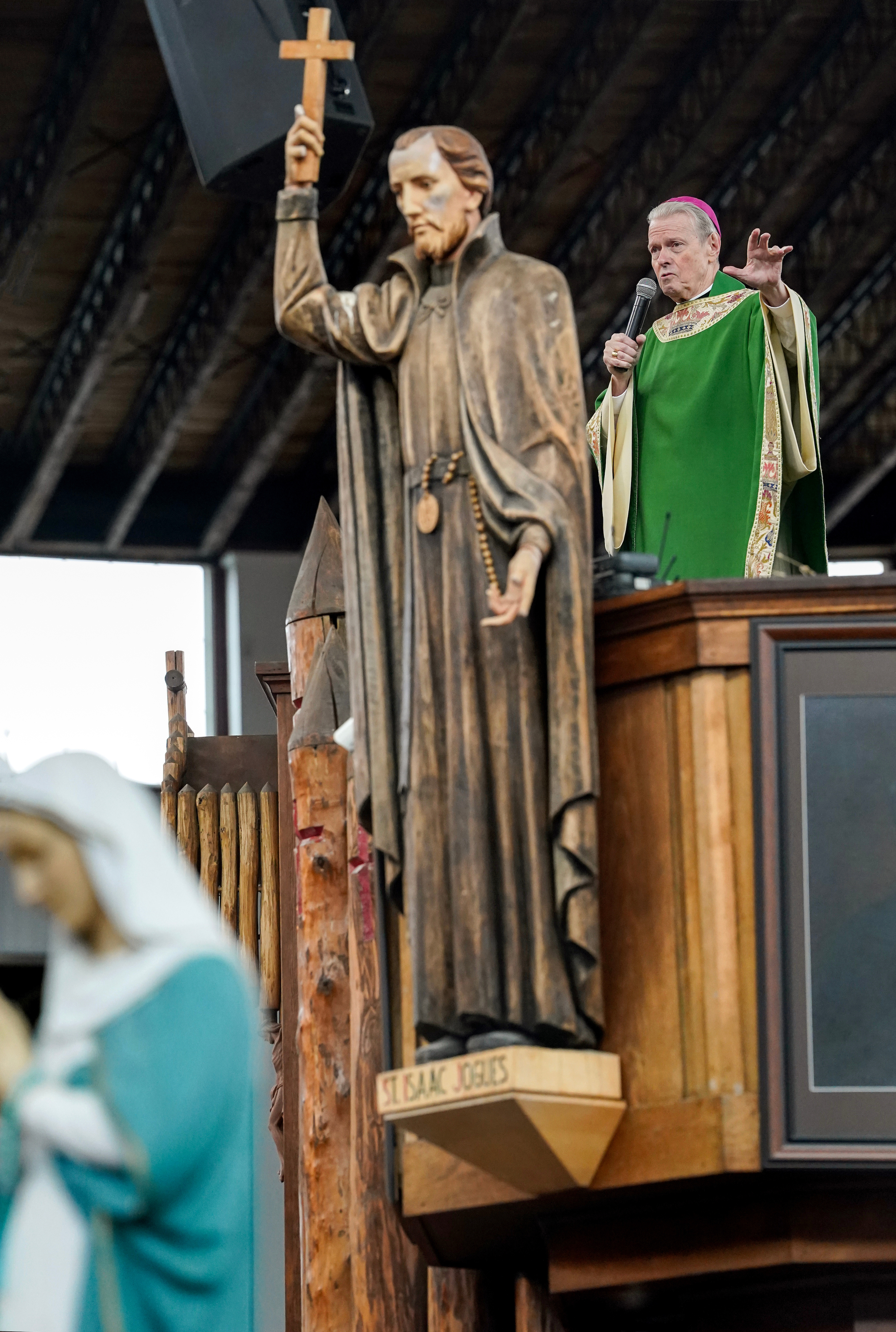
Bishop Edward B. Scharfenberger delivers the homily during the concluding of the New York State Eucharistic Congress on Oct. 22, 2023, at Our Lady of Martyrs Shrine in Auriesville. (Cindy Schultz photo for The Evangelist)
DEALING WITH THE ABUSE CASES, COVID, BANKRUPTCY, WAS THERE EVER A TIME WHERE YOU SAID, ‘I CAN’T HANDLE THIS?’
“I had no idea how I would handle any of this, but I always see things more about building relationship than — what is the term that they use? — transactional thinking vs. reactionary thinking,” Bishop Ed said. “So, the way that I stayed focused was beginning (each day by saying) ‘Lord Jesus, I trust in you.’ Like John XXIII said when he got cold feet two or three days after he called the Vatican Council and he lost two or three nights’ sleep, until he really had a distinct sense that Jesus was telling him, ‘Sleep John, it is my Church.’
“I always had the confidence that I am part of something larger than myself. Have I ever had sleepless nights? Of course, I wake up at 3 in the morning and say ‘Lord Jesus, I trust in you.’ Control is a myth. We think we have control — You fool, you build your towers and this may be the day your life is called (Lk 14:29). I always try to be realistic about that and try to build good teams. We have a wonderful team here; keep developing teams here and keep working together. One person can’t do everything.”
WHAT ARE SOME OF THE THINGS THAT YOU ARE GOING TO DO NOW THAT YOU’RE ‘RETIRED?’
“More of what I have been doing but less encumbered. I am basically a CEO, and a CEO has to make the big decisions ultimately,” he said. “You rely on advice and counsel from those that do the trench work and then it comes to your desk, and I never minded doing that, but what I really like doing is, I love pastoral work. I love being able to spend more time with people.
“I regret that so many times, because we have too many churches and too many Masses, so many times our pastors are running from place to place. Just to be able to spend more time and take a breath and relax with people, and not being confined by a schedule. … I enjoy preaching, I enjoy teaching, I enjoy writing.”
SO, PEOPLE WILL SEE YOU OUT IN THE DIOCESE?
“No question about it. I am not moving. I am not going back to Brooklyn. I do have a condo with my brother in Florida; we share it. I might spend a little more time down there when the bad weather hits, but I am not a golfer, so I can’t imagine myself sitting in a beach chair all day long.”
WHAT SURPRISED YOU MOST ABOUT ALBANY?
“It’s clean. I used to say I don’t trust air that I can’t see. I’m getting used to the air I can’t see,” Bishop Ed said. “I think it has added years to my life. I think it is just such a healthy place to be, although the driving is crazy! But it is a healthier part of the state, between two mountain ranges. I am just amazed every time I get on the road. You only have to go about 15 minutes and you are out in the country, and you see animals and horses. I love it. It is right in the middle of the state, close to Boston, close to Montreal. It is the place to be. I just wish the taxes were lower!”
WHAT IS YOUR MESSAGE TO THE FAITHFUL OF ALBANY BEFORE YOU HAND THE REIGNS TO BISHOP MARK?
“Do not be afraid. God is with us. The best is yet to come. Fear not! Trust in God and listen to one another. Listen before we strike back! I’ve come to realize that my own impatience is often connected with my own judgementalism. Nobody wants to be judged by others, and how are we going to avoid that? The only way we are going to avoid that is by being patient,” he said. “Patient enough to hear somebody out before we say, ‘Oh, I know what your problem is,’ or ‘I know what the solution is.’ We don’t have to fix everything. Sometimes we need to just relax and rejoice. Relax. Listen. Calm down. Take a breath; you’re not alone. Sometimes the presence of God is not in the sound and the fury like Elijah the prophet, but in the gentle breeze. We are so surrounded by noise, and sometimes we have to just get used to listening a little more to the silence and the quiet and the gentle breath. Just lower the decibel, emotionally, spiritually and physically.”

- A visit to St. Patrick’s grave — and two Irishmen on the road to sainthood
- Archbishop, witnesses testify on religious freedom risks in health care today
- As Iditarod kicks off, pilgrims find missionary spirit is the Church in Alaska’s North Star
- UPDATE: Supreme Court to hear arguments in Trump effort to end temporary protections for Haitians
- Pope Leo XIV urges media to show human face of war, not propaganda
- Every Church institution must listen to victims of abuse, Pope Leo XIV says
- Denver’s Regis University names woman as new president in historic first for Jesuit-run school
- Pope’s visit to show that Christianity is asset, not danger, for Algeria, bishop says
- Archbishop Caccia at UN: Surrogacy violates rights, dignity of both women and children
- At 10, ‘Amoris Laetitia’ still shapes landscape for marriage, family ministries
Comments:
You must login to comment.