


November 25, 2025 at 11:32 a.m.
AS TIME GOES BY
2014
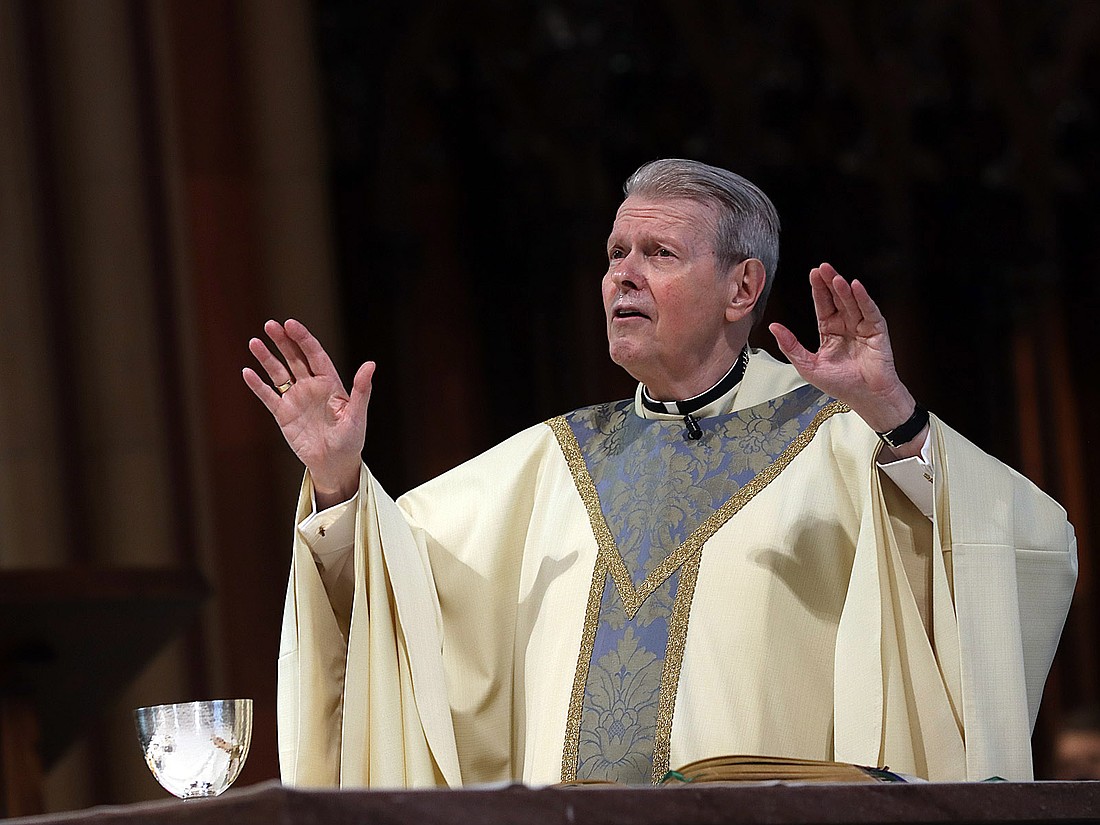
Feb. 11: Pope Francis appoints Bishop Edward B. Scharfenberger as the 10th Bishop of Albany, succeeding Bishop Howard J. Hubbard, who had been bishop for 37 years.
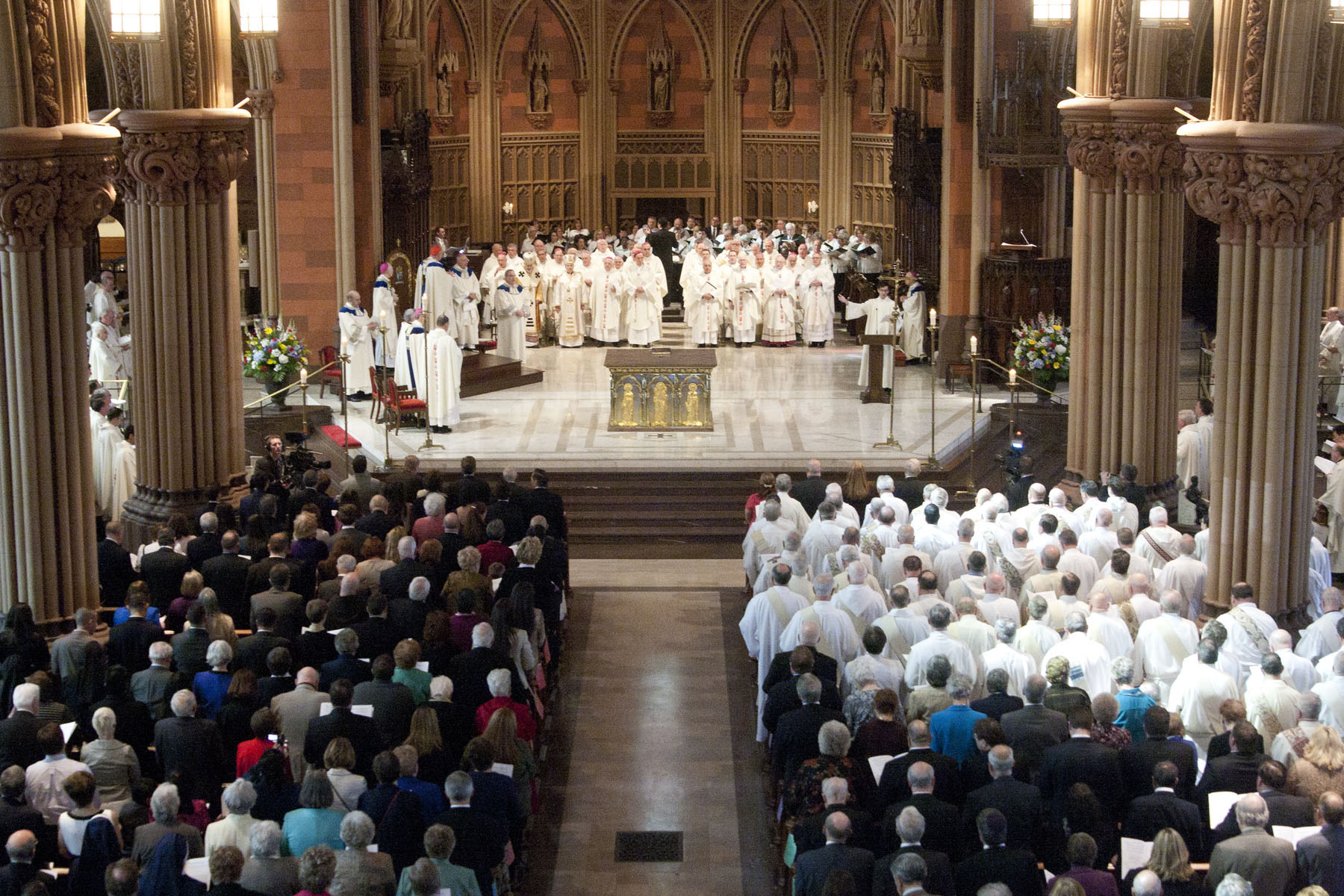
 April 10: Is consecrated by Cardinal Timothy Dolan at the Cathedral of the Immaculate Conception in Albany, with Bishop Hubbard and Bishop Nicholas DiMarzio of Brooklyn acting as co-consecrators.
April 24: Bishop Scharfenberger pens the first of his weekly columns in The Evangelist, which is later titled “Go and Make Disciples.”
June 14: Ordains his first two priests: Father James Davis and Father Brian Slezak.
June 17: Leads a pro-life rosary walk around the Capitol in Albany to promote a culture of life.
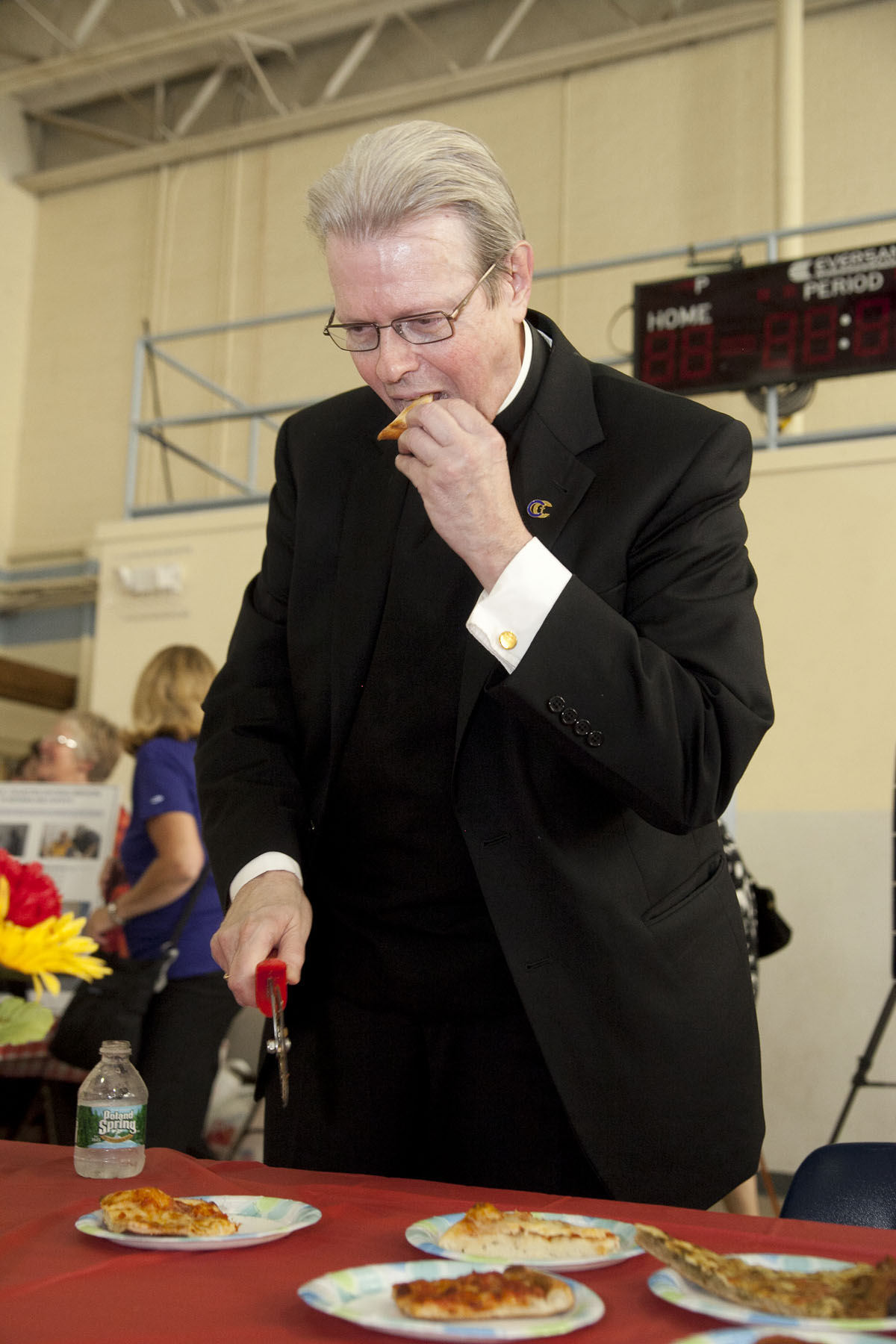
Sept. 2: After Bishop Ed remarks in an interview that he hasn’t found pizza in the Diocese as good as that in his hometown of Brooklyn, Catholic Charities challenges him to taste-test local pizzas as a fundraiser for its programs. He tastes 17 pies with the winner being The Orchard Tavern for its pepperoni pizza.
Sept. 18: While in Rome, Bishop Scharfenberger, along with 138 new bishops from around the world, meets with Pope Francis.
Dec. 25: Celebrates first Christmas as Bishop of Albany.
2015
Jan. 21: Delivers the homily during Night Prayer at the National Prayer Vigil for Life in the Crypt Church of the Basilica of the National Shrine of the Immaculate Conception in Washington, D.C. The all-night vigil Mass is held before the annual March for Life. ... On the same day, Bishop Scharfenberger’s father, Edward, dies at age 94.
March 24: The Albany Diocese announces that Bishop Maginn High School in Albany will be sold and the school relocated to the former Cathedral Academy building on Park Avenue in Albany.
April 23: In reflecting on his first year as bishop, Bishop Ed tells The Evangelist that he put close to 25,000 miles on his car, crossing the Diocese’s 10,000 square miles. He adds: “I love it. I just put on my Lighthouse (Catholic Media) series CDs or my opera, or I pray the Rosary or the Chaplet of Divine Mercy. I’m never bored in the car.”
May 28: In an op-ed piece published in the Times Union, Bishop Scharfenberger says a tax-credit measure to support parental choice in education is being falsely characterized as a “scheme to benefit the rich. … The investment tax credit is available to anyone who makes a donation to public education or to scholarship-making organizations. It is not for millionaires; it is for schoolchildren.”
June 11: In a pastoral letter, Bishop Scharfenberger describes a number of changes at the Pastoral Center, including reallocation of the resources of the former OECFL (Office of Evangelization, Catechesis and Family Life), the contracting of a consultant for the development and supervision of social media, the hiring of a coordinator for parish services to optimize customer service, and plans for a pastoral reorganization of the Diocese into regional vicariates to better nurture and share parish life.
June 20: Ordains Father Rick Lesser, a widower with three adult children and a retired equine veterinarian, at the Cathedral.
June 26: After the U.S. Supreme Court legalizes same-ex marriage, Bishop says “Today’s misguided Supreme Court decision cannot change what marriage is, any more than decreeing the world flat can make it so. Fortunately, the beauty and holiness of what marriage is will continue to shine in the intimate, lifelong partnership of love and sacrificial self-giving between one man and one woman, fundamentally open toward the procreation and education of human persons.”
July: Presents a new Pastoral Center organizational chart to focus more effectively on its mission of parish service, greater vocational awareness and development throughout the Diocese, and to encourage and support parish life and initiatives.
July 31: In his desire to extend and deepen his pastoral presence in all diocesan parishes, Bishop Scharfenberger appoints a regional episcopal vicar to each of the seven newly constituted regions.
Aug. 13: In a column titled, “Women do not need Planned Parenthood,” Bishop says of the organization that “contrary to its self-congratulatory assertions, Planned Parenthood can only be described as the largest health care provider for women in the United States if, and only if, one defines ‘health care’ services exclusively as abortion.”
Sept. 1: After Pope Francis’ announcement that priests worldwide will be able to absolve women for the sin of abortion, Bishop Ed welcomes the pope’s “wonderful gesture. … The priests of the Roman Catholic Diocese of Albany and throughout the United States have had the faculties to lift the sanction of excommunication for the sin of abortion for more than 30 years. Any woman who has had an abortion, any person who has been involved in an abortion in any way, can always seek God’s forgiveness through the Sacrament of Reconciliation, if they are truly sorry for their actions.”
Sept. 25: Attends Pope Francis’ Mass at Madison Square Garden. Fifty youth from the Diocese were randomly selected to attend the Mass as well.
November: Diocese posts the names of all clergy abuse offenders on the diocesan website.
Dec. 13: To kick off the Holy Year of Mercy, the Holy Door of Mercy at the Cathedral is opened by Bishop Scharfenberger..jpg) 2016
2016
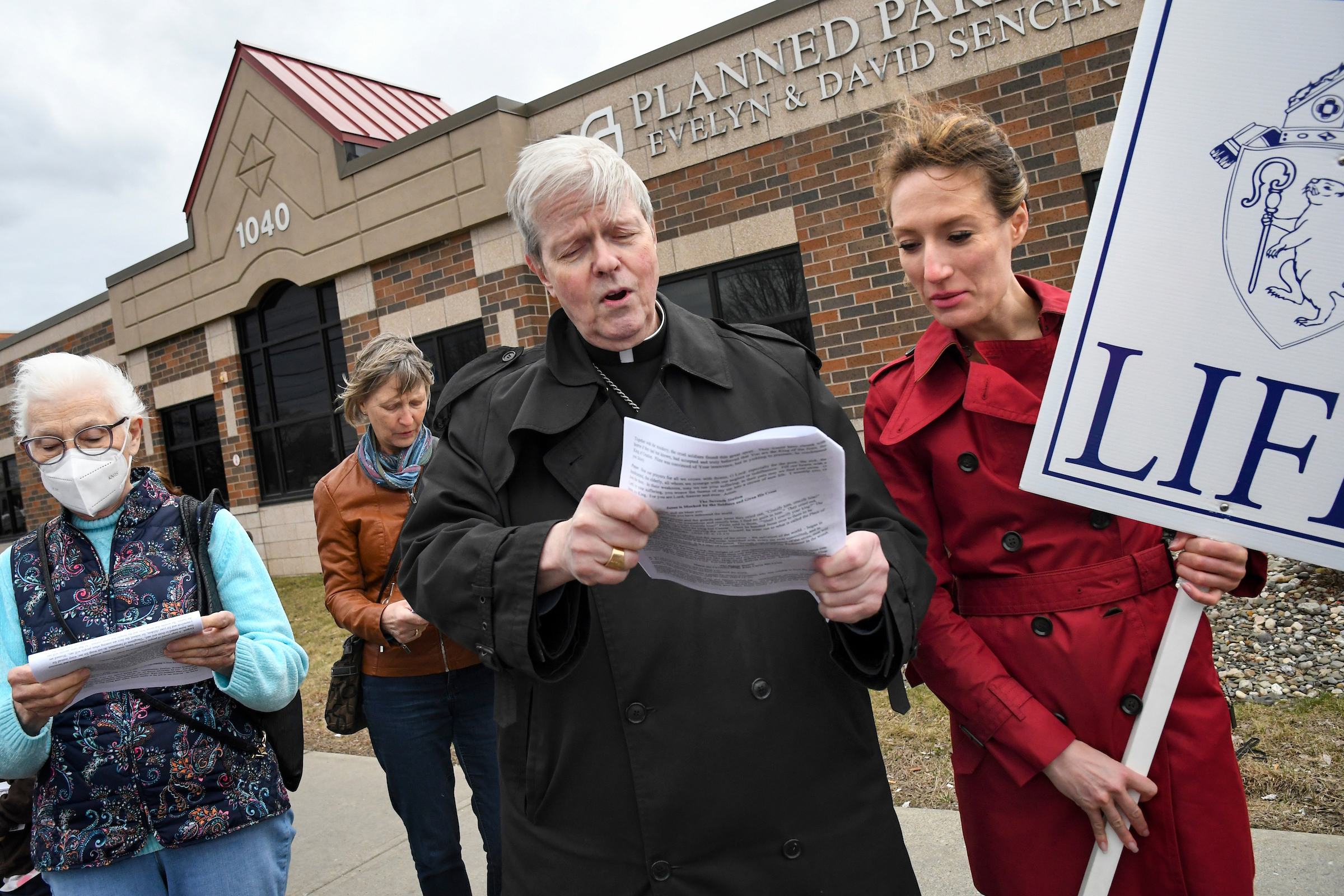
Jan. 27: Bishop presents testimony on behalf of the New York State Catholic Conference to a joint legislative budget hearing before members of the State Senate and Assembly regarding Gov. Andrew Cuomo’s executive budget. In addressing the state’s elementary and secondary education budget, he says, “Unless something meaningful is done to support the education of children in religious and independent schools … more and more children will be denied the opportunity to escape poverty and have a brighter future that the remarkable success of Catholic schools offers.”
April: Bishop addresses the need for reform of solitary confinement in a column in the Times Union. The Humane Alternatives to Long-Term (HALT) Solitary Confinement Act would limit the time anyone can spend in segregation, end solitary confinement of vulnerable people, restrict the criteria that can result in isolation and create more humane and effective alternatives for inmates. (The law was enacted in New York in 2021 and went into effect on March 31, 2022.)
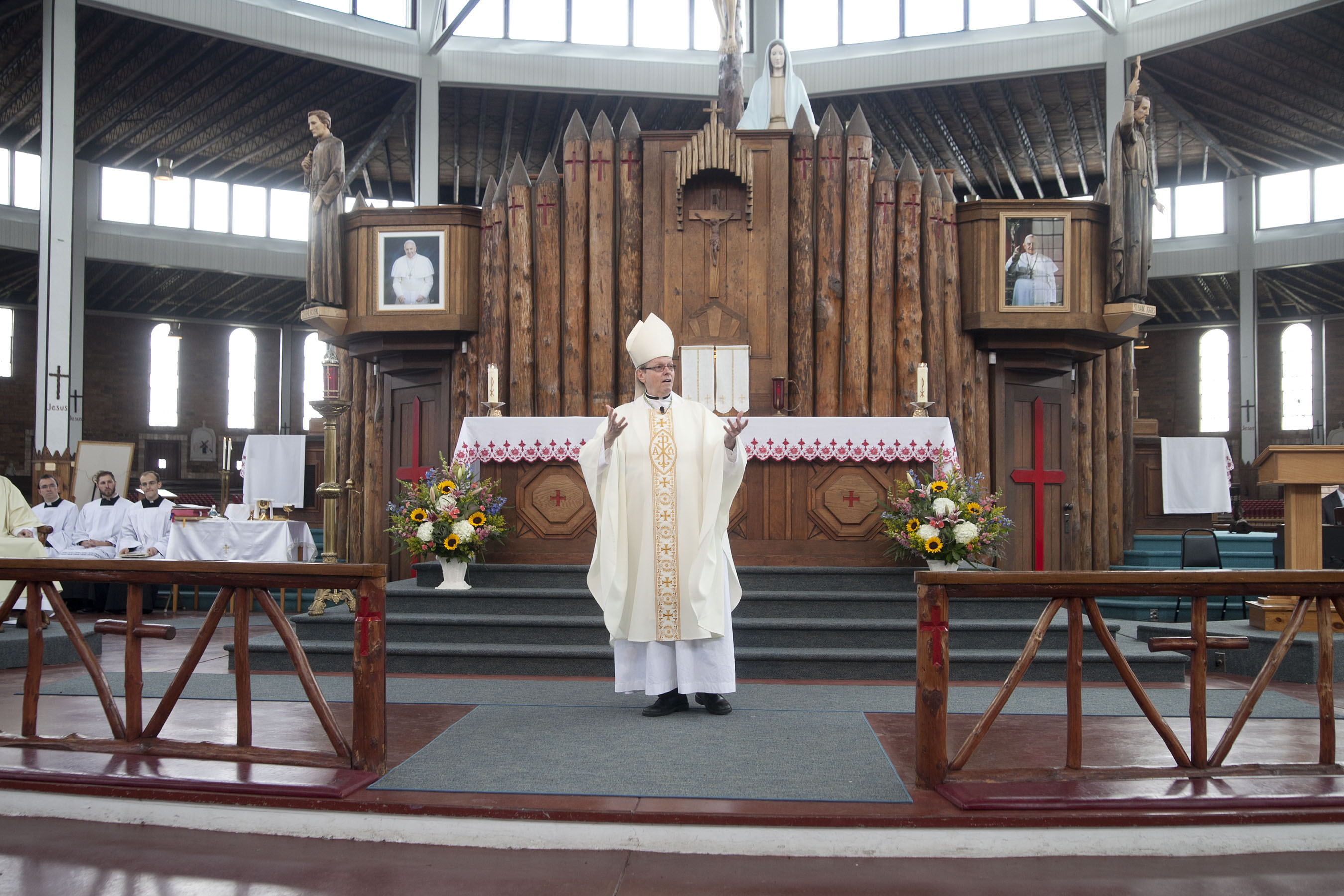
May 4: The Albany and Ogdensburg dioceses, Catholic Charities agencies and other groups file a lawsuit against the New York State Department of Financial Services and several health insurance companies challenging the constitutionality of making religious and other employers cover abortions for their workers. “Anyone of goodwill who values religious liberty or our country’s cherished freedoms should be deeply concerned by the actions of the state,” says Bishop Scharfenberger. In his May 12 Evangelist column, he writes: “What is objectionable in the mandates is not only that they force us to fund and participate in actions that are gravely immoral and contrary to our religious beliefs and conscience, but also that they were promulgated and enforced under color of law, without our knowledge and in clear violation of the law.” (The lawsuit is still winding its way through the court system).
June 1: Bishop Scharfenberger, Catholic Charities’ employees and others, join a march for farmworker justice that began on Long Island in May and ends at the State Capitol in Albany.
June 16: After a mass shooting at a gay nightclub in Orlando, Fla., that kills 49 and wounds 58, Bishop writes in his Evangelist column that the objective of the gunman at the nightclub “seemed clear enough: to put a violent end to defenseless members of a class of human beings simply because they existed and he did not want them to live. We must state unequivocally that our respect for the dignity of all human beings includes those who themselves identify or are associated in the judgment of others as members of the LGBTQ community.”
June 18: Ordains Fathers Patrick Rice, Francis Vivacqua, Steve Matthews and Brian Kelly at the Cathedral.
July 14: After a sniper shoots and kills five police officers and wounds seven more officers and two civilians at a demonstration in Dallas on July 7 to protest the police killing of black men in Baton Rouge, La., and St. Paul, Minn., Bishop writes in his column that “racism is an individual and structural sin that cannot be regarded with indifference toward its reality and the threat it poses to the value of all human lives.”
July 25-31: Attends World Youth Day in Krakow, Poland, saying of the event: “In the end, it was all about Jesus, the one person who formed the bond among the millions who came to Krakow.”
Sept. 18: The last broadcast of “Table of the Lord,” the televised Mass, which debuted in the Albany Diocese on Jan. 8, 1967, takes place. On Sept. 25, the Diocese begins livestreaming a weekly Mass through its website, www.rcda.org.
Oct. 1-2: The Diocese holds its first Summit on the Family at the Shrine of Our Lady of Martyrs in Auriesville. A follow-up to the Summit on Vocations, it focuses on the vocation of family life.
Nov. 12-13: The Albany Diocese marks not just the end of the Year of Mercy, but a diocesan-wide consecration to Divine Mercy and the 164th anniversary of the dedication of the Cathedral.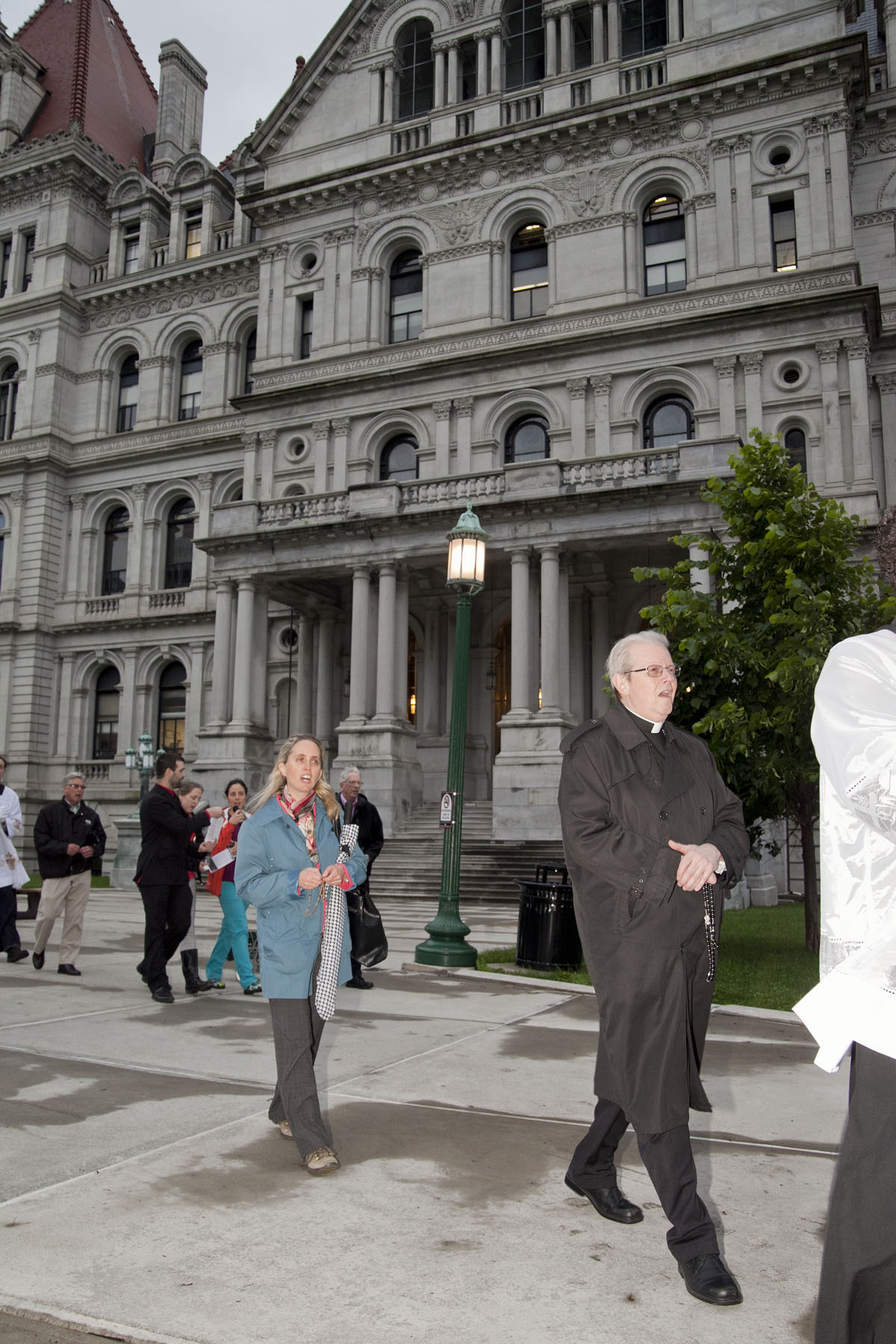
2017
Jan. 27: Bishop Ed takes part in the March for Life in Washington, D.C., saying, “It was a day full of joy and youthful exuberance. For me, it was also an experience of being surrounded by love.”
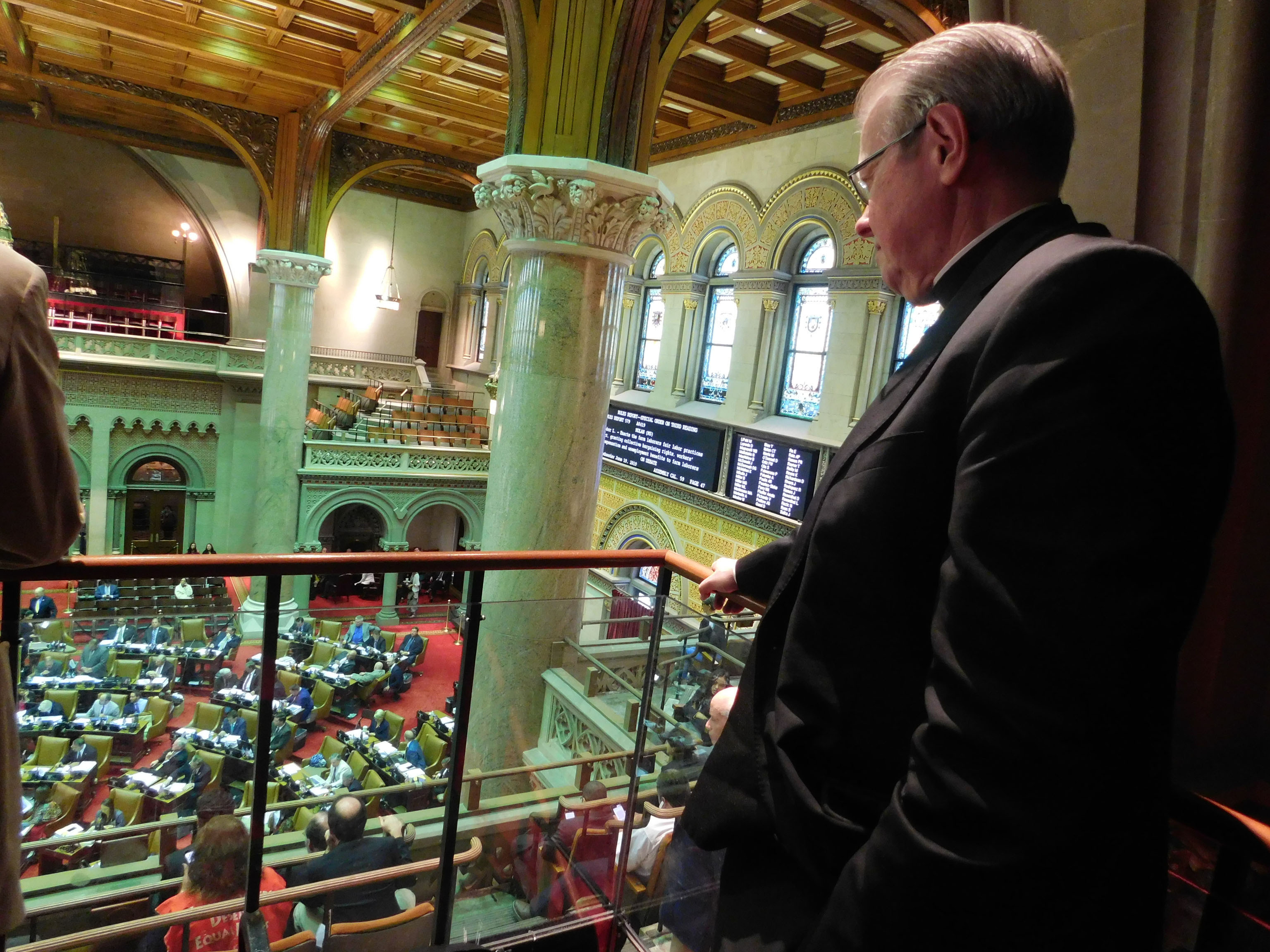
Feb. 6: Delivers remarks in support of the Farmworkers Fair Labor Practices Act at the State Capitol in Albany.
Feb. 13: After rallies to defund Planned Parenthood in Albany on Feb. 11, Bishop Scharfenberger says in a statement: “Without question, Planned Parenthood provides some morally unobjectionable health services to women. However, … Planned Parenthood is the unquestioned number one provider of abortions in our country. This is the primary ‘product’ for which it is known.”
March 2: Issues a statement on immigration, which he begins by saying, “It’s no surprise that immigration issues and concerns are in the news these days, and weighing heavily on people’s minds. As a nation of immigrants, the subject feels intensely personal. As Christians, we are called to begin and end with the human person, respecting the dignity of our brothers and sisters, regardless of whether they were born in this country or not.” … Earlier in the week, he participates in the kickoff of the 40 Days for Life pro-life prayer campaign in front of Schenectady’s Planned Parenthood.
May 23: Diocese continues its challenge of the state’s abortion mandate in the State Supreme Court. “These coercive mandates are an attack on innocent human life, but also an attack on religious liberty and the democratic process itself,” says Bishop Scharfenberger.
June 4: Catholic Charities celebrates 100 years of service in the Diocese of Albany with a liturgy at the Cathedral.
June 17: Ordains Father John Cronin at the Cathedral.
August: At Sacred Heart Parish in Sidney, Bishop Scharfenberger consecrates two new altars at the Delaware County parish.
Oct 12: Diocese launches “Re-Igniting Our Faith” campaign, which “is a $45 million Diocese-wide, parish-based campaign to empower and enable parishes to strengthen and invest in themselves as communities of faith — spiritually, economically and organizationally,” Bishop Ed writes in his weekly column.
Oct. 28-Nov. 8: Bishop Scharfenberger is on a nearly two-week trip to Eastern Europe with a group from Congregation Beth Emeth in Albany. He visits Vienna, Austria; Budapest, Hungary; Krakow, Poland, and Prague in the Czech Republic. During the trip, the group has a day of prayer and reflection at the Auschwitz and Birkenau concentration camps. Bishop also learns more about his Jewish roots on the trip; his maternal grandfather, Max Magdal, was a Russian Jew from the Kiev area whose parents migrated to the Midwest during the pogroms of Alexander III in 1883.
Nov. 16-18: Attends the National Catholic Youth Conference in Indianapolis with youth from the Diocese of Albany.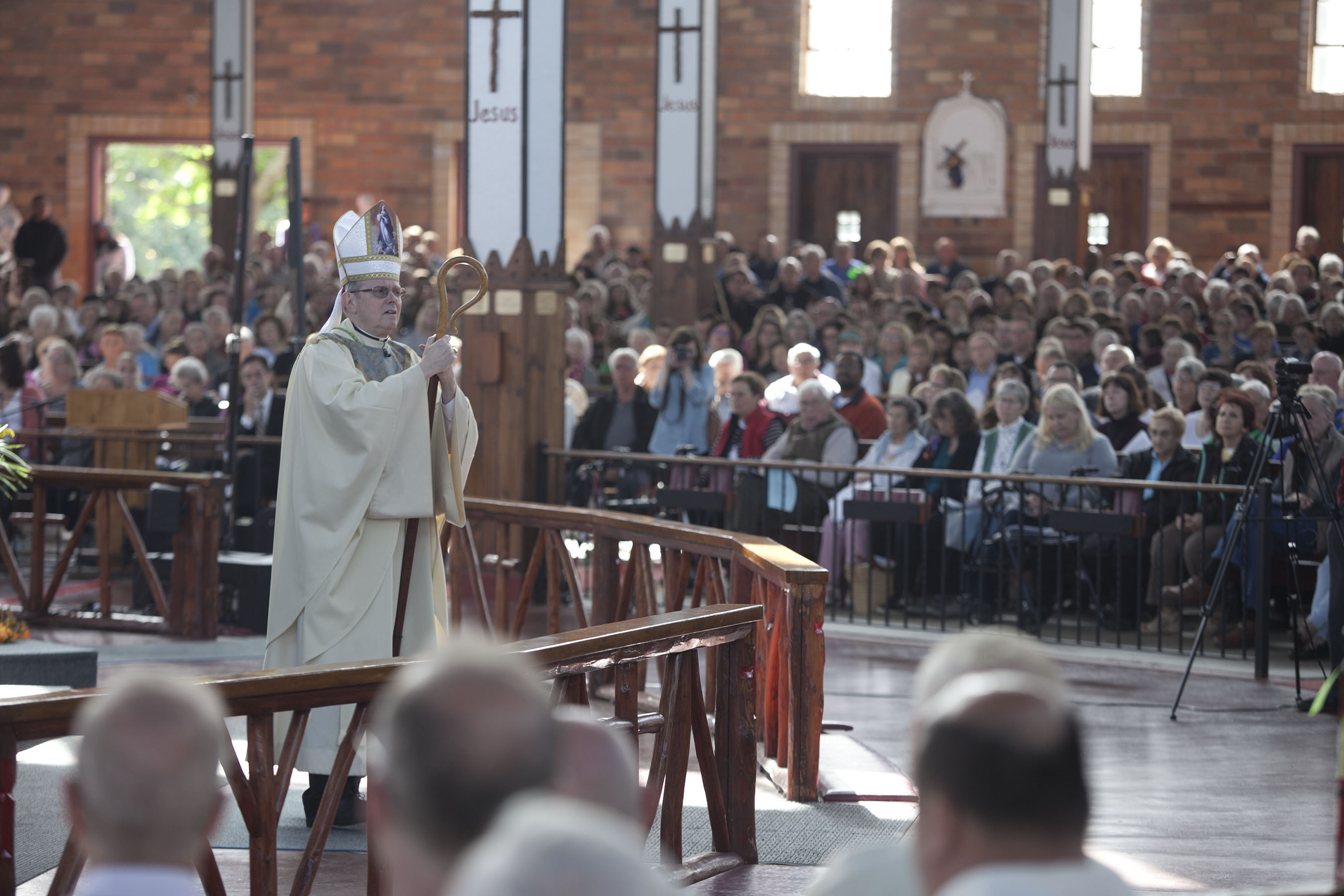 2018
2018
Jan. 18: Attends the March for Life in Washington, D.C., with hundreds of faithful from the Diocese.
Feb. 11: Joins local pro-lifers for the kickoff rally for the 40 Days for Life prayer campaign in front of Planned Parenthood in Schenectady.
April 28: To promote a “culture of life,” Bishop Scharfenberger leads Catholics of the Albany Diocese on a Rosary Walk for Life in Albany, processing near the State Capitol while praying the Rosary.
June 16: Ordains Father Zachariah Chichester at the Cathedral.
June 22-24: During the Region II Encuentro in Albany, which includes about 300 Hispanic Catholic leaders from the eight dioceses of New York State, Bishop Ed says the Catholic Church needs to focus on family ministry because families are the foundation of society and evangelized families would transform the world. “We reflect God’s divinity in our family relationships. That helps us to be more credible in witnessing to the reality of who we need to be.” Bishop Ed, who is fluent in Spanish, celebrates a bilingual Mass on June 23 at the Desmond Hotel in Albany.
July 27: With sexual abuse allegations surrounding Cardinal Theodore E. McCarrick, in a letter to the clergy in the Diocese, Bishop writes, “We can — and I am confident that we will — strengthen the rules and regulations and sanctions against any trying to fly under the radar or to ‘get away with’ such evil and destructive behaviors. But, at its heart, this is much more than a challenge of law enforcement; it is a profoundly spiritual crisis.”
Aug. 2: After Pope Francis orders a revision of the Catechism of the Catholic Church to assert “the death penalty is inadmissible because it is an attack on the inviolability and dignity of the person” and to commit the Church to working toward its abolition worldwide, Bishop Scharfenberger says: “I never saw any real justification for the death penalty. To me, this change to the catechism is not a new teaching, but a clarification of our genuine teaching — that all life is sacred from the moment of conception until natural death.”
Aug. 6: Becomes one of the first bishops in the nation to call for an independent investigation of McCarrick, saying “I think we have reached a point where bishops alone investigating bishops is not the answer. To have credibility, a panel would have to be separated from any source of power whose trustworthiness might potentially be compromised.” He adds what is currently needed is “an independent commission led by well-respected, faithful lay leaders who are beyond reproach, people whose role on such a panel will not serve to benefit them financially, politically or personally. These will be people with a deep understanding of the Catholic faith, but without an axe to grind or an agenda to push. It will not be easy, but it will be worth every ounce of effort, energy and candor we can muster.”
Aug. 17: After the Pennsylvania grand jury report on clergy sex abuse is released, Bishop Scharfenberger writes in a letter to the Diocese saying, “When I first heard the results of the Pennsylvania grand jury inquiry, I was as saddened and sickened by the news as you likely were. Speechless, really. … I know that this news is making you angry, disgusted, confused and perhaps unsure about how — or whether — to hang on in faith and support of the universal Church. What I want to say to you today is, please don’t lose hope.”
Aug. 31: In a letter to diocesan priests on clergy abuse, Bishop Scharfenberger writes, “My dear brothers in Christ, First of all, I want you to know that I stand by you and with you as we face together what will be a long and challenging crisis of faith, leadership and identity. Who we are and who God and our people need and expect us to be must be one and the same. … Most of our people are remarkably compassionate and forgiving. While they understand the need for justice and transparency, they also love Jesus and his Church and will not abandon us, if they can only have the assurance we will shepherd them.”
Sept. 6: Asks Albany District Attorney David Soares to review diocesan records on abuse cases, saying, “Unless the Church as an institution is perceived as credible, we cannot really help victims of sexual abuse. Survivors need to know that we are truly here to accompany them. Inaction has had devastating consequences, as we have witnessed recently. We have to do what is right, even if it is not easy.”
Sept. 22: “You are my inspiration,” Bishop Scharfenberger tells the more than 4,000 Catholics at the Diocese’s Hearts Aflame Eucharistic Congress. Held at the Shrine of Our Lady of Martyrs in Auriesville, the Eucharistic Congress is the Diocese’s first such event since 1938.
Dec. 20: In an effort to identify issues and figure out a way to assist St. Clare’s pensioners, Bishop Scharfenberger meets with the former employees of St. Clare’s Hospital at Siena College, calling it a “first step” in what will be an ongoing conversation.
2019
Jan. 2-8: Bishop Scharfenberger is among the U.S. bishops called by Pope Francis to spend time on retreat at Mundelelin Seminary at the University of St. Mary of the Lake near Chicago in order to pray and reflect on the sexual abuse crisis that has shaken the Church worldwide.
Jan. 19: Bishop Ed urges Gov. Cuomo to stop the “Death Star” as he calls a bill in the state Legislature to expand the current state law on abortion that has the full backing of Cuomo, a Catholic.
 Jan. 22: On the anniversary of the U.S. Supreme Court’s 1973 Roe decision legalizing abortion nationwide, the New York State Legislature passes the Reproductive Health Act (RHA) and Cuomo signs it into law. After the measure was introduced the week of Jan. 7, the governor had promised it would pass both houses within the first 30 days of the legislative session. Bishop Scharfenberger addresses the bill and Cuomo’s support for it in an open letter to the governor published at evangelist.org, the website of The Evangelist. “Although in your recent State of the State address you cited your Catholic faith and said we should ‘stand with Pope Francis,’ your advocacy of extreme abortion legislation is completely contrary to the teachings of our pope and our church. Once truth is separated from fiction and people come to realize the impact of the bill, they will be shocked to their core. By that time, however, it may be too late to save the countless lives that will be lost or spare countless women lifelong regret.”
Jan. 28: The New York State Legislature passes the Child Victims Act (CVA) into law. The New York State Catholic Conference, which represents all the bishops and dioceses in the state, had removed its opposition to the CVA, after the Legislature expanded the retroactive window to include both private and public institutions, noting that the support for all victims — regardless of where the abuse occurred — had been a critical reason the bishops could not support past versions of the bill.
Feb. 8: After some Catholics call for Cuomo’s excommunication, Bishop writes in The Evangelist, saying: “Here is my biggest concern: We are taking attention away from what really is the problem, what really is the cancer here, focusing on punishment and forgetting about what really has caused this, and that is the ideology that has been deceiving us for years, that it’s a good thing when women feel they have no other choice but to kill their child. That’s a bad thing for women. That’s a bad thing for society.”
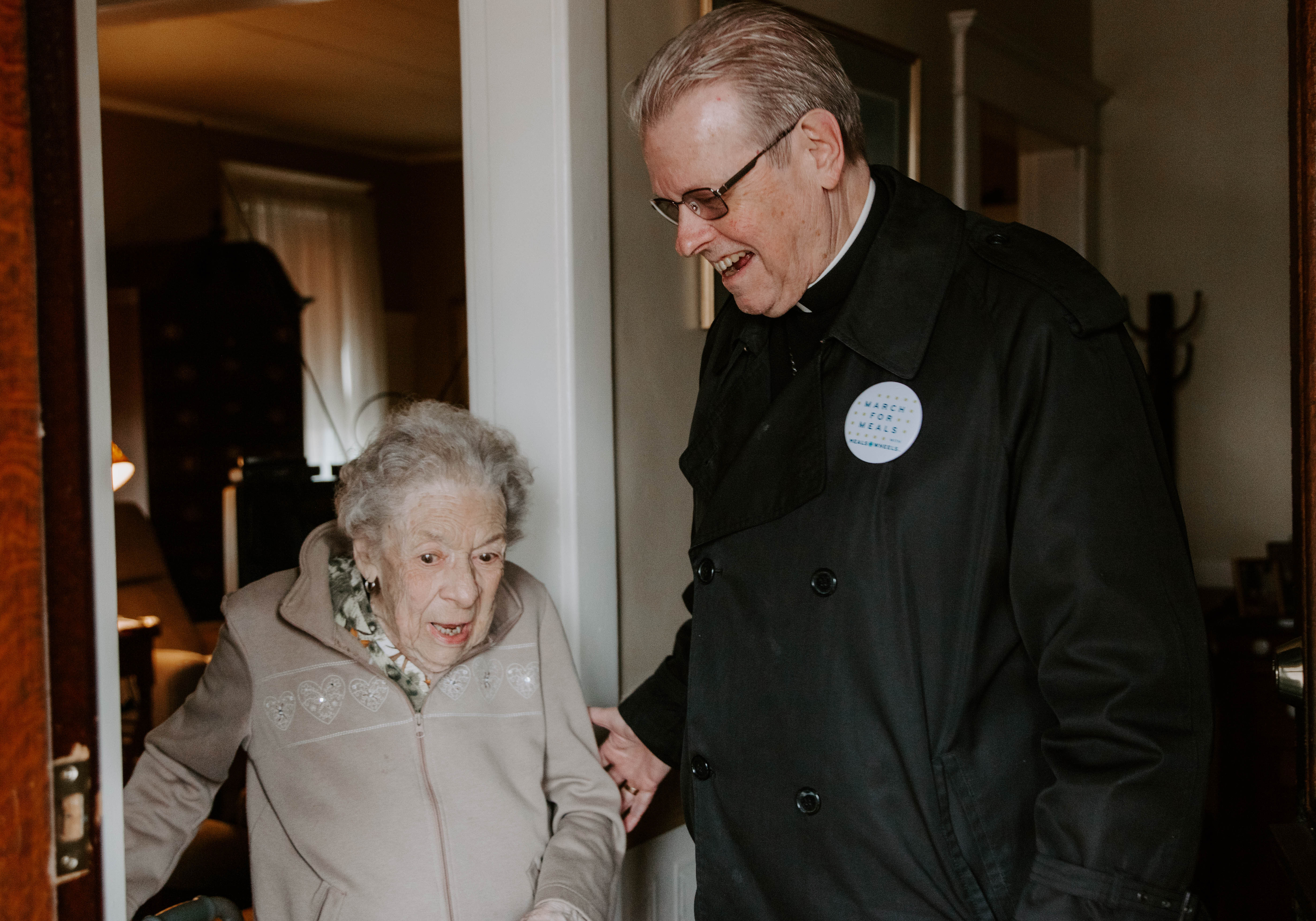
March 22: Spends a day with the Schenectady County Meals on Wheels Program, helping hand out meals to those in need and blessing the people they visited.
April 10: Celebrates fifth anniversary as Bishop of Albany.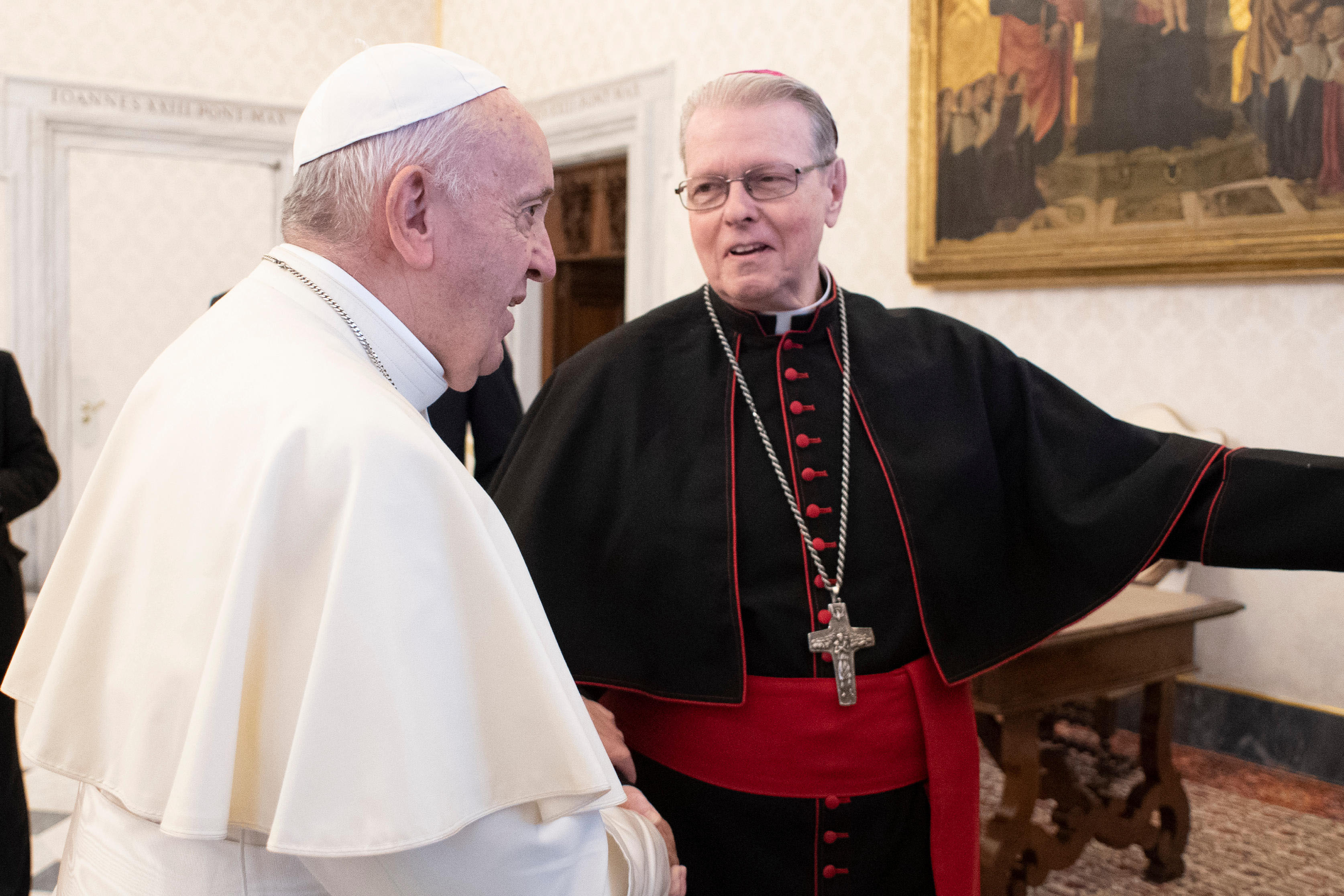 April 11: Creates a Task Force to establish protocols for greater accountability and increased transparency at all levels of the Diocese of Albany, while integrating the healing journey of clergy-abuse survivors and their families into the life of the Church.
April 25: After Notre Dame Cathedral nearly burns to the ground on April 15, Bishop says, “So many people felt a part of this, and I think it’s the power of the human spirit. If those walls could speak of all the pilgrims that have come; people of faith, people of no faith that have found something here. (The Cathedral) brings out the best in all of us.”
June 15: Ordains Fathers Samuel Bellafiore, Kyle Eads and Michael Melanson at the Cathedral.
June 19: New York State lawmakers pass the Farmworkers Fair Practices Act, which for the first time grants farm workers overtime pay, a day of rest and a right to unionize with limitations. The New York State Catholic Conference had advocated for more than two decades on this issue with Bishop Scharfenberger, Bishop Emeritus Hubbard and Cardinal Timothy M. Dolan directly involved with the issue
June 23: Pens a Pastoral Letter on the Holy Eucharist titled “This is My Body,” for the clergy, religious and laity of the Diocese of Albany.
Aug. 14: New York State’s yearlong “window” into the statute of limitations opens through the CVA, allowing suits to be filed by victims alleging abuse by priests, church workers and employees of public schools, hospitals and other institutions no matter how long ago the alleged abuse occurred.
Nov. 6: Bishop Scharfenberger’s mother, Elaine Magdal Scharfenberger, dies at age 99.
Nov. 11-15: Bishop Scharfenberger joins the other bishops of New York State in Rome for their “ad limina” visit. When they meet Pope Francis, Bishop Ed says he expressed his gratitude, recognizing the difficulties many of them were facing. At the meeting Nov. 15, Pope Francis tells the bishops from the eight dioceses to speak frankly and from the heart; “it was intense, in terms of the painful situations we shared. … What was heartwarming was how you could tell that Pope Francis was listening with his heart, and he expressed his gratitude realizing that we are in difficult situations where there is lots of pain and expressed great admiration for the work that’s been done.”
Dec. 4: Due to fallout from the abuse crisis, Buffalo Bishop Richard J. Malone resigns, and Bishop Scharfenberger is named apostolic administrator of that diocese.
2020
March 4: Diocese releases guidelines to combat the coronavirus.
March 10: As the coronavirus continues to spread in the United States, particularly in New York State, the Diocese of Albany increases precautions on how to combat the virus while at Mass, including the suspension of the physical sign of peace.
March 16: In a historic announcement, the Diocese of Albany cancels all public Masses until further notice, in order to stop the spread of the coronavirus. Churches will, however, remain open for private prayer, pending further regulations. Bishop Ed says: “Although we know how difficult it is for Catholics to be without the Mass and without the Eucharist, we must do our part to help ‘flatten the curve’ and stop the spread of COVID-19 in order to protect the most vulnerable among us.” The next week parishes start livestreaming Masses.
April 16: Cuomo extends the New York State on PAUSE guidelines until May 15, which means all social-distancing rules must be followed at least until then.
April 23: In an interview with The Evangelist, Bishop Ed says during this period of isolation and social distancing to “allow the feeling of longing and the feeling of separation to stir up in our hearts the desire to come closer to the Lord and one another in every way we can. Allow it to stimulate in us that real part of our humanity that teaches us that we are more than individuals, that we are connected to one another and that we do need to maintain relationships.”
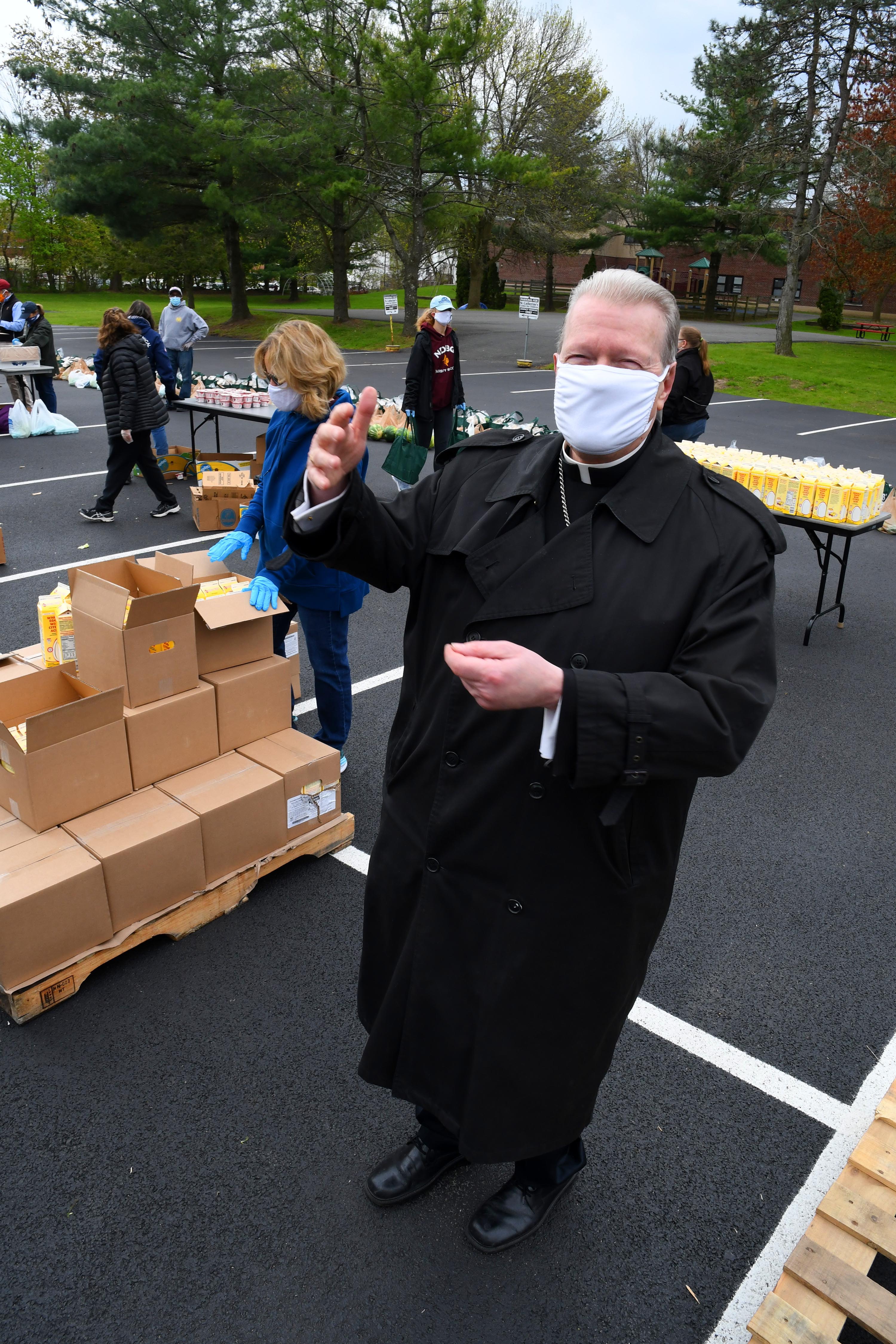
May 11: Bishop Ed blesses the food, workers and volunteers prior to a Catholic Charities’ food drop at the Pastoral Center.
May 21: Baptism, weddings and funerals, with social distancing in place, restart in Diocese.
June 1: After the Memorial Day killing of George Floyd, Bishop Scharfenberger says that Catholics have “the responsibility and mandate to eliminate the tragedy and scourge of racism. We mourn with people of conscience everywhere who have been motivated to speak out against abuse of power and to give voice to all who suffer the persistent injustices of racist attitudes and practices. It is not enough just to decry injustice, or even to pray and sympathize with those who suffer from an everyday experience of being treated as inferior or unworthy because of their racial or ethnic identities. This must be our constant work.”
June 6: Cuomo announces that places of worship could reopen immediately at 25 percent capacity as long as they meet strict safety protocols for COVID-19. The last day public Masses were held in the Diocese was March 15.
Aug. 20: Bishop Scharfenberger, through Most Holy Redeemer Cemetery in Niskayuna, gifts a two-acre parcel of property for the future site of the Capital District Holocaust Memorial.
Sept 5: The combined Priesthood Ordination Rite and Diaconate Ordination Rite is celebrated by Bishop Scharfenberger, with Father Charles Onyeneke ordained to the priesthood and 13 men ordained to the diaconate — eight men to the permanent diaconate and five men to the transitional diaconate.
Nov. 25: In a 5-4 decision issued just before midnight, the Supreme Court lifts the pandemic restrictions on congregation sizes at houses of worship imposed by Cuomo. Bishop Scharfenberger welcomes the ruling and the view that worship is essential: “We have an obligation to do everything we can to protect one another from the threat that the coronavirus poses. At the same time, we welcome this decision that upholds the First Amendment’s free exercise clause. Food and drink for the soul are as essential as food and drink for the stomach.”
2021
Jan. 7: Saying violence can never be the answer, Bishop Scharfenberger prays for peace and for the healing of our divided nation in the wake of the violent breach of the U.S. Capitol on Jan. 6. “The events and passions culminating in the chaos and violence at the Capitol on Jan. 6 have shaken many of us to the core. This is not who we are or want to be as a nation. As we move forward, we pray for peace and a renewal of our commitment to our foundational principles and the rule of law. We are grateful to lawmakers and staff on both sides who returned to the chamber despite ongoing threats and carried out the work of their office with grace and without fear.”
Feb. 19: Bishop rides along with members of Catholic Charities to help deliver bags of socks to the CoNSERNS-U food pantry in Rensselaer and the St. Charles Lwanga Center in Albany.
May 22: Bishop Scharfenberger ordains four permanent deacons and one transitional deacon at the Cathedral. The four permanent deacons are James Agnew, Craig Dempsey, Thomas M. Poznanski and Gregg Wilbur. The transitional deacon is Russell Bergman.
June 19: Ordains Fathers Matthew Duclos, Kyle Gorenski, Daniel McHale, Nathaniel Resila and Stephen Yusko at the Cathedral, telling them that he wanted this day “to be not only the happiest day of your life but the beginning of many, many other happy days.” 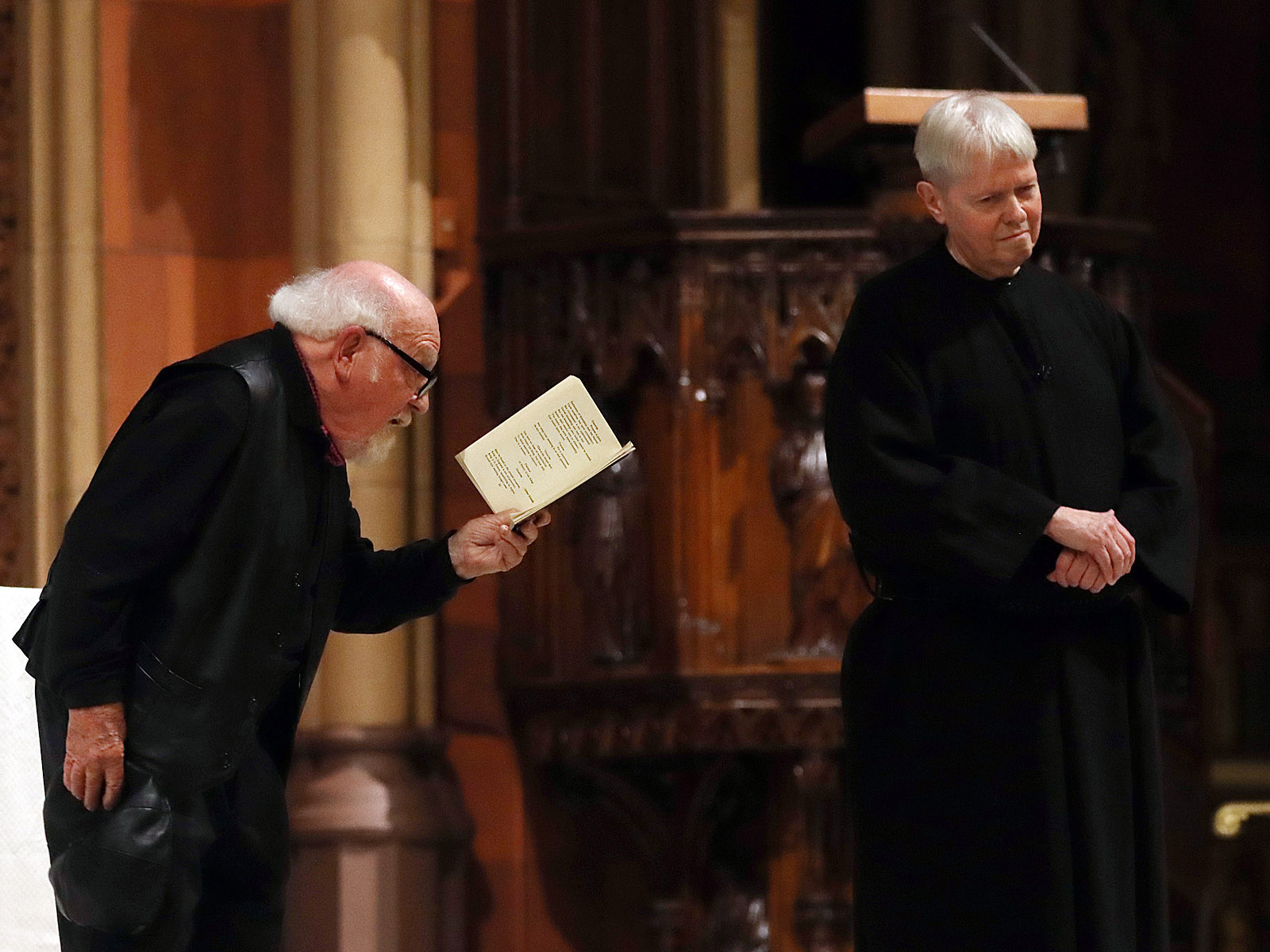 June 30: Diocese of Albany presents a free, staged reading of “Murder in the Cathedral” — with Bishop Scharfenberger in the lead role of Archbishop Thomas Becket.
July 22: Sits down with The Evangelist to talk about the idea of Pastoral Networks in which parishes in the Diocese of Albany will work together to better share resources and ideas all to further the diocesan plan of evangelization and mission.
Aug. 12: In a message to the faithful and to those wounded by abuse, Bishop Scharfenberger says, “I know you are hurting. I am hurting with you and for you. To the victims who have spent their entire lives carrying the cross of a sin committed by someone else, someone who seemed (wrongly) to be all powerful, even godlike. To the families who have been wounded — sometimes left fractured — by abuse. To the school communities and parishes that have suffered the shock and betrayal of discovering past abusers. To the many good priests who have suffered the betrayal of our vows by those who would harm the vulnerable, who are faced with a wariness and held at a distance by the people we give our lives to serve. ... Human beings will fail us again and again, but the One who heals and saves will never fail us, if we put our trust in Him. Come to him today, and lay your burdens down.”
Sept. 25: Saying the time is right “to gather together as a diocesan community — to pray, to celebrate, and to recommit ourselves to being the missionary disciples God so urgently needs us to be,” Bishop Scharfenberger and the Diocese of Albany hosts a Diocesan Day of Prayer and Celebration. The free, diocesan-wide event — with the theme of “Come Holy Spirit! Renew Our Strength! Reaffirm Our Hope!” — is held at St. Edward the Confessor in Clifton Park.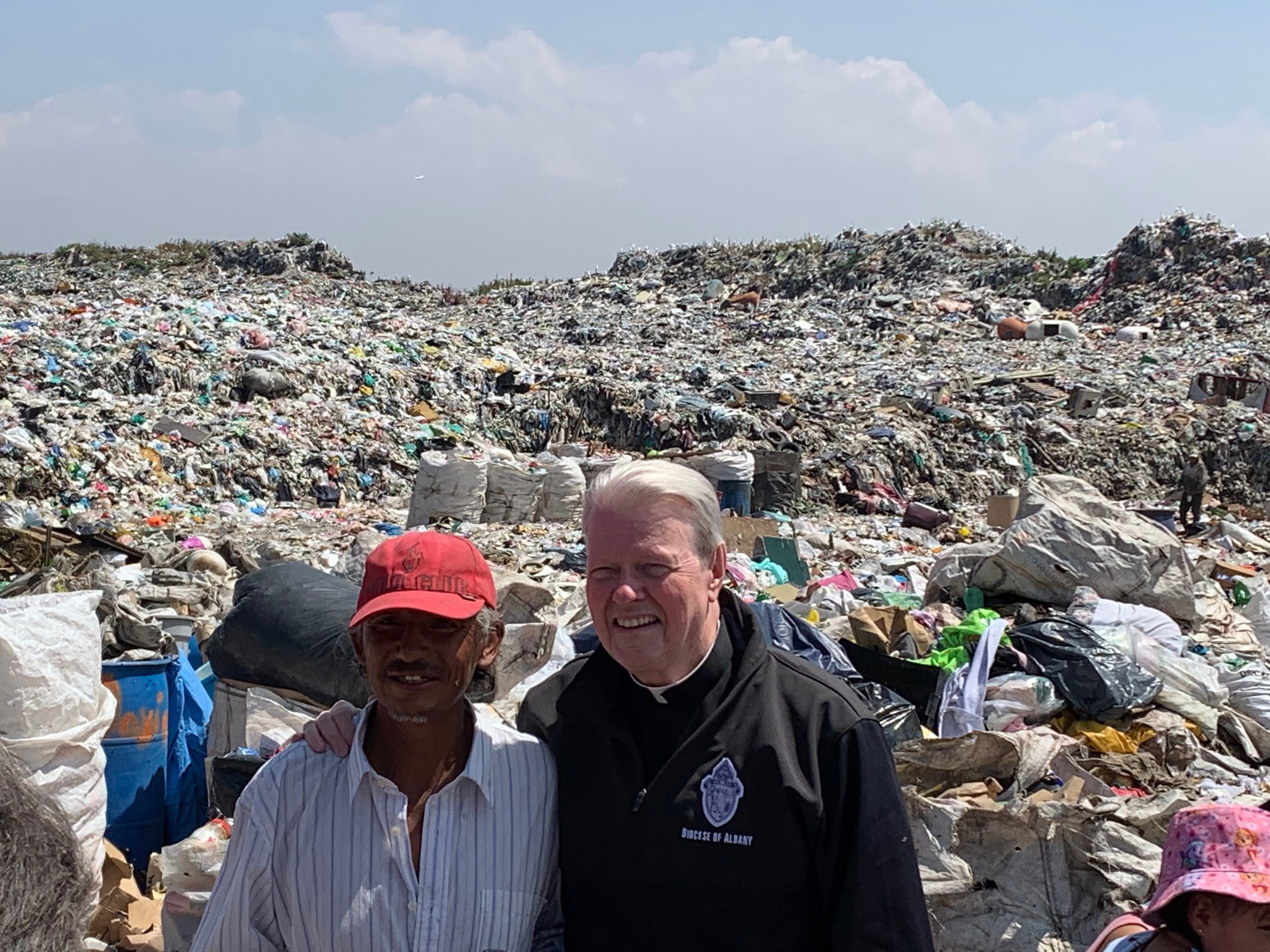
Oct. 7-11: On a mission to Mexico, which includes a trip, literally, to the city dump, Bishop says, “I was changed and blessed by the humanity of the poor.”
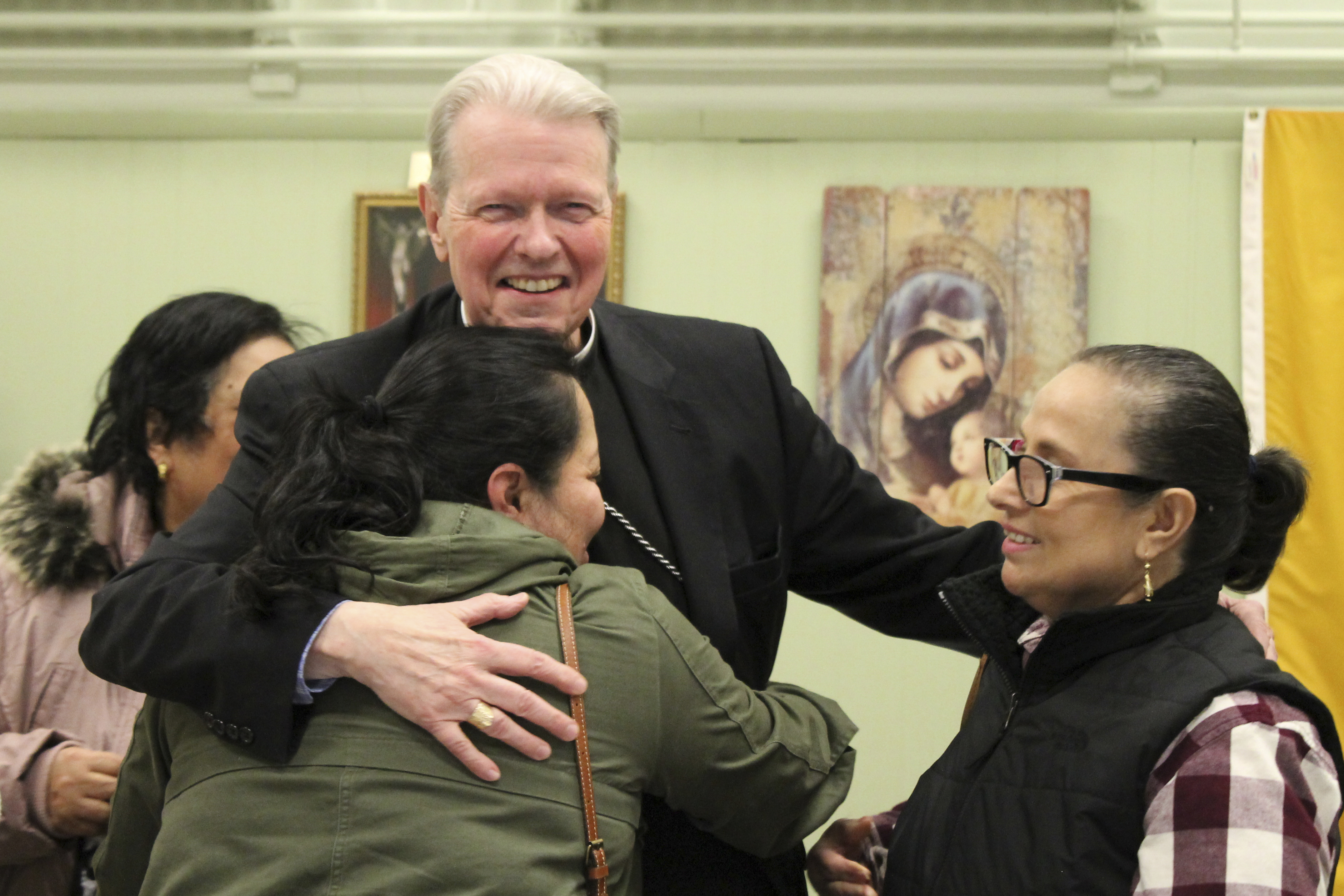
Oct. 24: Saying “every one of us has a role to play,” Bishop Scharfenberger celebrates a special liturgy at the Cathedral to mark the start of the Synod on Synodality.
Nov. 1: In an ongoing battle, the Supreme Court sends a case back to a lower court asking it to reconsider a ruling against the Diocese of Albany and other religious groups that challenged the state’s mandate requiring employers to provide abortion coverage in their employee health insurance plans. Bishop Scharfenberger, says: “We are gratified and grateful that the Supreme Court has recognized the serious constitutional concerns over New York State’s heavy-handed abortion mandate on religious employers.”
Nov. 15: In taking a proactive step to strengthen the future of Catholic education in the Diocese of Albany, the Albany Diocesan School Board, under the leadership of Bishop Scharfenberger, announces it will create a new pre-K to 12th grade regional school in Latham. The new Catholic Central School will open its doors in September 2022.
Dec. 31: Pope Emeritus Benedict XVI dies at the age of 95.
2022
Feb. 16: Due to increasing costs and low enrollment, the Diocese announces that Bishop Maginn High School will close at the end of the 2021-2022 school year.
Feb. 24: After Russia invades Ukraine, Bishop Scharfenberger says, “Appallingly, we are again seeing the face of evil as Russian troops have launched an unprovoked attack on the people of Ukraine. We fervently pray through the intercession of Mary Immaculate, to whom our Diocese is consecrated, that this military action quickly ends, that casualties are limited, and we pray for the repose of the souls of those who have been killed and those who will no doubt lose their lives in the coming days.”
March 19: Saying “God will bring peace,” Father Michael Myshchuk, along with other clergy of the area’s Ukrainian churches, leads a Prayer Service for Peace that is hosted by the Diocese of Albany at the Cathedral. Bishop Scharfenberger presides over the Moleben — which is a supplication prayer service in Eastern churches that is in honor of either Jesus Christ, the Mother of God, or a particular saint or martyr — asking for intercession for peace in Ukraine.
 April 20: The Albany Diocese holds its first in-person group gathering to discuss Pope Francis’ Synod of Bishops on synodality initiative at Holy Trinity Church in Johnstown. “This is wonderful,” Bishop Scharfenberger says. “This isn’t a program; it’s a process. It’s a way of being Church.”
May 21: Deacon Daniel Vallejo is ordained as a transitional deacon at the Cathedral with Bishop Scharfenberger presiding.
June 18: Calling the priesthood “a ministry of love,” Bishop presides over the ordination of Fathers Russell Bergman and James O’Rourke at the Cathedral.
June 24: In a 5-4 decision, the U.S. Supreme Court overturns its nearly 50-year-old decision in Roe v. Wade that legalized abortion in this country.
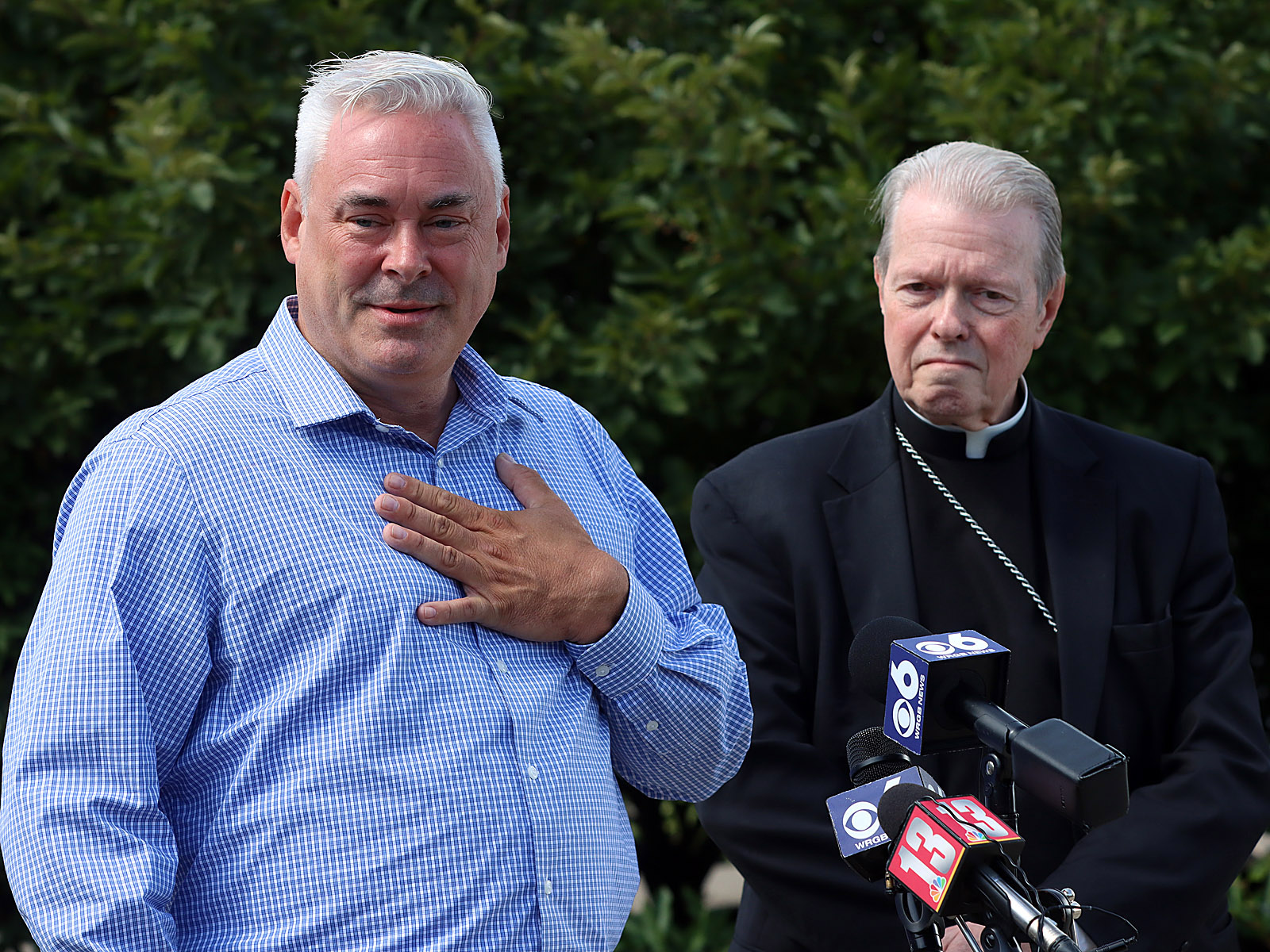
July 31: Clergy sex abuse survivor Stephen Mittler and Bishop Scharfenberger have a historic meeting at Corpus Christi Church in Round Lake, the same church where Mittler was abused as a child.
Oct. 23: Diocese begins a series of “Hope and Healing Masses,” with the first one at St. Gabriel the Archangel Church in Rotterdam. 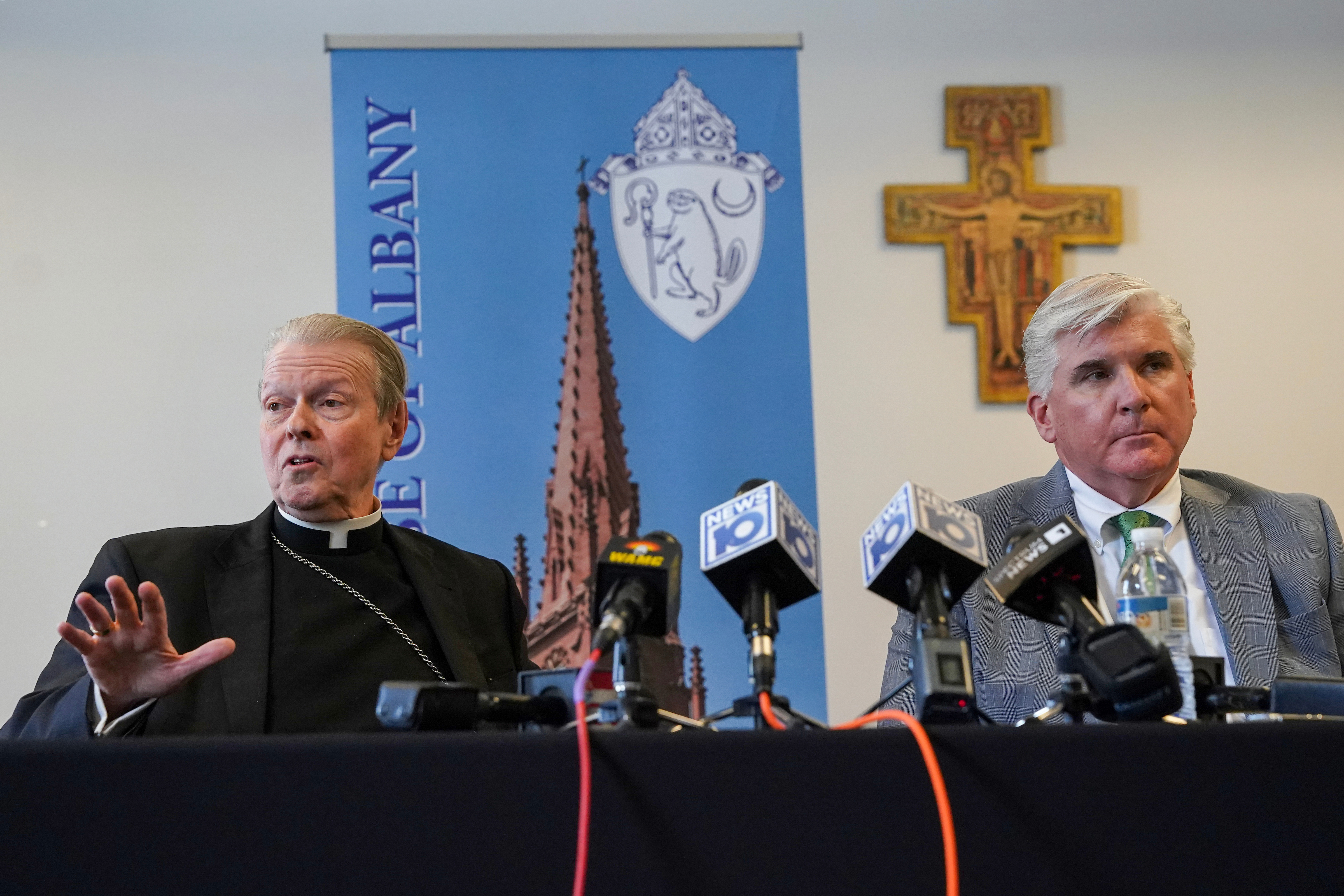
2023
Feb. 8-16: On his mission trip to Nigeria, Bishop Scharfenberger, who is accompanied by Father Charles Onyeneke, gets to meet the people of the Archdiocese of Lagos, celebrates Mass and meets with potential seminarians.
March 15: The Diocese of Albany announces that it has filed for bankruptcy reorganization under Chapter 11 of the U.S. Bankruptcy Code due to the over 400 lawsuits filed under the Child Victims Act. In both his written and recorded messages, Bishop Scharfenberger apologizes to victims and survivors of clerical abuse in the Diocese: “I am deeply sorry that anyone suffered abuse in the Church. I cannot take away those memories and that pain,” he says in his video. “I have promised and am committed to walking with you on the road to healing. That involves more than any financial settlement. You do not have to walk alone.”
May 20: Bishop Scharfenberger celebrates the diaconate ordination of four men at the Cathedral. Deacons Adam Feisthamel, Anthony Onu and Joseph Tuan Pham are all ordained to the transitional diaconate, with Deacon Eduardo Trevino ordained to the permanent diaconate.
May 29: Celebrates his 75th birthday, and, as required by canon law, submits his resignation to Pope Francis.
July 2: Celebrates the 50th anniversary of his ordination to the priesthood.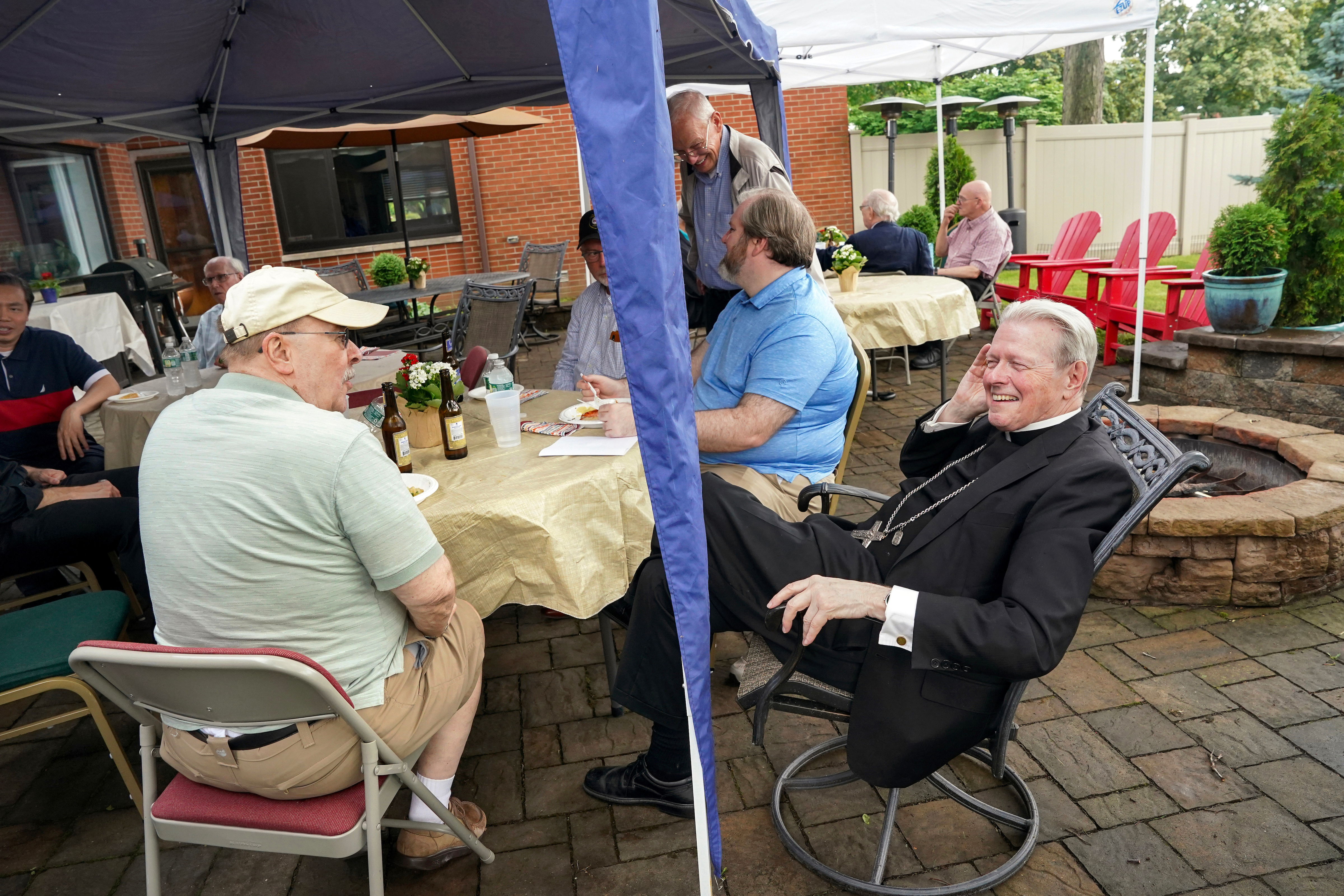 Aug. 19: Bishop Emeritus Howard J. Hubbard dies at the age of 84 in Albany. Bishop Scharfenberger celebrates the funeral Mass.
Oct. 20-22: More than 11,000 Catholics converge on the hamlet of Auriesville for the New York State Eucharistic Congress that highlights both the immensity and the intimacy of a relationship with Jesus, found truly present in the Blessed Sacrament. The Diocese of Albany, teaming with the Archdiocese of New York and the state’s six other dioceses, hosts a range of activities as a local component of the Church’s National Eucharistic Revival. The goal — to restore devotion to the Real Presence and its mystery of love — is a “game-changer” for individuals and the world, as Bishop Scharfenberger puts it in his homily at the event’s concluding Mass. “Jesus changes lives. Everyone who comes into Jesus’ presence is somehow transformed by that. If we bear the presence of Christ, yes, my brothers and sisters, we will change the world because God wants to save the world through us.”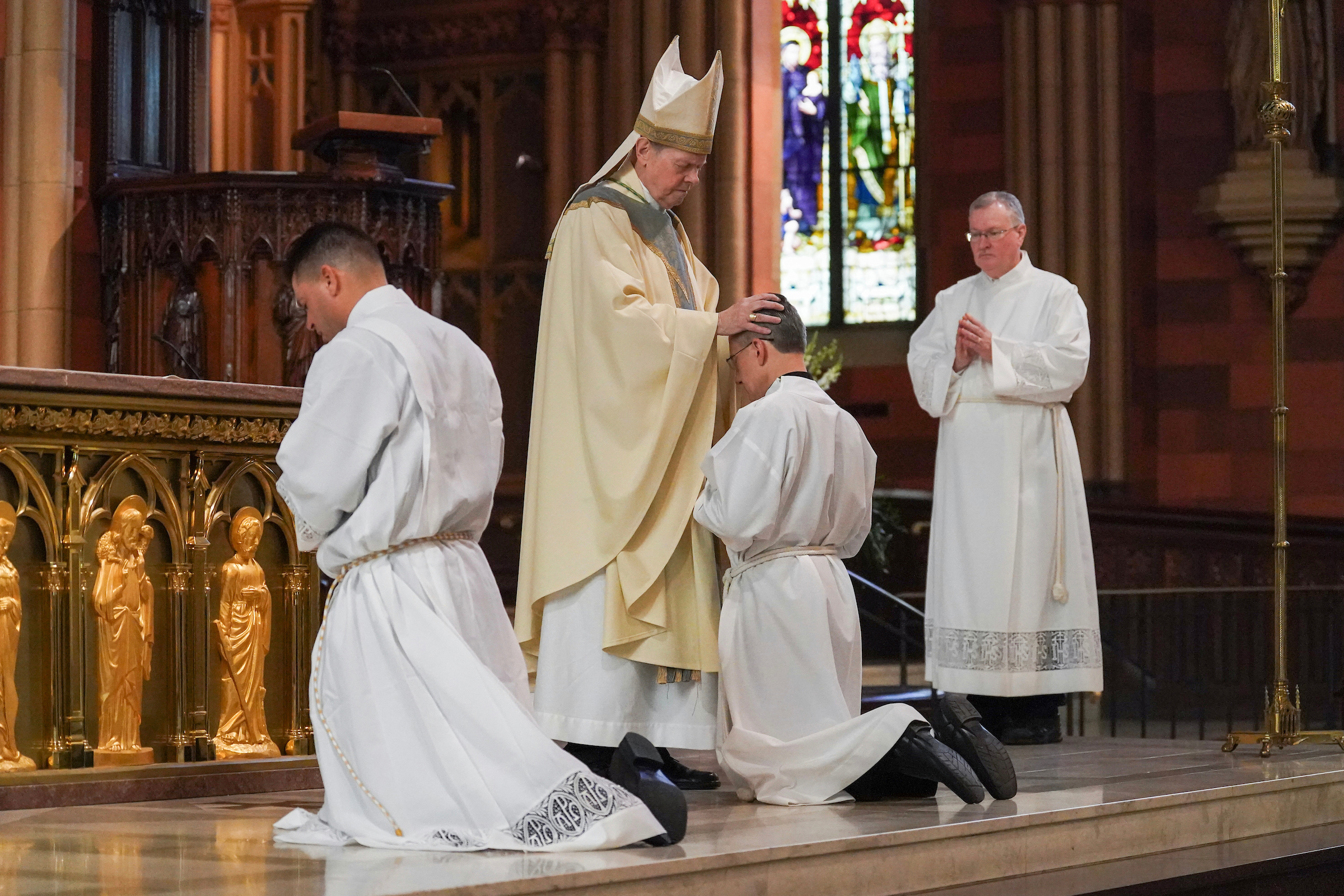 Nov. 18: Father Daniel Vallejo and Deacons Thomas Fallati and Paul McDonald are ordained at a combined Priesthood and Diaconate Ordination Mass at the Cathedral.
2024
March 6: Diocese holds its second round of Synod listening sessions, this time at Our Lady of the Annunciation Church in Queensbury, after Pope Francis calls on the faithful to hold a new round of sessions focusing on Church structure, organization, leadership and Church life. “What I’m hearing tonight more than anything else is we need to stay connected,” says Bishop Scharfenberger in the session’s closing prayer. “That’s what we are doing; we’re doing what God made us to do. There’s a reason we want to be a part of something larger than ourselves; we were made that way. And we find our true selves when we recognize that God put us here to find God’s presence in one another.”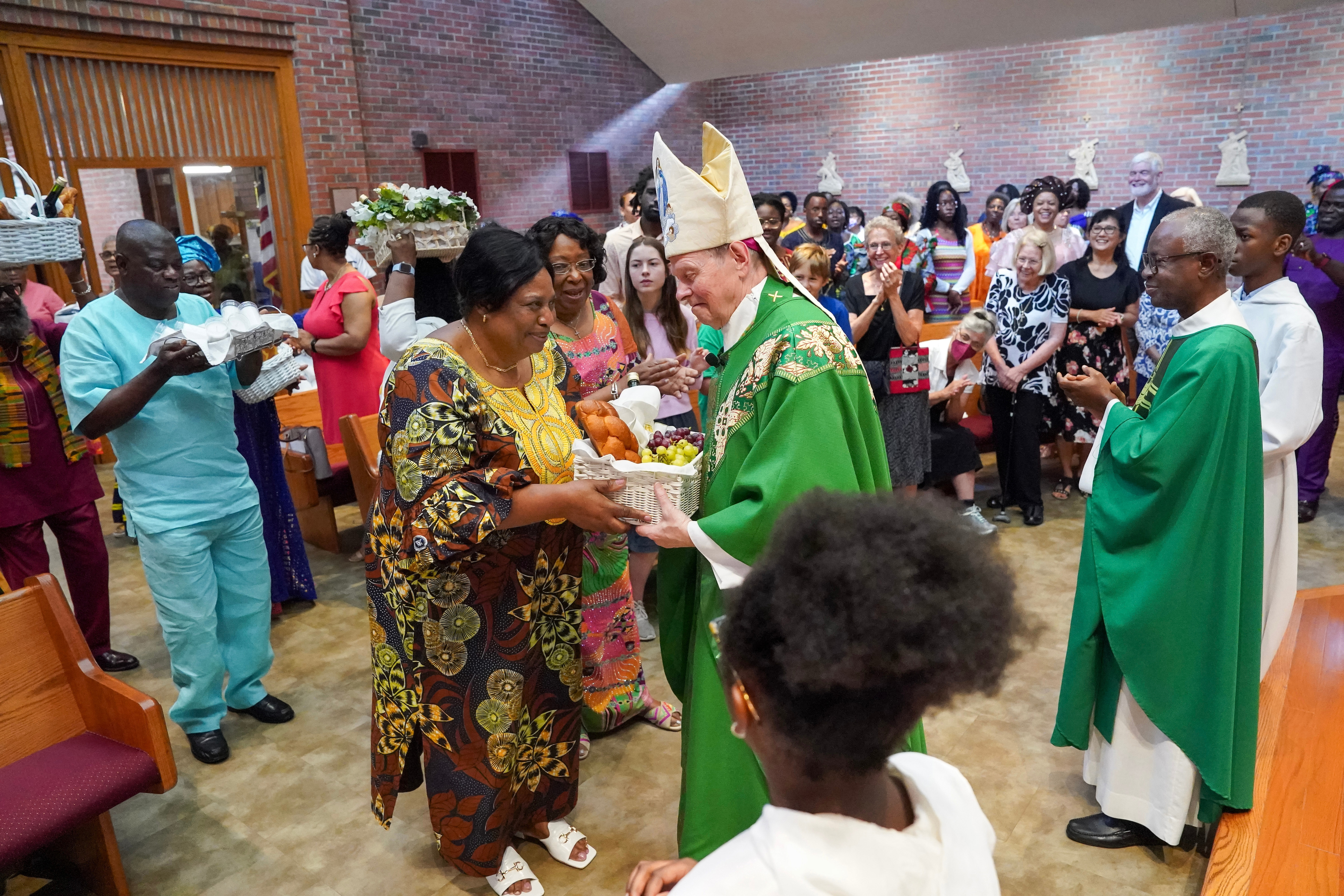 April 29: After it is announced that the Burdett Birth Center in Troy, which was slated to close at the end of June, will remain open for five years, Bishop Scharfenberger says “This is wonderful news for the families relying on the Burdett Birth Center in Troy. I am grateful to all involved for their willingness to set aside differences and work together to meet the needs of the community for the next five years. I pray that the spirit of cooperation continues as work proceeds to find a permanent solution.” Bishop Ed and the faithful in the Diocese have been following the news of the center’s potential closure and resulting outcry from the public while brainstorming ideas on how to help since the previous summer.
May 18: Celebrates the combined Priesthood and Diaconate Ordination at the Cathedral. Five men — Fathers Thomas Fallati, Adam Feisthamel, Paul McDonald, Anthony Chibueze Onu and Joseph Tuan Pham — are ordained to the priesthood, and Deacon Eric Ramirez is ordained to the permanent diaconate.
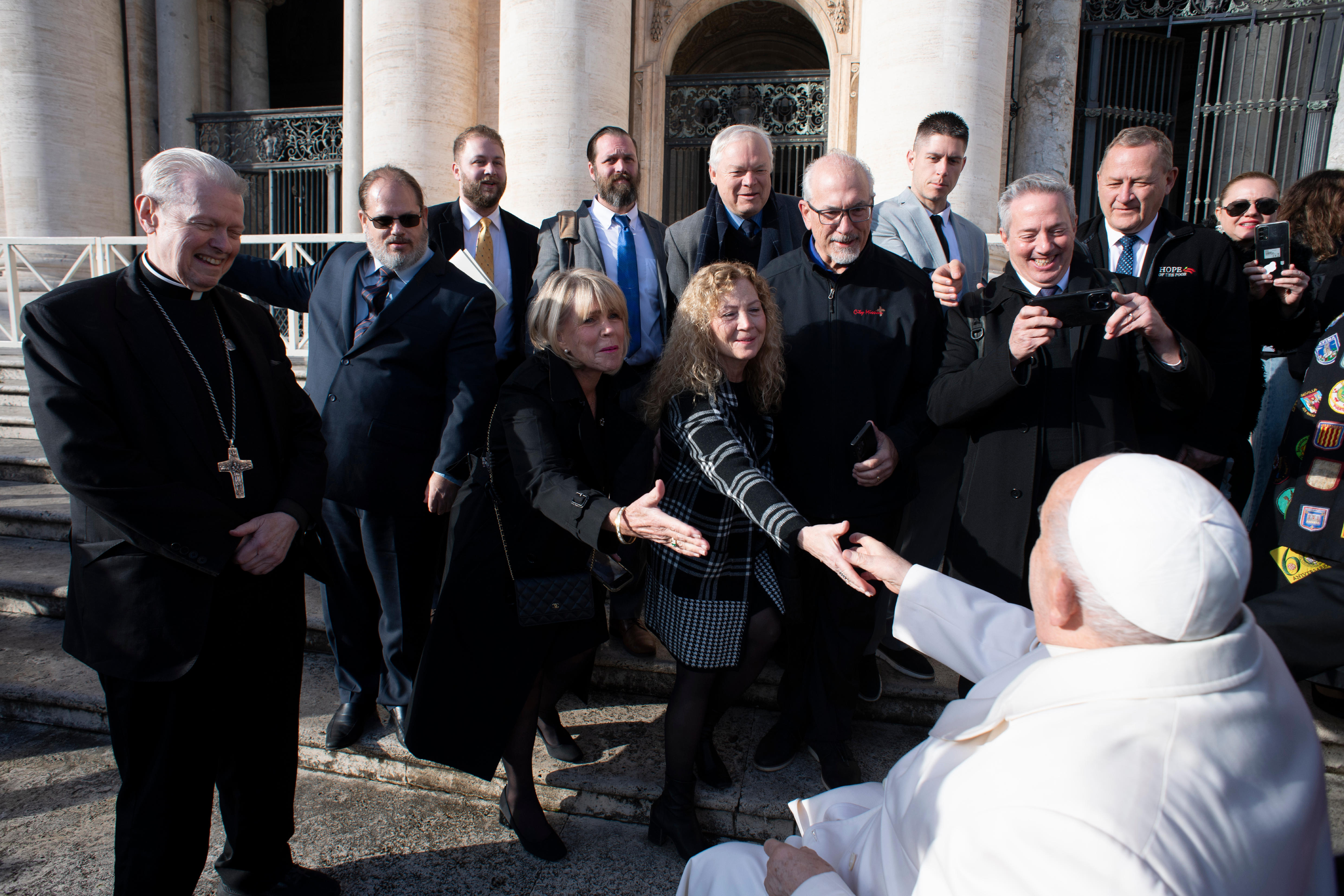 Aug. 11: The Black Catholic Apostolate (BCA), a diocesan congregation which shares worship space with parishioners of St. Joan of Arc Church in Menands, celebrates its 40th anniversary with Bishop Scharfenberger as celebrant for the Mass.
Oct. 20: “Groomed,” an award-winning, one-man play about abuse makes its U.S. public premiere in the Diocese of Albany. The Hope and Healing Committee hosts the evening at Siena College as a free-of-charge gathering for survivors of child abuse, for those who might desire relevant counseling, and for anyone wanting to learn more about the subject. Bishop Ed also attends the premiere.
December: Bishop Ed and a diverse group of 12 mission-focused pilgrims have an audience with Pope Francis in Rome and discuss with the Dicastery for the Promotion of Integral Human Development their common vision for personal and parish renewal called “Hope from the Margins.” 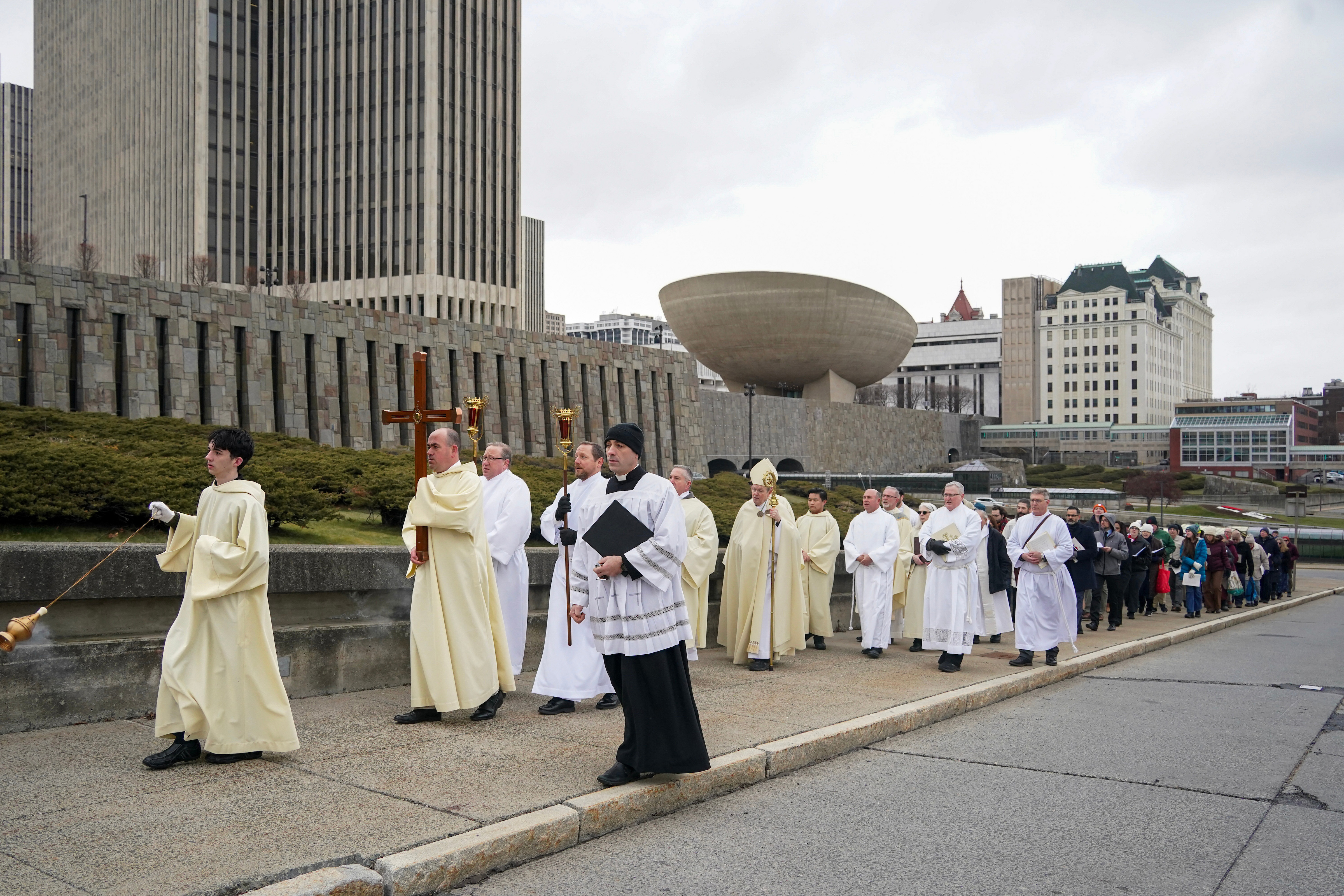
2025
Jan. 5: Bishop Ed and the faithful of the Diocese celebrate the opening of Jubilee Year 2025, which has the theme of “Pilgrims of Hope,” with a procession/pilgrimage. The day starts with a prayer service at Historic St. Mary’s on Capitol Hill, and is then followed by the half-mile prayerful walk from St. Mary’s to the Cathedral of the Immaculate Conception.
Jan. 27: The United States Conference of Catholic Bishops announces that Our Lady of Martyrs Shrine in Auriesville has been designated as a national shrine for pilgrims. “We are delighted that the bishops have confirmed what the faithful have long instinctually known: The National Shrine of Our Lady of Martyrs is our home for the cultivation of holiness here in the U.S., Canada and Mexico,” Bishop Scharfenberger says. “The inspiration of the martyrs in my upstate New York backyard was foundational to my own early calling to the priesthood. To this day, I go to the shrine as a pilgrim to refuel in prayer for God’s outpouring of graces in my daily decisions and the lives of the faithful people the Church has entrusted to me.”
March 14: The Catholic School Office announces that Mater Christi School will remain open as a pre-K through Grade 8 school, Blessed Sacrament School will restructure as a pre-K through Grade 6 school, and All Saints Catholic Academy will close after the 2024-25 school year. In addition to the Albany closures, the school office also announces that Sacred Heart School in Troy will close after the 2024-25 school year.
April 10: In a letter to the faithful about the future of the Diocese, Bishop Ed writes “This is not a plan with a narrow focus on mergers and closures. Reconfiguration or merging of parishes and the repurposing, closing or sale of some churches, rectories and schools must surely be anticipated as part of the outcome. More importantly, however, this is a process to focus each parish on its mission as the Church, making best use of its personal and material resources. … We need to focus now on re-evangelization, re-education and becoming the mission Church we long for and know we can be.”
April 21: Pope Francis dies at the age of 88.
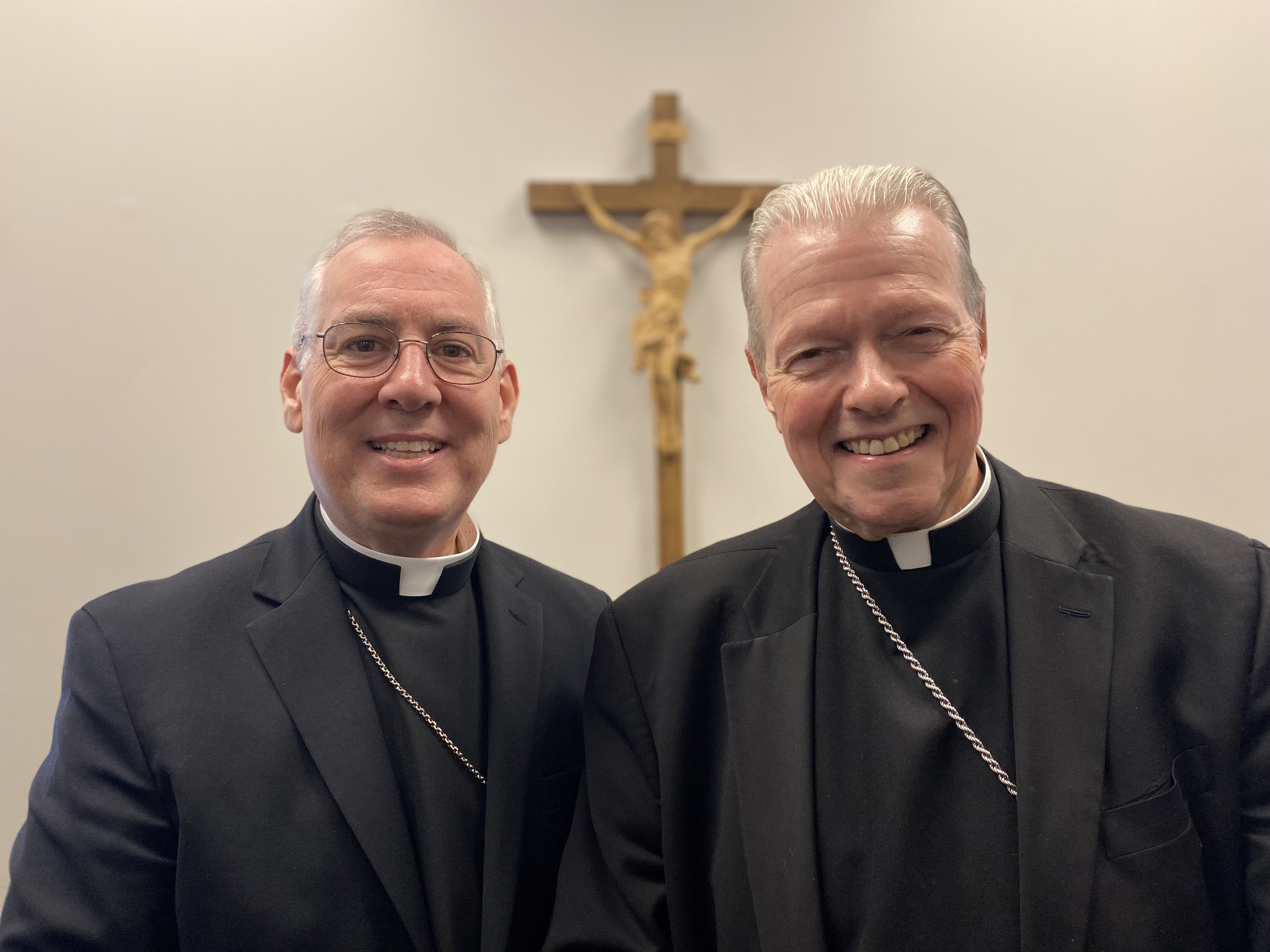 May 1: With the New York state-sanctioned suicide bill on the verge of passing, Bishop Ed writes in his weekly column: “Must our response to suffering be one of personal denial or indifference or disguised by socially sanitized forms of denial or indifference, euphemized as ‘death with dignity’ or ‘medical aid in dying’? It is still homicide. Other states may jump off the cliff. Must New York join the herd — inside of leading with our motto: Excelsior?” (The bill moved to Gov. Kathy Hochul’s desk. She has given no indication whether she will sign it into law).
May 8: Pope Leo XIV, 69, formerly Cardinal Robert F. Prevost, is elected as the first American-born pope. Bishop Scharfenberger, who is away on a mission trip, says: “We are grateful to the cardinal electors for their prayerful consideration in the process, we are grateful to all who prayed for the Holy Spirit’s guidance. May prayers continue for our new pope and for our Church in this Jubilee Year of Hope. May God’s light shine through each of us, in all that we say and do.”
May 17: Celebrates the Ordination to the Diaconate of Alexander Turpin at the Cathedral.
June 12: Diocese launches “Remade for Mission” initiative, which is a blueprint for spiritual renewal and parish revitalization.
Oct. 20: Bishop Mark O’Connell, auxiliary bishop of the Archdiocese of Boston, is named the 11th Bishop of Albany. His Installation Mass is slated for Dec. 5. He will succeed Bishop Scharfenberger, who now becomes the apostolic administrator of the Diocese. When Bishop Mark is installed, Bishop Ed will become bishop emeritus.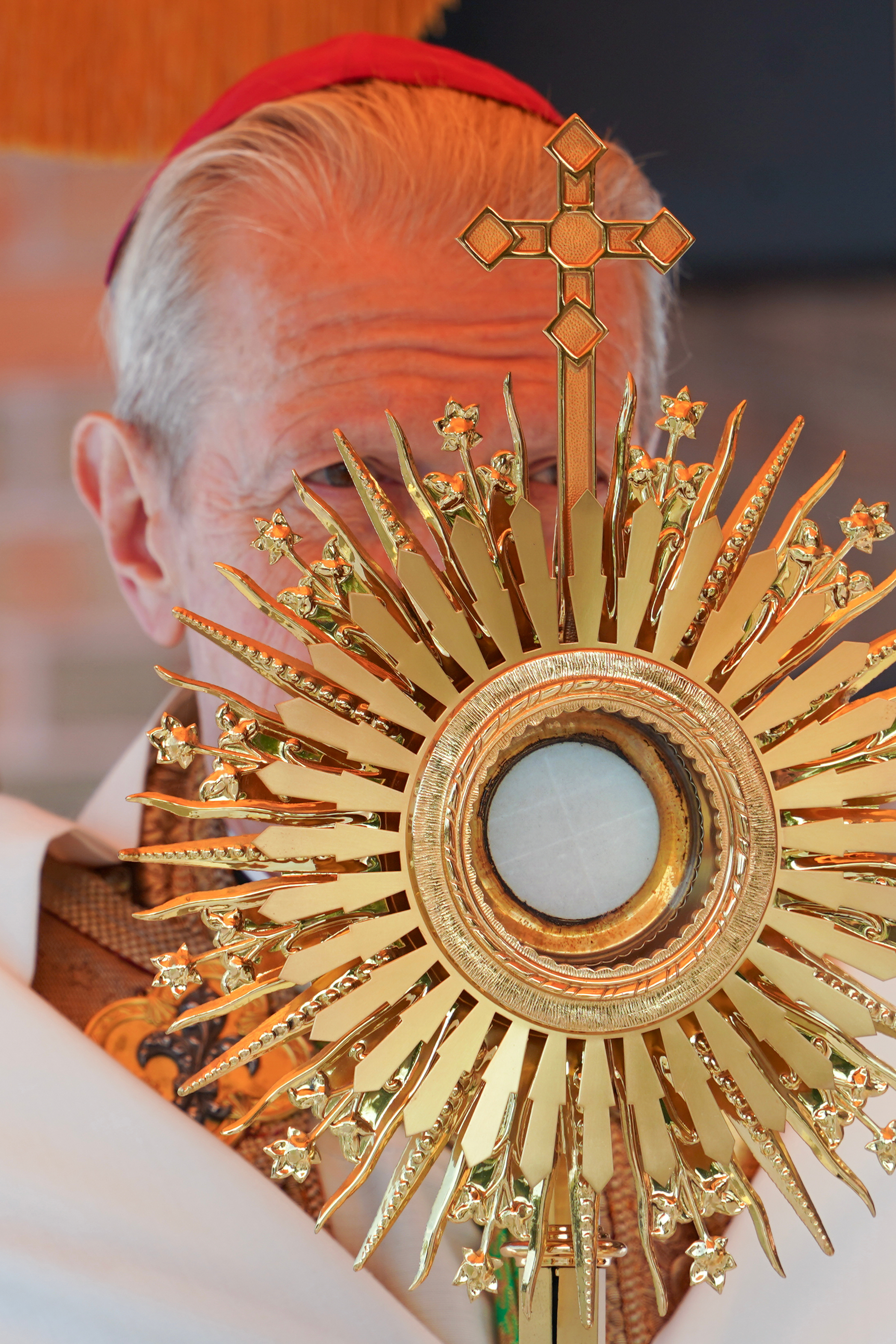
- ‘The Story of All Stories’ children’s Bible vividly conveys salvation history
- Pope Leo XIV accepts resignation of Iraqi Cardinal Louis Sako
- Lovable therapy dog brings serenity, fun to Catholic school every day, one tail wag at a time
- Cardinal Mathieu in Rome after evacuation from Iran
- HHS proposes scrapping policy requiring foster homes to affirm children’s LGBTQ+ identity
- Black farmers see hope in Catholic farming aid, grant program
- White House ‘gamifying’ war on Iran marks a ‘moral crisis,’ warns US cardinal
- Academy Awards Best Picture Nominees
- Lebanese Maronite Catholic priest killed by Israeli tank fire in southern Lebanon
- Pope Leo XIV urges Chicago students to be ‘co-workers for peace with Christ’
Comments:
You must login to comment.