


November 4, 2025 at 3:09 p.m.
DIOCESE-ST. CLARE'S TRIAL

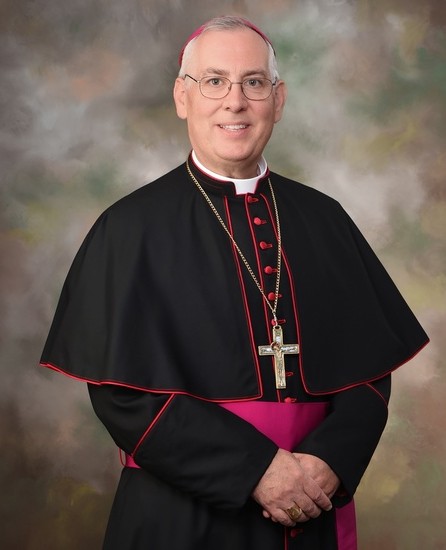
Bishop Edward B. Scharfenberger took the stand on Monday to testify in the St. Clare’s case.
The Bishop, who has been in attendance at Schenectady County Courthouse for most days since the trial kicked off on Thursday, Nov. 6., reiterated what he has stated in the past: that his involvement with the St. Clare’s Corporation was in a pastoral capacity, and any voting decisions made were done as part of that role and in the context of the information he had at the time.
Bishop Scharfenberger is one of seven people/entities being sued by AARP, representing the over 1,000 pensioners from St. Clare’s Hospital who received little to no funds from their promised pension plan, and the New York State Attorney General's Office, which collaborated with AARP’s lawsuit in 2022.
Monica Connell, assistant attorney general, questioned the Bishop on Monday morning, laying out the timeline of his involvement in the St. Clare’s Corporation for the jury, reviewing the minutes of meetings he or his Vicar General Father David LeFort attended, and how much information he had gathered about the St. Clare’s pension fund before voting as a member of the corporation.
In February 2014, Bishop Scharfenberger was appointed by Pope Francis as the 10th Bishop of Albany, succeeding Bishop Howard J. Hubbard, who had been serving the Diocese since 1977.
Bishop Hubbard also served as an honorary chairman of the St. Clare’s Hospital board of directors when he served as the bishop of the Diocese, in accordance with St. Clare’s bylaws. He served this role until the board dissolved with the hospital’s closure and became St. Clare’s Corporation (SCC), an entity focused entirely on overseeing the St. Clare’s pension plan.
Bishop Scharfenberger was consecrated in April 2014 and officially took over as bishop of the Albany Diocese. With that transition came the passing of responsibilities as a member of the SCC from Bishop Hubbard to Bishop Scharfenberger; however, Bishop Scharfenberger reiterated numerous times on the stand that it was not something he was made aware of until 2016. During his deposition in September 2021, Bishop Scharfenberger noted Bishop Hubbard saying he “regrets handing” the St. Clare’s situation over to him.
Connell was curious if Bishop Scharfenberger ever asked more about what that meant at the time. The bishop said no, and that he was waiting to follow the lead of other advisors who had been on the board longer and knew the situation better than he did.
“I had a meeting about transitioning (with Bishop Hubbard) before I was Bishop of Albany but I was rarely alone,” he said, “I was always with advisors.”
Connell pulled up multiple meeting minutes from the SCC, starting with the first one attended by Bishop Scharfenberger on July 18, 2016. In the meeting, there was a discussion of pensioners turning to the Diocese for financial assistance but it was concluded it might be inappropriate.
For the following handful of meetings, Father LeFort attended on behalf of Bishop Scharfenberger when he was unable to be present, voting on his behalf and relaying meeting details back to him.
In an October 2017 meeting, the SCC board discussed the potential of electing PBGC insurance, and in a following meeting attended by Father LeFort on the bishop’s behalf, the board voted unanimously to elect PBGC coverage.
Bishop Scharfenberger had qualms with electing the coverage, noting he “believed taxpayers covered that” and had moral concerns with having the public pay into the plan. As he sought further answers, the Bishop stated that “he wasn’t looking for a collaborator, I was looking for answers.”
“Our vote to go into PBGC was aspirational, but I had questions if we could do that,” he said.
The board revisited the idea of PBGC coverage and ultimately decided against it. Bishop Scharfenberger noted that at the time he wanted to seek out more information about the plan and why it had reached the level it did.
“It’s not just a question of getting money but accountability,” he said. “There were things going on in my mind.”
Bishop Scharfenberger did ask for information on SCC records and contacted Raymond McCabe, attorney for St. Clare’s Corporation, for information on the pension plan. Connell asked if the Bishop ever called for a third-party group to look into the plan. He said he did not, noting he didn’t think that was something he could do within his role.
In April 2018, the SCC board voted to terminate the St. Clare’s pension plan, and in July, began discussing how to notify pensioners. In October 2018, a letter was sent to pensioners announcing the termination of the plan.
After the letter’s release, Bishop Scharfenberger voiced his desire to call for a public forum and allow pensioners to voice their concerns, while also letting them know that pastorally, the church was there for support. “These are my people, I wanted to be with them,” Bishop Scharfenberger said.
In an email from McCabe to Bishop Scharfenberger and Michael Costello, the attorney for the Albany Diocese, he reiterated that the board had previously discussed and rejected the option of a public meeting with the pensioners.
McCabe goes on to write in the email: “I trust that you also understand that, as a legal matter, the Bishop’s participation in these decisions personally or through the Vicar General does not render the Diocese derivatively liable to the participants for the underfunding of the pension plan or of the administration of the plan by the St. Clare’s Corporation.”
Despite concerns, a public discussion with pensioners was held by the diocese in December 2018 at Siena College. Bishop Scharfenberger reiterated on the stand that his desire to hold the forum was based on being there for anyone struggling with the pension’s termination.
The plaintiffs’ are expected to rest their case this week. The defense is expected to start calling witnesses on Dec. 1
POFIT TAKES THE STAND
Joseph Pofit, a key player in the ongoing St. Clare’s trial, took the stand on Tuesday, Nov. 18.
Pofit served as a chairman on St. Clare’s Hospital board and as the head of the Diocesan Community Health Alliance (DCHA), a Catholic entity that partners between Catholic hospitals, Catholic Charitities and other Catholic organizations to collaborate on community health initiatives.
When St. Clare’s Hospital shut its doors in June 2008, the St. Clare’s Hospital board of directors dissolved with it. Afterwards, the St. Clare’s Corporation (SCC) was formed, composed of previous and new board members, with the intent of overseeing the pension plan.
Pofit, like fellow defendant Robert Perry, former CEO of St. Clare’s Hospital, is accused of violating his fiduciary duties as to the St. Clare’s Corporation, and failing to ensure the pension plan was well funded or that pensioners were informed of the issues at hand.
Monica Connell, a Section Chief and Assistant Attorney General at the Office of the New York State Attorney General, had a whiteboard brought into the Schenectady courtroom to break down key dates during her questioning.
In 1999, Pofit joined the DCHA, and in 2006, the late Bishop Howard J. Hubbard appointed Pofit to serve on the board of St. Clare’s Hospital. Pofit knew Hubbard professionally from his previous work as executive director at St. Peter’s Hospital, and noted during his questioning that Bishop Hubbard married Pofit and his wife.
In December 2006, the Berger Commission report for New York State was released. The Commission on Health Care Facilities in the 21st Century — commonly referred to as “The Berger Commission” — was conducted to evaluate and consolidate the state of health care and health care facilities in the state.
As part of its report, it stated that St. Clare’s Hospital was $27 million underfunded in 2004. St. Clare’s then hired Milliman, an actuary firm, to conduct a report on the hospital and its pension projections. St. Clare’s Hospital also hired Prudential, another actuary firm, to conduct projections on the pension plan.
In May 2010 — after St. Clare’s Hospital had closed — Prudential presented to the St. Clare’s Corporation their projections that the St. Clare’s pension fund would run out of money between 2025 and 2035.
“Regardless of a low or high return, the pension eventually runs out of money,” Connell noted during her question.
In 2011, another report done by Prudential showed the funds would run out sooner than the previous year’s projections of 2025-to-2035.
Prudential delivered a report to the St. Clare’s Corporation every year from 2012 through 2017 with predictions that continued to show the pension eventually running out of funds, sooner and sooner each year.
However, in each letter delivered to the pensioners of St. Clare’s, nothing was noted about any issues with the pension until 2017.
Karen Griffin, a former nurse for St. Clare’s Hospital, testified last week to the timeline of St. Clare’s updates. In July 2017, Griffin received a letter stating that the pension plan would be exhausted earlier than expected, and pensioners should plan to receive only 6-7 years' worth of their pension.
However, in October 2018, that was “the letter where the axe dropped,” Griffin said, and pensioners were notified that the plan had been terminated.
Connell asked whether it was important to tell pensioners that their pensions wouldn't make it to the end.
“Yes,” Pofit said.
Pofit also discussed how his role at DCHA blended with his time at St. Clare's.
DCHA is funded by its provider members through annual membership dues. Subsequently, Pofit’s salary with DCHA is also funded by these dues. However, St. Clare’s Hospital, which was a member of DCHA, paid dues while Pofit was still serving as a chairman for St. Clare’s.
Pofit would also inform Bishop Hubbard about the insights of meetings he wasn’t able to attend, or would sit in on meetings on his behalf.
This was “given who he was, and my desire to keep him informed,” Pofit said.
Bishop Hubbard — like his successor, Bishop Edward B. Scharfenbeger — served as an honorary chairman of the St. Clare’s Hospital’s board of directors. The role’s focus was to ensure the hospital’s canonical duties were performed and its Catholic identity remained intact, but it also allowed bishops to appoint chair members and vote on decisions.
In 2008, Bishop Hubbard asked Pofit to help with the merger and with the winding down of the hospital.
Connell displayed emails during that Pofit sent to Perry that were forwarded to Bishop Hubbard and Sister Maureen Joyce, CSJ.
Pofit’s testimony came the day after Neil Benjamin took the stand, an employee of the Department of Health who worked with the Berger Commission on implementing the mandates, such as how to navigate St. Clare’s, Ellis and Bellview Hospital in Schenectady.
After the Berger Commission report was released, a sum of $550 million in funding was available for healthcare facilities to apply for to carry out the mandates across New York. However, because the state only had a finite amount of funds, the applications were triaged in order to ensure all needs across the state were met.
Ellis and St. Clare’s originally requested $187 million to implement the Berger Commission recommendations and $47 million for pension stabilization.
The DOH rejected both requests “because it wouldn't be affordable” to supply that amount and still address the other requests across NYS, said Benjamin.
However, St. Clare’s Hospital did receive $28.5 million to put toward the pension stabilization.
“It appeared they worked out something to support the plan,” Benjamin said.
During Connell’s questioning of Pofit, she discussed how the actuary report conducted by Milliman for St. Clare’s Hospital in 2008 said that the additional $28.5 million wouldn't be enough to keep the plan afloat and the funding would eventually run out.
THE FIRST AND SECOND WEEK OF THE TRIAL
The first week of the St. Clare’s trial was emotional and information-heavy.
The long-awaited trial, which is set out to determine if the Roman Catholic Diocese of Albany shared responsibility for the collapse of the St. Clare’s Hospital pension fund, began Nov. 6 and is expected to run through December.
Anne Hotaling, 69, a nurse for St. Clare’s Hospital for over 30 years, was the first witness to be called in the case and testified last week about her time working at the now-closed hospital.
Her memories and time as a nurse were happy ones; the hospital felt like a second family to her. Hotaling, who is also Catholic, enjoyed that St. Clare’s was a Catholic hospital. The hospital itself was founded in 1949 by the Franciscan Sisters of the Poor but cosponsored by the Diocese.
Hotaling recalled visits from the late Bishop Howard J. Hubbard to St. Clare’s. The bishop of the Diocese served as an honorary chairman of the hospital’s board of directors and had voting power to carry out the hospital’s canonical duties and responsibilities.
Michael Costello, attorney for the Albany Diocese, argued that the bishop of the Diocese was being “conflated” with the Diocese itself, and that the individual bishop is separate from the entity of the Diocese.
Costello, who has long represented the Albany Diocese, does not represent Bishop Edward B. Scharfenberger or the estate of the late Father David LeFort, who both served on the St. Clare’s board, and are being sued separately for their alleged mishandling of the pension plan.
Supreme Court Judge Vincent Versaci, who is overseeing the case, explained to the jury in the opening week that the St. Clare’s case is slightly different, and from that, more confusing, than a typical case. There are two plaintiffs in the trial — AARP, which first sued the Albany Diocese in 2019, and represents the over 1,000 pensioners, including Hotaling, who received either a fraction of or none of their promised pension plan, and the New York State Attorney General’s Office, which joined in suing the Diocese in 2022.
During Hotaling’s testimony, plaintiffs displayed letters regarding St. Clare’s pension plan sent by the hospital over the years, both leading up to and following the hospital’s closing.
In 2009, a letter was sent out regarding the impact the 2008 stock-market crash had on the pension plan, saying St. Clare’s was “not immune to the financial impacts” but promised the pension would still be “paid in full.”
Despite the letter’s assurances, the plaintiff’s attorneys contend that the hospital leadership and board of directors knew the pension plan was underfunded and did not make the recommended contributions necessary to keep the plan afloat.
During his cross-examination of Hotaling, Costello asked if any of the letters regarding the pension plan directly mentioned the Diocese of Albany. Hotaling said they did not.
On Friday, Nov. 7, attorneys for the pensioners called an expert witness to the stand. Matthew Estersohn is a certified public accountant for CBIZ, an organization that works with nonprofit clients in New York, and was paid by the state attorney general’s office to conduct an analysis of the St. Clare’s governing structure and how the management of the hospital’s finances impacted the management of the pension plan.
During his testimony, Estersohn discussed the hospital’s decision to seek “church plan” status from the Internal Revenue Service, which exempted the St. Clare’s plan from federal pension rules and from the Employee Retirement Income Security Act of 1974 (ERISA), a federal law that sets minimum standards for private-sector employee benefit plans.
From his analysis, Estersohn concluded three main takeaways: That there was a long failure of control and lack of oversight by management at St. Clare’s; there were violations of internal policy; and that, under the Generally Accepted Accounting Principles (GAAP), St. Clare’s was controlled by the Diocese.
Costello went on to question Estersohn on how he came to this conclusion, and if he was outside his scope of understanding as a CPA, making claims on the governing structure of a nonprofit.
Costello repeatedly asked him, in the course of making his report, why he did not consider looking at the Diocese’s financial records and statements if the Diocese was allegedly in control of St. Clare’s hospital. Estersohn stated he would not have found it relevant to his report.
Much like with his question of Hotaling, Costello repeated that assertion that the Diocese did not legally control St. Clare’s Hospital or the pension plan.
On Monday, Karen Griffin, a former nurse for St. Clare’s for over 30 years, took the stand. Griffin reiterated Hotaling’s sentiments of St. Clare’s being a Catholic hospital, and liked that it did not allow treatments that didn’t align with Catholic values (i.e. no abortions were performed).
OPENING STATEMENTS
The much-anticipated trial between the Diocese of Albany and the St. Clare’s pensioners began Nov. 6 with opening statements.
While the plaintiffs and the defendants will argue over the next several weeks (the trial is anticipated to run through December), both parties agree on one thing: what happened to the pension plan was wrong, and the impacts on the dedicated employees of St. Clare’s were devastating.
“The uncertainty over the last six years of these lawsuits has caused pensioners immense suffering, and I want you to know I feel terrible about what happened with this pension issue,” said Costello during his opening statement. “It is not the intention of the parties in this lawsuit or their desire to prolong that suffering and hardship.”
“(The pensioners) losses are real; that’s not in dispute,” said Brian E. Whiteley, attorney for defendants, Robert Perry, Joseph F. Pofit, St. Clare's Corporation and St. Clare's Retirement Income Plan.
The case has wound its way through the court system since 2019. Lawyers representing the St. Clare’s pensioners — including the AARP and the Office of the Attorney General, which came aboard in 2022 — contend that the Diocese was to blame for the collapse of the St. Clare’s pension fund.
Opening statements were also given by Diane Hertz, representing the Office of the Attorney General, Victoria Williamson, representing AARP, and Anthony Cardona, attorney for defendants Bishop Scharfenberger and the estate of the late Father LeFort.
Costello continued that the trial “to address and resolve these long-standing claims” and employed the jury to “keep an open mind until all of the evidence and exhibits are in.”
Hertz and Williamson provided an overview of the case and explained how they believe the Diocese of Albany was connected to St. Clare’s Hospital in an impactful way, making the Diocese also liable for the mishandling of the pension plan.
“I specifically submit to you that it is one chapter or one side of a multi-sided story,” Costello told the jury. “As instructed by the judge, and consistent with the commitments you gave during the jury selection process, let's keep an open mind until the end.”
St. Clare’s pension fund, which was created in 1959, received $28.5 million in state Medicaid money to solidify the fund and to continue to pay the pensioners when St. Clare’s Hospital closed in 2008. But by 2018, the pension fund shortfall had grown to $55 million. Approximately 450 pensioners have received 70 percent of their estimated benefits while nearly 1,100 have received nothing. They are suing the Diocese for $73.7 million in damages which includes interest.
Diocesan lawyers — representing the estate of the late Bishop Howard J. Hubbard, Bishop Edward B. Scharfenberger, the estate of the late Father LeFort, Profit and Robert Perry, both of the St. Clare’s Corporation — contend that the Diocese of Albany essentially had a purely canonical role in making sure that St. Clare’s Hospital followed Catholic principles, and was not involved in the running of the hospital or the mismanagement led to the collapse of the pension fund.
DIOCESAN STATEMENTS
The lead-up to the trial highlighted what the Diocese of Albany called “misinformation” about the past history of the case in the media.
“The Roman Catholic Diocese of Albany would like to clear up misinformation that continues in media reports throughout our diocese regarding the St. Clare’s pension. It has been widely reported that the Diocese is responsible for the failure of the pension, that the Diocese managed the pension,” read a recent diocesan statement. “That is not true. The Roman Catholic Diocese of Albany was never party to and never exercised any control over St. Clare’s Hospital operations or its pension. The Diocesan Administrative and Finance offices have never had any responsibility or involvement regarding St. Clare’s Hospital or its pension.
“All decisions regarding pension eligibility and benefits were made by the St. Clare’s Hospital’s board of directors and its pension trustees, not by the Roman Catholic Diocese of Albany. The Roman Catholic Diocese of Albany was never a member, trustee, or director of St. Clare’s Hospital or its pension plan.
“The claim that the Diocese of Albany was deeply involved in the hospital’s day-to-day activities is inaccurate. The bishop’s canonical oversight was focused on the Ethical and Religious Directives for Catholic Health Care Services. The hospital was Catholic because of its mission to serve all in accord with Catholic moral standards, and that’s why it was canonically co-sponsored with the Franciscan Sisters of the Poor.
“You might also want to look at the Final Report of the Commission on Health Care Facilities in the 21st Century, the Berger Commission Report, and the New York State Department of Health Report on Implementation of the Berger Commission Report. Neither mentions nor references the Roman Catholic Diocese of Albany. The pension claims began with the Berger Commission which determined the level of funding for the pension at St. Clare’s Hospital and its closure. That report was delivered in late 2006.
“Bishop Edward Scharfenberger, who arrived in the Diocese in 2014, has actively sought ways to help the pensioners. He hosted a listening session with pensioners at Siena College to identify issues and consider ways to help those in need. He also reached out to the Mother Cabrini Foundation to try and secure funding for the pensioners, but that effort was unable to move forward once the pensioners filed the lawsuit.
“The Diocese is eager to see the case move forward and promptly resolved. Our prayers continue for all who are struggling in any way, and as we stated previously, our offer to connect those in need with services that can help, stands. No one should walk alone.”



- Alberta rejects separation in referendum, but ‘road to healing will be a long one’
- Archbishop Coakley: Botched execution, proposed livestream reveal ‘inhumanity’ of death penalty
- Most Catholic health institutions in Illinois temporarily protected from assisted suicide law
- Vatican’s doctrine office publishes ‘Venite ad Me’ on passing on the faith amid ‘epochal change’
- Meeting US Jewish leaders, pope warns differences must not fuel prejudice
- Notre Dame welcomes Banana Ball — and a story of perseverance
- 48 years after installation, St. John Paul II provides moral foundation for today’s tech race
- Pope invites youth to bring wounds, dreams to Seoul as WYD registration opens
- Haitian Catholics in Philly mark 50 years of faith, despite immigration crackdown
- Archbishop ‘grateful, honored’ Indianapolis chosen to host 2029 National Eucharistic Congress
Comments:
You must login to comment.