


December 17, 2025 at 10:08 a.m.
The joy of discovery
As a boy I was introduced to an unforgettable character in one of Walt Disney’s animated classics dating back to 1940: Pinocchio.
In the familiar story of Pinocchio, a wooden puppet created by an Italian woodcarver named Geppetto, the puppet’s ardent wish is to become a boy of flesh and blood. Late in the story, he and some mischievous boys find themselves on Pleasure Island, where they soon get into trouble. As punishment, Pinocchio is changed into a donkey after making an ass of himself.
The question arises why an animal known for its stupidity and stubbornness should be the chosen animal for a curse inflicted on a hapless puppet.
Honestly, we seem to have a prejudice against the donkey, even though for centuries it has been the poor man’s friend.
We play the game, “Pin the tail on the donkey,” and not “Pin the tail on the dog or horse.”
If someone were to call me a jackass, I certainly would be offended.
Consider the infancy narratives in the Gospels of Luke and Matthew.
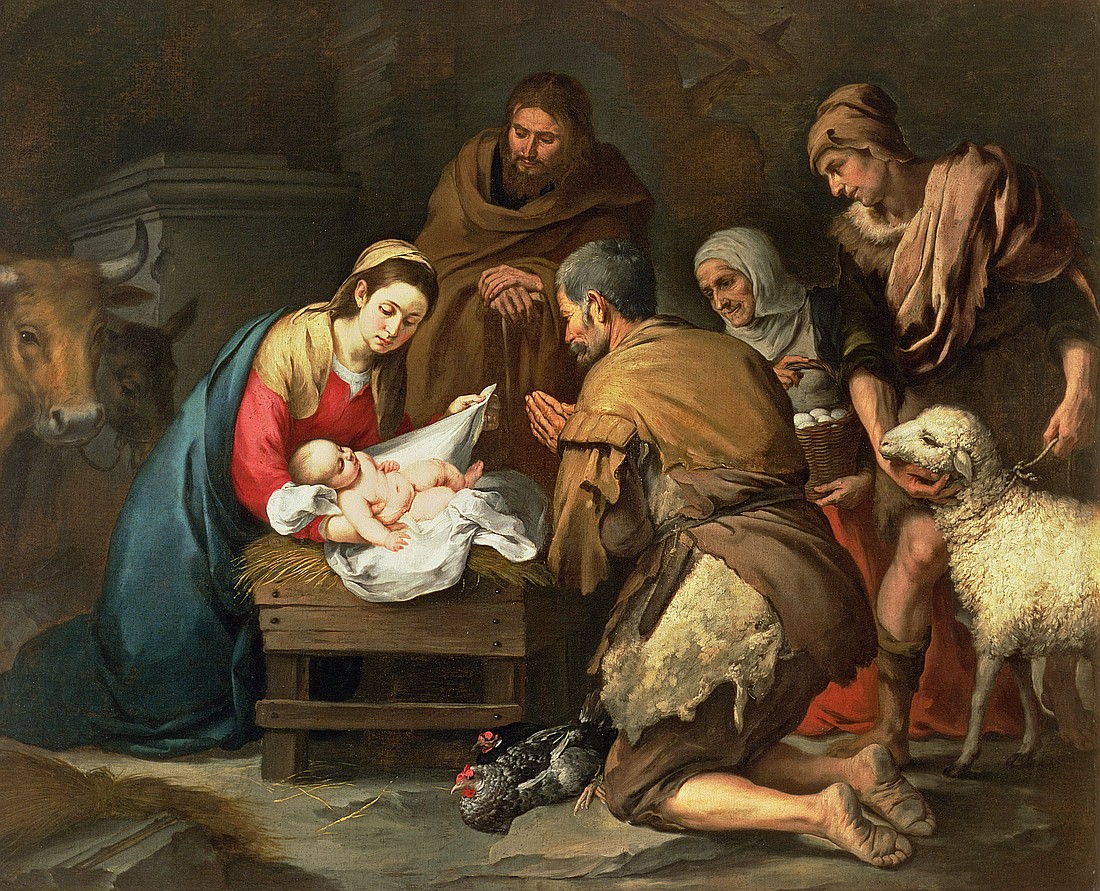
Let us note that the humblest of all the figures around the Christmas crib is the ass (or donkey). It is telling that in the accounts of the birth of the Messiah there is no mention of an ox or ass. Nor is there mention of any other animal.
It was the 13th-century saint, Francis of Assisi, who famously introduced to the world what we now imagine as the nativity scene.
In the great works of Christian art, the ox and the ass are present at the manger, the place where animals find their food. They are silent witnesses to the unfolding of a profound mystery, the birth of the long-awaited savior.
It is surely puzzling!
Are we afforded any clues in the sacred writings that explain the presence of the ox and the ass at Christ’s birth?
The Fathers of the Church found the answers in two passages of the Old Testament.
The first one may be found in the first chapter of the Book of the Prophet Isaiah:
“The ox knows its master and the donkey its master’s crib, but Israel does not know, my people do not understand.”
In one of the Gospel readings of Christmas day, the Evangelist, Saint John writes, “He was in the world, and the world came to be through him, but the world did not know him. He came to what was his own, but his people did not accept him. (Jn. 1:10-11)”
God has been a father to his people. He cared for them and fed them. Israel refused to recognize their master.
The Second passage is an obscure one, and is found in the book of one of the minor prophets, Habakkuk:
“In the midst of two living creatures, you will be recognized.”
The presence of the ox and the ass is a reminder of the earthiness of the birth of Jesus, and the universal dimensions of the coming of God in the flesh. God’s humility is one of the extraordinary truths of divine revelation.
In his reflection on the meaning of Christmas, St. Augustine zeroes in on the manger, a feeding bin for animals. The child lying in the manger is he who called himself the true bread that comes down from heaven, the nourishment we need to nourish our souls. This is the food that gives us life, eternal life. Thus, the manger becomes a reference to the table of God to which we are invited to receive the Bread of God.
If you were to contemplate one of the ancient paintings depicting the birth of Jesus, you would surely notice the way in which the ox and the ass gaze intently on the child. It is striking to note how the artists of centuries past gave the two animals almost human faces and how they stand before the mystery of the child and bow down in awareness and reverence.
The point the artists wish to make, although with a twist of irony, is that even dumb animals know their master, the one who feeds and cares for them.
One of the lessons we learn from the accounts of Christ’s birth is that he was not recognized by the world at large, which looked to Herod, a man well known for his ruthlessness and brutality.
Even the learned scholars, the Masters of the Law, were conspicuously absent at his birth.
The unlikely ones who recognized the Messiah were poor, lowly shepherds, a disreputable group, the devout Jews, Joseph and Mary, and the Magi, men of science who were likely astrologers.
Having found the Lord, they rejoiced.
In his best-selling book, “Jesus of Nazareth: the Infancy Narratives,” the late Pope Benedict XVI, writes, “the image of the two animals, the ox and the ass, now appear as an image of a previously blind humanity which now, before the child, before God’s self-manifestation in the stable, has learned to recognize him, and the lowliness of his birth receives the revelation that now teaches all people to see.”
Do we truly recognize him today? Is he to be found in our legislatures, our courts, our homes and even in our neighbors?
Do we acknowledge his sacramental presence in the Eucharist?
Do we find ourselves far away from the stable, a symbol of the church?
No representation of the crib is complete without the ox and the ass.
On this holy night, we ought to ask God to give our hearts the simplicity that discovers the Lord in the child, as Saint Francis once did many centuries ago.
It is my hope that everyone returns home full of the spirit of Christmas, which is joy.
Merry Christmas!
Father John Yanas is pastor of Sacred Heart Church in Troy.


- In primetime address, Trump cites nuclear threat as polls show most Americans disapprove of Iran war
- USCCB president asks Catholics to ‘pray ardently’ for an end to war with Iran
- Catholic leaders warn against antisemitism in Holy Week liturgies
- Pope Leo XIV to wash the feet of 12 priests on Holy Thursday, highlighting support for clergy
- Supreme Court hears case on birthright citizenship executive order with Trump in attendance
- Thomas More Society is awarded $4.5 million in attorney fees in California gender secrecy case
- Some thoughts on washing feet
- From the Chesapeake to the Carolina frontier: Catholic origins in the Upper South
- All Catholics share in Church’s mission, not just clergy, pope says
- Full text: Pope Leo XIV’s general audience given April 01, 2026
Comments:
You must login to comment.