


December 10, 2025 at 10:09 a.m.
|
Updated January 12, 2026 at 4:12 p.m.
Blazon and Explanation of the Armorial Bearings of the Most Reverend Mark O’Connell, JCD XI Bishop of Albany
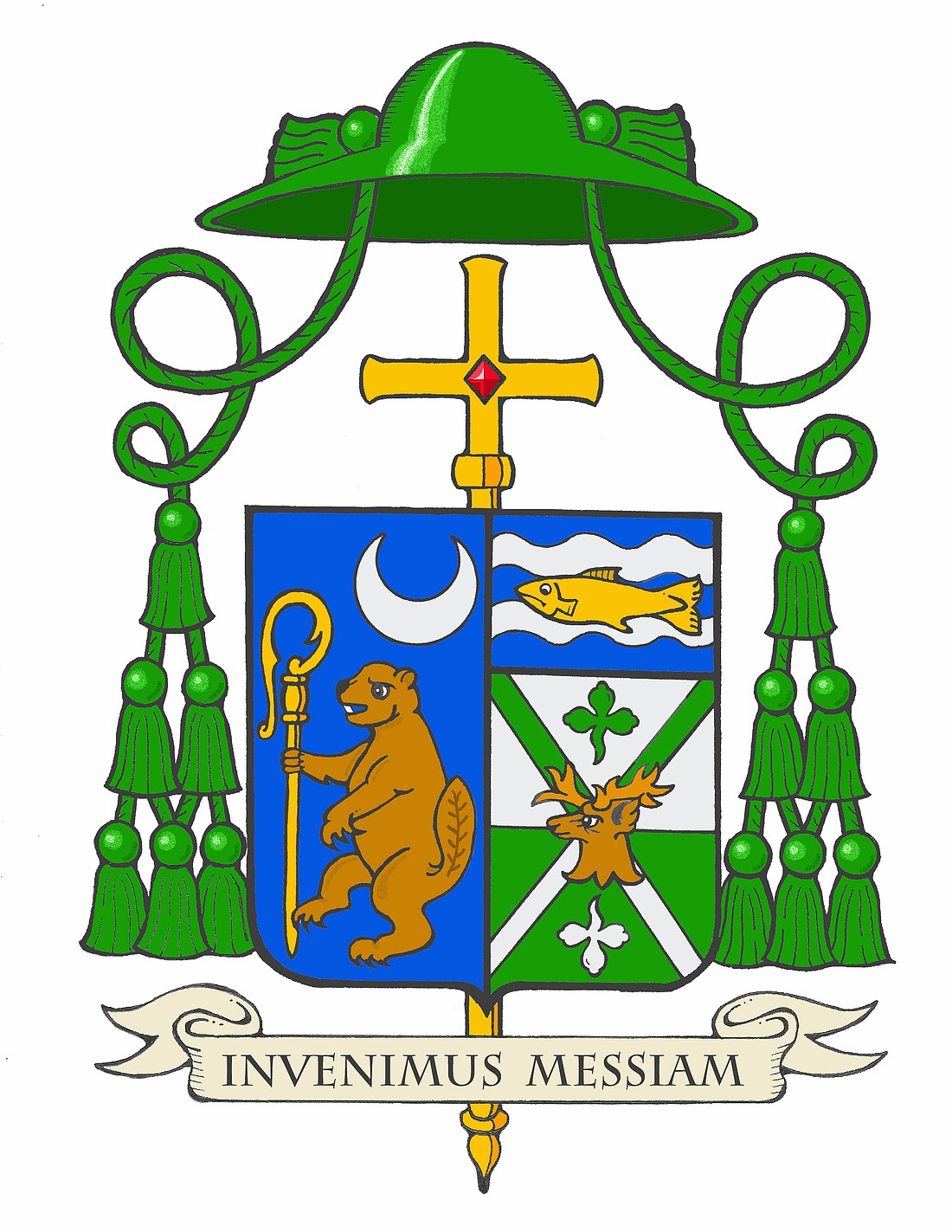
BLAZON: Arms impaled. In the dexter: Azure, a beaver springing Tenné holding in its dexter paw a bishop’s crozier. Or in chief to sinister a crescent Argent. In the sinister: per fess Argent and Vert, a saltire between in chief and in base two trefoils facing the centerpoint all Counterchanged; overall a stag’s head erased Tenné. On a chief barry wavy Azure and Argent; overall a fish naiant Or The shield is ensigned with an episcopal cross Or and a bishop’s galero with cords and twelve tassels flanking the shield disposed in three rows of one, two and three all Vert. On a scroll below the shield is the motto, “Invenimus Messiam.”
EXPLANATION: The armorial bearings of Bishop Mark O’Connell impale the coat of arms of his episcopal See with his personal coat of arms. These evoke his family and heritage as well as his ministry. The coat of arms is composed of a shield with its charges (symbols), a motto and the external ornamentation. The shield is described (blazoned) in terms that are archaic to our modern language, and this description is presented as if given by the bearer with the shield being worn on the arm. Thus, where it applies, the terms dexter (right) and sinister (left) are reversed as the device is viewed from the front.
It is customary in heraldry that the arms of a Diocesan Bishop, or Ordinary, are joined side by side on the same shield with the arms of his See. In this case, these are the arms of the Diocese of Albany. Such marshaling is called impalement and employs the same method used when joining the coats of arms of two people who are married. In this way, the coat of arms, like the episcopal ring, is symbolic of the bishop being “married” to his diocese.
The arms of the Diocese of Albany are composed of a blue field on which are placed a beaver standing on one foot and holding a bishop’s crozier below a silver (white) crescent in the upper right corner. The beaver holding a crozier in the arms of the See comes from the fact that the original name of Albany was “Beverwyck” as it was a major outpost on the route for traders. It holds a crozier as an indication of Albany as the seat of a bishop. The crescent alludes to the Immaculate Conception, the titular of the cathedral church.
Bishop O’Connell’s personal coat of arms was originally assumed when he became a bishop in 2016. That design has now been modified by the bishop so that his personal arms have a rather different appearance. It had been decided to try and simplify the design for greater clarity since it would now be impaled on the shield with the arms of the See of Albany. The basic design of the main part of the field is based on the arms traditionally associated with the name O’Connell but with some significant changes in order to “difference” them from the original and make them unique to Bishop O’Connell. So, the background is divided in half with the upper portion silver (white) and the lower portion green is taken from the O’Connell arms. To this is added a saltire (a cross in the shape of an “X”) as a symbol of St. Andrew, to whom the Bishop has a great devotion, and who was crucified on an X-shaped cross. This saltire is “counterchanged” meaning its colors are reversed with the background colors. Above and below the saltire are two trefoils (which also resemble shamrocks). These are also counterchanged to maintain the green and white color scheme. They are depicted facing each other, as it were, with their stems in an attitude toward the center of the shield. In this way they appear to be mirror images of each other. They, too, are taken from the original O’Connell arms. While there are three in the original, only two are depicted here for a sense of symmetry. They allude to both the Holy Trinity and the Bishop’s Irish heritage.
Placed in the center overall there is a stag’s head. This is retained from the arms the Bishop assumed in 2016 where it served there, as it does again here, as a reference to the full stag usually depicted in the arms of O’Connell. For purposes of creating another difference from the original while at the same time hearkening back to the coat of arms the Bishop first assumed, the head of the stag cut off at the neck, rather than the whole animal, has been depicted. Instead of being depicted facing the viewer and colored red it is shown in profile and is colored Tenné. This tone is used in heraldry as a representation of the color brown, which doesn’t exist in heraldic art. The closest approximation of brown that can be used while maintaining heraldic tradition is this “stain,” as opposed to a tincture, called T enné.
On the upper third of the shield, called a “chief” we see a background composed of blue and silver (white) wavy bars. This is borrowed from the coat of arms of the Archdiocese of Boston where Bishop O’Connell served as a priest and an Auxiliary Bishop. The two white lines also represent the two rivers of Albany. Over the wavy lines there is a gold (yellow) fish. This symbol is borrowed from the arms associated with the name Delaney which was the Bishop’s mother’s name. In the Delaney arms it represents the “Salmon of Wisdom” associated with the legend of the mythical warrior, Fionn. In addition, it is worth noting that the fish was the earliest symbol used by the infant Church as a symbol of the faith. The word for fish is ichthus in Greek. Using the letters of the Greek alphabet to spell the word fish, early Christians secretly bore this symbol as it created an acronym with the hidden meaning “Jesus Christ, Son of God, Savior.” The fish was a pictorial representation of this phrase and thereby formed a secret symbol for the first Christians.
The fish upon the waves, therefore, alludes to the Bishop’s maternal family, the Archdiocese of Boston, the Diocese of Albany as well as the concept of the Apostles — and their successors, the bishops — are called to be “Fishers of Men.” In a further allusion to St. Andrew we know that St. Andrew was present during the miracle of the loaves and fishes, where he identified a boy with five loaves and two fish, which Jesus then multiplied to feed a crowd of five thousand people. This event highlights Andrew’s role in bringing others to Jesus and his participation in the early ministry of Christ.
The external ornaments include a gold episcopal cross placed vertically behind the shield. This is often mistaken for a processional cross like the one used in liturgical processions. However, like other heraldic ornaments the episcopal cross has its origins in something which is no longer actually used. At one time all bishops had, in addition to the processional cross at the head of the procession, another cross carried directly in front of them by a cleric. This other cross was a sign of the office of bishop. While no longer actually used it has remained a symbol of the episcopal office in heraldry.
Similarly, the broad-brimmed green galero was, at one time, worn by bishops in outdoor processions and cavalcades. No longer used, it remains a heraldic symbol of the office of bishop and takes the place of the helmet, mantling and crest that would appear in the coat of arms of a layman. In Catholic heraldry, the color and number of tassels on the galero indicates the rank of the bearer. The single barred episcopal cross and the green galero with twelve tassels signifies the coat of arms of a bishop according to the Instruction of the Holy See, “Ut Sive” issued in 1969.
The motto chosen by Bishop O’Connell appears on a scroll below the shield. “Invenimus Messiam” which translates to “We have found the Messiah” and is taken from John 1:41. The words are attributed to Saint Andrew who purportedly used them when greeting people for the first time as a way of announcing the coming of the Lord, His great work of Redemption, and his Resurrection. Bishop O’Connell’s spirituality is deeply rooted in this spiritual dictum.
The coat of arms of Bishop O’Connell was originally designed and emblazoned in 2016 by James Noonan and then redesigned and marshaled to the arms of the See of Albany by Father Guy Selvester, a priest of the Diocese of Metuchen, N.J. Father Selvester is a Fellow of the American College of Heraldry and a Fellow of the American Heraldry Society.
- BREAKING: Trump backs down from threat to annihilate Iran condemned by Catholic leaders
- Experts: Trump threat to wipe out Iran’s civilization violates international law, Christian ethics
- ‘We need more saints’: Center helps to advance canonization causes
- Pope sends Easter message to displaced Lebanese Christians living ‘in dramatic circumstances’
- Pope Leo urges citizens to call on their leaders to reject war after Trump’s ‘unacceptable’ Iran threat
- Chicago group’s Easter Triduum visits bring comfort of the Eucharist to ICE detainees
- In a time of war, Catholic parish’s interfaith peace meal celebrates ‘our oneness in faith’
- US bishops’ leader rebukes Trump after he threatens Iran’s ‘whole civilization will die tonight’
- ‘Miracle Doctor’ of Lourdes retires after 17 years, insisting miracles aren’t his job
- Will Meta and YouTube’s youth harm verdict be ‘tobacco industry moment’ for Big Tech?
Comments:
You must login to comment.