


April 17, 2020 at 1:43 p.m.
DIVINE MERCY SUNDAY
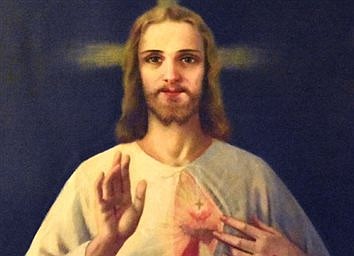
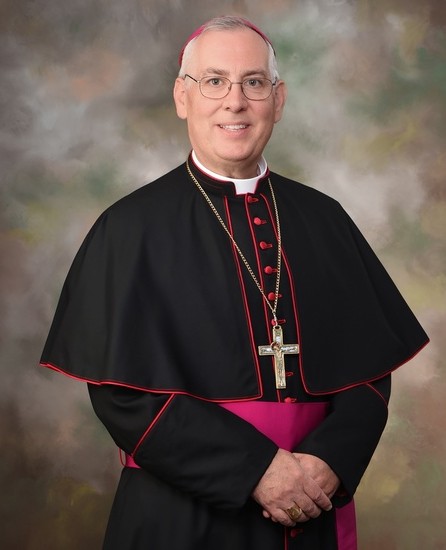
Bishop Scharfenberger will celebrate Mass for Divine Mercy Sunday via livestream from the Cathedral of the Immaculate Conception on Sunday, April 19, at 11 a.m. Viewers will also have the opportunity to make the annual Consecration to Divine Mercy during Mass. Watch the livestream at www.rcda.org/livestream. Learn more about the Consecration to Divine Mercy at www.rcda.org/divinemercyconsecration.
A guide to praying the Divine Mercy Chaplet can be found at https://www.thedivinemercy.org and on the website of the U.S. Conference of Catholic Bishops, www.usccb.org.
St. Faustina was a 20th-century Polish nun to whom Jesus appeared and asked for a special feast devoted to Divine Mercy to be celebrated on the Sunday after Easter. The psalm and Gospel reading for the liturgy on that day focus on mercy, on the forgiveness offered by God for those who are truly sorry for their sins.In her diary,
St. Faustina recounted Jesus' request: "My daughter, tell the whole world about my inconceivable mercy. I desire that the feast of Mercy be a refuge and a shelter for all souls, and especially for poor sinners. On that day the very depths of my tender mercy are open. I pour out a whole ocean of graces upon those souls who approach the fount of my mercy."St. John Paul II established the first Sunday after Easter as the feast of Divine Mercy April 30, 2000, the same day he canonized St. Faustina.
St. Faustina's sisters today share the message of Divine Mercy at the St. John Paul II National Shrine in Washington. Holy Rosary in Baltimore's Fells Point neighborhood is home to the Archdiocese of Baltimore's official Divine Mercy Shrine.Divine Mercy Sunday is a day when many Catholics go to confession. Because of the coronavirus pandemic, however, the sacrament is currently only available in the archdiocese to those whose death is imminent.
Archdiocesan leaders encouraged the faithful to make acts of "perfect contrition," as suggested by Pope Francis, when they are unable to go to confession.
According to the Catechism of the Catholic Church, contrition is called "perfect" when it "arises from a love by which God is loved above all else."
Such contrition remits venial sins and obtains forgiveness of mortal sins if it "includes the firm resolution to have recourse to sacramental confession as soon as possible," according to the catechism.
Pope Francis said the message of the catechism is "very clear."
"If you cannot find a priest to confess to, speak directly with God, your father, and tell him the truth," the pope explained. "Say, 'Lord, I did this, this, this. Forgive me.' and ask for pardon with all your heart."Make an act of contrition, the pope said, and promise God, "'I will go to confession afterward, but forgive me now.' And immediately you will return to a state of grace with God.""As the catechism teaches," Pope Francis said, "you can draw near to God's forgiveness without having a priest at hand. Think about it. This is the moment."In celebrating previous Divine Mercy Sundays,

- Canadian bishops at plenary hear presentations about progress on creating a ‘listening’ Church
- Federal agency sues Ohio-based Catholic health system over alleged antisemitism
- Pope Leo urges Europe to stave off increased nationalism, barbaric relations
- Notre Dame consecrated to the Sacred Heart for first time thanks to student-led initiative
- Pope Leo XIV says he’s not losing sleep over AI apocalypse fears
- McElroy: Americans can no longer ‘pass on by’ ignoring how US is treating immigrants
- Bernadette Soubirous is a saint — but not because Mary appeared to her at Lourdes
- Wrapping up France visit, Pope Leo calls on Europe to choose reconciliation over division
- Evangelization Lab helps churches bring digital travelers to the Catholic faith
- Polish priest wounded in stabbing returns to altar with message of forgiveness
Comments:
You must login to comment.